
 Weather:
Canola Canada: wetter than both last year and the 30-year average; heat has spiked but the 16-day forecast eases back toward normal.
Corn US: precip roughly in line with average; a short hot spike is forecast before temps converge back to seasonal norms.
Wheat Argy: drier than average and drier than last year since June; temps are turning the seasonal corner off winter lows.
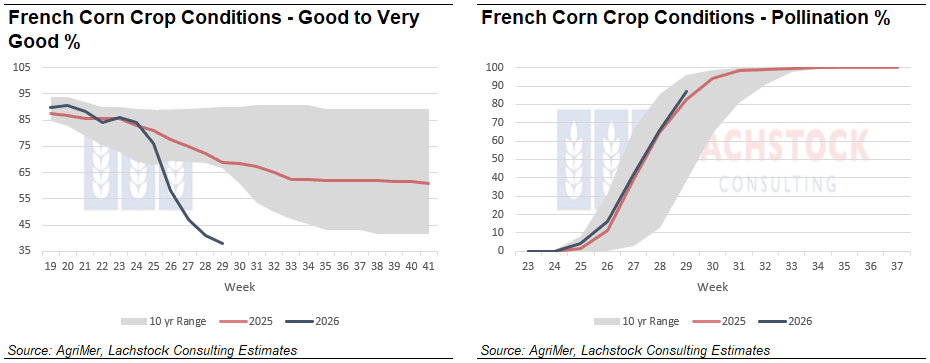
Corn France: above-average rainfall all season hasn’t offset persistent heat stress, with repeated mid-30s °C spikes matching the crop condition slide seen in the wires.
Markets
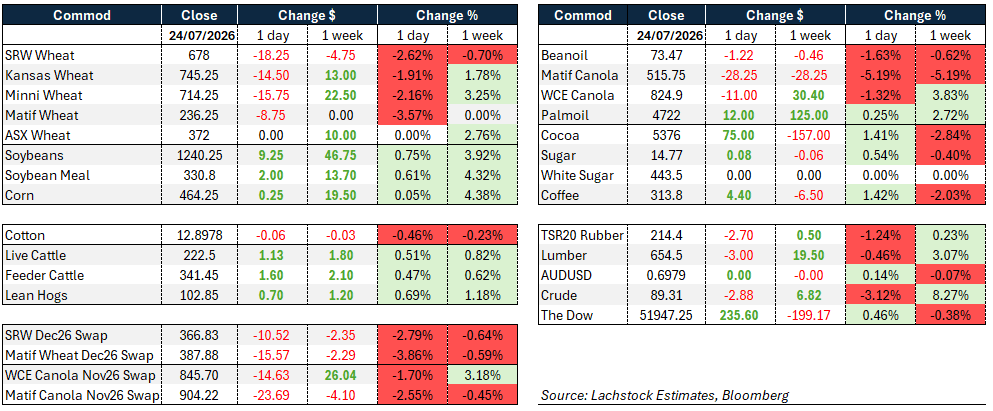
Wheat: Chicago fell 2.62 percent on profit-taking after the week’s BSEA-driven rally, whipsawing from US711.25c/bu to 659.50 before settling at 678; Russian export/production cuts (IKAR) and a soft WQC spring wheat tour yield offered some support, but heat risk in the Northern Plains and French crop deterioration are the swing factors into next week.
Corn: little changed, fractionally higher on spillover support from beans rather than its own drivers; Argentina’s 2026/27 crop was raised to 60.5 million tonnes (Mt) on larger plantings.
Oilseeds: beans firmer on renewed Chinese buying chatter ahead of the September Trump-Xi meeting and a hot/dry weather story, while canola corrected sharply lower (-5.19pc on the week for Matif) on profit-taking and spillover from weak crude and Chicago soyoil, despite Canadian production uncertainty still underpinning prices.
Macro: crude slumped over 3pc as the US extended its Iran strike pause and Iran-Oman Hormuz talks progressed, even as Houthi attacks on Saudi facilities kept a second Middle East front open; equities and AUD were little changed.
Day Ahead – Australia
No real relief in the north of the country with most forecasts getting into mid-Aug. How this will impact the east coast market will be interesting given that current Downs new crop is already reaching a long way into NSW. The southern growing belt continues to look good with more rain on the way.
The linkage of Australian grains to offshore futures will be tested today. Yes there was a ceasefire in Iran but, from an Australian perspective, the Black Sea conflict arguably holds more importance. They smashed into each other again over the weekend so the Aussie market will be faced with a decision – does it see incremental demand in both old and new crop given the shipping impact in the north or does it say, “futures down, cash price down” – gut says former, head says latter.
 Wheat: Chicago wheat gave back a chunk of the week’s geopolitical premium as longs booked profits into the weekend, with WU swinging from an overnight high of 711.25 to a session low of 659.50 before stabilising at 678.
The session was headline-driven and directionless — unsubstantiated chatter about a flagged-ship arrangement or a short truce to clear BSEA shipping lanes was later undercut when Ukraine’s Agriculture Minister denied any alternative export mechanism was under discussion.
Russia struck three Ukrainian ports overnight (Odesa, Izmail, Mykolaiv), while Novorossiysk’s harbour master denied reports of a night-navigation ban, and Ukraine urged shippers to avoid Russian Black Sea ports altogether. Russian Grain Union/ING data showed Russian shipments down 13.6pc y/y to 1.3Mt in the first twenty days of July.
IKAR’s Dmitry Rylko cut Russia’s wheat production forecast to 90Mt (-1.2pc) and exports to 44.5Mt (-3.7pc), with total grain exports seen at 58.5Mt versus 60.9Mt last season.
The Wheat Quality Council’s Northern Plains tour landed a final HRS yield of 48 bushels/acre — barely below last year’s 48.3 and well under USDA’s 58bpa call for North Dakota, prompting Jim Wiesemeyer to describe a variable but non-disastrous crop.
KC’s relative strength continues to baffle given how far it sits above world HRW values.
The bigger swing factor into the week was spring wheat heat: GFS is running 25-30°C warmer than the EU model for week two, with Sunday/Monday already trending hot.
Europe’s crop is deteriorating in parallel — French wheat/maize ratings fell to 38pc good-to-excellent from 40pc a week earlier and 69pc a year ago, with Spain declaring a national wildfire emergency and France seeking EU help as heat forces mass evacuations.
Matif Sep wheat lost €10.25/t on the day.
Other grains and oilseeds: Beans shrugged off the Black Sea noise entirely, running instead on persistent Chinese interest, hot Midwest weather and a constructive chart. SX added 9.75c, SU 9.25c higher, while BOU fell 122pts and SMU gained $2.00, pulling Sep crush down 18.25c to 295.75.
Meal built on yesterday’s larger-than-expected new-crop sales while bean oil was weighed down by diesel softness.
AgResource flagged that signals on Chinese buying remain mixed, but fresh optimism is building around China fulfilling its 25Mt soybean commitment ahead of the September 24 Trump-Xi meeting in the US.
Corn (CU) edged fractionally higher despite an early 7-8c CZ dip, with beans lending support it wouldn’t have had from wheat alone; Argentina’s USDA attaché lifted 2026/27 corn production to 60.5Mt on a larger planted area, still 2.5Mt below last year’s record.
Matif maize slipped in sympathy, down €2.50/t. Canola corrected sharply lower on profit-taking, spilling over from weak crude and Chicago soyoil.
Weekly Canadian exports of 168,100t were roughly half the prior week’s pace, with crop-year-to-date exports of 8.7Mt trailing last year’s 9.4Mt with two weeks left in the marketing year; production uncertainty on the Prairies kept a weather premium underpinning the market.
Separately, EarthDaily’s satellite analysis shows Canadian Prairie crop conditions at a decade-best despite flooding, tornadoes and hail.
Palm oil hit a 15-week high on strong oil prices and a Dalian olein rebound, its third straight weekly gain .
Macro: Crude slumped as the US extended a pause on Iran strikes for a second night, with Tehran signaling it was holding off retaliation while Iranian and Omani deputy foreign ministers held what Iran’s foreign ministry called “constructive” talks on Hormuz navigation.
Brent had rallied roughly 27pc over the prior two weeks to $96.78 on the conflict, and Trump’s “locked and loaded” rhetoric hasn’t yet translated into fresh action — the New York Times reported the administration is holding off amid concern over depleted Patriot interceptor stocks, while Axios cited Admiral Brad Cooper recommending a halt on the view that strikes had exhausted their target list; US Ambassador Mike Waltz disputed the interceptor concern but confirmed talks are continuing at every level.
The de-escalation came even as Yemen’s Houthis opened a parallel front, striking Saudi Aramco-linked facilities at Jizan and Yanbu and hitting Saudi-linked tankers in the Red Sea, prompting Saudi coalition strikes on Houthi positions; HSBC has flagged a “substantial squeeze” risk across commodity markets given already-drawn-down stockpiles.
Equities were little moved, with the Dow up 235 points on the day but still down on the week.
On trade, Washington imposed new tariffs of at least 10pc on 60 economies as it rebuilds the tariff structure struck down by the Supreme Court, with a 12.5pc rate applied to countries lacking forced-labour laws.
Local: In the west of the country bids eased on Friday for wheat, while canola bids started with $9 in front for the first time since June last year. New crop bids in Albany PZ were A$900/t FIS for canola and $885 for GM, wheat $381, and barley $334.
East coast was mixed but broadly higher across regions and grades. Downs values are already starting to influence other regions as far south as Griffith. This El Niño is already shaping up differently given there is relief on the east coast vs other years where every trader was doing WA import calcs.
Very very rough, but the $110/t import calc from FIS WA to FOT Brisbane is still around the mark.
HAVE YOUR SAY