
 Weather:
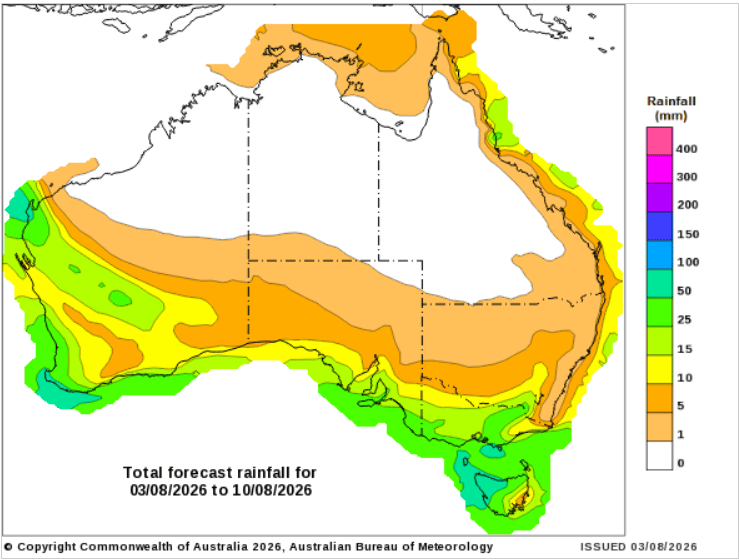
Weather remains broadly favourable across North America, with widespread Midwest rainfall supporting corn and soybean crops despite heat across the Plains and southern Canadian Prairies. Locally the next week looks promising for WA, SA and Vic with 15-25mm forecast for most parts.
Markets
Wheat sold off sharply as month-end liquidation and weak importer demand outweighed escalating Black Sea shipping risks. The market remains vulnerable to a rebound if export disruptions tighten further and major buyers return.
Favourable North American weather pressured corn, soybeans and canola, with speculative selling adding to the weakness. However, deteriorating EU corn prospects and renewed Chinese soybean demand provided some underlying support.
Geopolitical tensions remain elevated across the Black Sea and Middle East, increasing risks to energy, grain and shipping flows. At the same time, weather concerns in India and low Rhine River levels are adding to broader inflation and logistics risks.
Day Ahead – Australia
Softer for canola on the back of Friday’s move, while cereals are flat to slightly softer. However, with little to no rainfall forecast where it is most needed over the next eight days, basis is likely to firm.
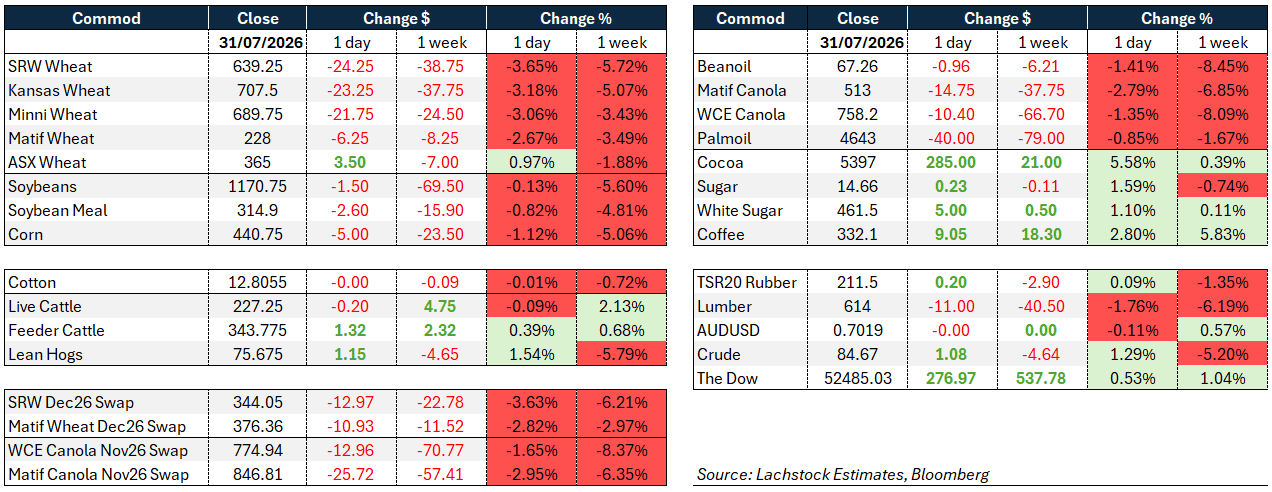
 Wheat: Wheat futures fell sharply on Friday, with Chicago down 24.25c, Kansas down 23.25c and Minneapolis down 21.75c as traders liquidated positions at month-end.
The sell-off came despite continued attacks on Black Sea port and shipping infrastructure, including disruptions around the Kerch Strait and Sea of Azov.
The market is currently focused more on muted importer demand than constrained Black Sea export capacity, with buyers comfortable waiting through harvest.
Export disruptions remain a longer-term bullish risk, particularly if Black Sea flows decline further and major buyers including Egypt, Morocco and Turkey return to the market.
EU wheat production prospects continue to deteriorate, with the European Commission cutting its 2026/27 soft wheat forecast to 124.4 million tonnes (Mt) and exports to 29.0Mt.
Poland’s winter wheat crop is forecast to fall 11 percent to 11.6Mt due to frost, heat, storms and hail, while Russian cash wheat eased $2 to $226/t and September Matif lost €6.75/t.
Other grains and oilseeds: Corn futures weakened as widespread Midwest rainfall improved crop prospects, pushing market yield expectations back above 180 bu/ac.
EU corn production was cut sharply to 51.9Mt, down 8Mt from the previous estimate and 13.8pc year-on-year, lifting projected imports to 24Mt.
French maize conditions declined again, with just 34pc rated good-to-excellent compared with 38pc last week and 69pc a year ago, the lowest level in comparable records.
Soybeans were relatively resilient as China returned as an active buyer, with reports of up to 12 US cargoes purchased and a further 252,000t sold to unknown destinations.
Favourable Midwest rainfall limited soybean upside, while weaker meal demand and expectations of additional crush supplies pressured processing margins.
Canola fell around C$70/t over the week as speculative longs liquidated, with November closing at C$758.20/t amid weakness across soyoil, rapeseed and palm oil markets.
Macro: Russia and Ukraine continued targeting energy, port and shipping infrastructure, increasing uncertainty around Black Sea grain and oil flows.
Ukraine called for greater diversification of export routes following Russian attacks on Odesa infrastructure and the Black Sea corridor.
Crude oil strengthened as conflict involving the US and Iran escalated, including Iranian attacks on US military bases and renewed discussion of further US strikes.
A drone strike at Egypt’s Damietta port raised concerns over shipping through the Suez Canal, an increasingly important route for global energy and commodity trade.
Rhine River water levels fell close to record lows amid prolonged heat and dryness, although cargo traffic was still operating.
Inflation concerns remain elevated, with below-normal Indian monsoon rainfall threatening crops and power supplies while Federal Reserve officials warned against waiting too long to address persistent inflation.
Local: H
Bids were softer to end the week in the west, with canola back A$10/t to $840 and GM canola at $820. Wheat was bid at $375 and barley at $328 FIS Albany.
Through the east, canola was bid at $795 and GM canola at $753, while wheat was $364 and barley $306 track Geelong for the new season.
Northern delivered markets remain firm, with January-onwards Darling Downs SFW around $440 and barley at $420.
It may be time to become a little more bullish on protein spreads, with Southeast Asian consumers returning to the market for Argentine and Australian wheat. Argentina’s August export pace is expected to be well above average, but its remaining stocks are largely below 11pc protein. NSW is carrying some protein, although it is unlikely to come cheaply.
HAVE YOUR SAY