
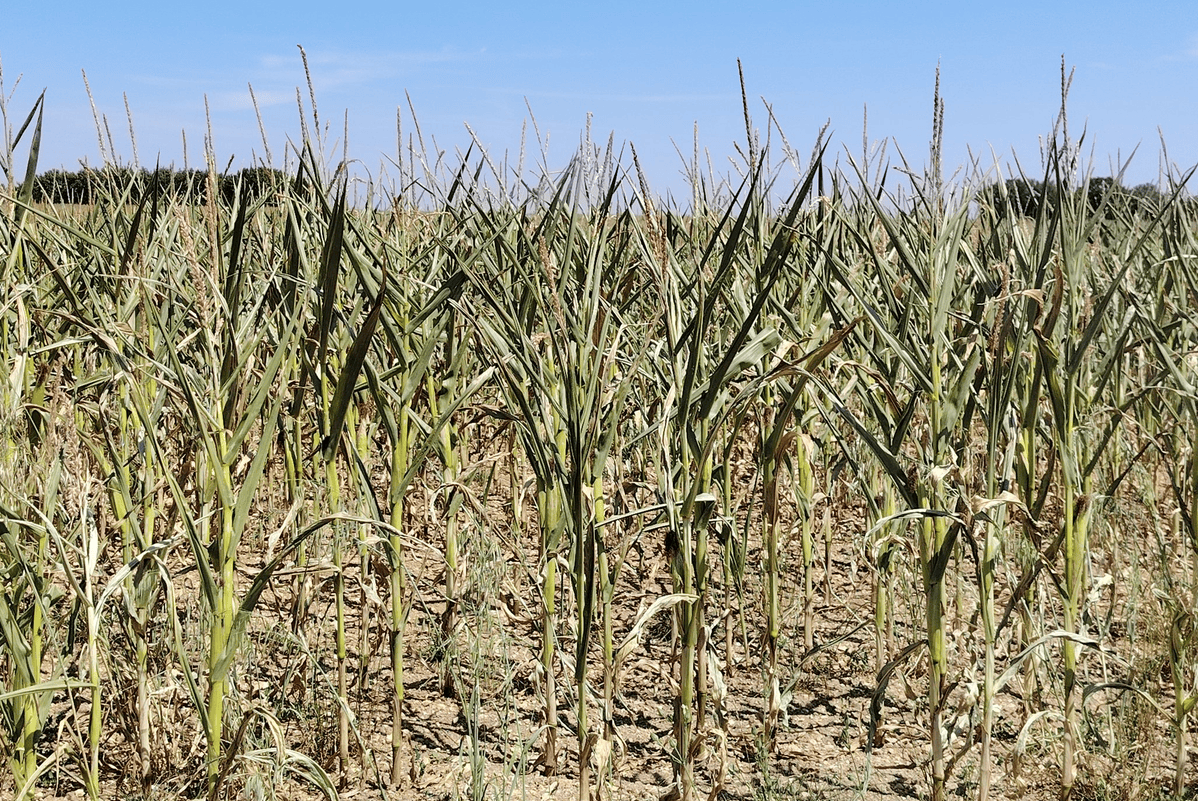
Corn crops in France, like this one in Poitou-Charentes in the country’s south-west, have borne the brunt of a fiercely hot summer. Photo: Benjamin Aude
A SERIES of heatwaves across much of western, central and southern Europe in the second half of June, and again midway through July, shortened the grain-development phase and accelerated the harvest of this season’s winter and spring cereal and oilseed crops.
While the winter and spring crops were generally at an advanced stage of development or close to harvest, the prolonged heat and lack of precipitation have negatively impacted the production outlook. However, the impact on summer crops is expected to be far greater, with the region’s corn crop currently forecast to be the smallest since the 2017 harvest of just under 50 million tonnes (Mt).
In France, the European Union’s biggest grain producer, crop conditions were generally good until May, before the June heatwaves accelerated the cereal harvest, first for barley and then for wheat. The extreme heat also made harvesting more difficult, with restrictions introduced in some regions to minimise the risk of fire. The most significant yield reductions were in central and western France, which were hit hardest hit by the drought and repeated heatwaves, while northern and eastern regions generally reported better yields.
The European Commission decreased its yield outlook and harvest projection for all crops in its July crop monitoring report and left open the prospect of further reductions, especially in summer crops such as corn, as the 2026 harvest progresses and final figures are collated.
The EC expects cereal production in the 27 member countries to total 262.8Mt, 9.3 percent, or 27.1Mt, lower than the 2025 harvest of 289.9Mt, and 5.2pc, or 14.5Mt, lower than the average of the past 10 seasons. This is off a planted area of 48.8 million hectares, 1.1Mha lower than last year and 2.7Mha less than the 10-year mean. The average yield of 5.38t/ha is down from 5.81t last year but bang on the average of the past 10 harvests.
EU soft wheat, barley crops down 8pc
The biggest cereal crop in the EU each season is soft wheat, with production forecast to fall by 8.1pc from 135.3Mt last year to 124.4Mt this season. The harvest in France wound up last week, with output expected to fall by 4.1pc compared to the 2025 campaign despite a 2.7pc increase in the planted area.
The German crop forecast is 3.5pc lower season on season at 21.9Mt, and the Polish soft wheat harvest is projected to fall by 6.8pc to 12.5Mt. However, the heatwave conditions have taken a huge toll on the Spanish crop, now expected to be 5.9Mt, 23.5pc less than last year’s record harvest of 7.9Mt.
The bloc’s barley output is estimated at 51Mt this season, a fall of 8.2pc from the 2025 harvest of 55.6Mt, but only 1.2pc below the 10-year mean of 51.7Mt. The French harvest forecast of 11Mt is 6.4pc, or almost 800,000t lower than last season on a slightly lower planted area but compares more favourably with the 10-year mean of 11.4Mt.
To the east in Germany, the barley harvest is projected at 10.8Mt, 400,000t less than last year on a slightly higher seeded area, but around 100,000t above the average since 2016. To the west, however, the Spanish barley crop has been decimated by the arid conditions this season, with production down from 9.1Mt in 2025 to 6.4Mt this year off an unchanged planted area.
Maize down 14pc and falling
The EU corn crop will undoubtedly be the biggest loser from the extreme summer heat, with the EC’s current forecast of 51.9Mt already 13.8pc lower than last year. The arid conditions at planting led to a 11.1pc reduction in the planted area from 8.6Mha to 7.5Mha, with the yield forecast only 3.1pc lower when the report was released mid-July.
Further yield reductions are expected in the EC’s August update, with the hot and dry conditions persisting in most regions through to the end of July, and heat stress during the critical pollination period a widespread issue. Forecasters say Europe is facing a warmer-than-normal August with persistent heat domes, marked by high temperatures exceeding 40 degrees Celsius in southern and western regions and shifting eastward into mid-month, further exacerbating summer-crop yield erosion.
Oilseeds mixed
Total oilseed output for the EU-27 is projected to be 32Mt, fractionally higher than last year’s harvest of 31.8Mt, but 1.2Mt or 5.3pc higher than the 10-year mean of 30.4Mt. Nevertheless, the planted area of 12.2Mha is 4pc higher than in 2024-25, and 8.2pc above the 10-year mean. This season’s area increase is offset by a 3.2pc reduction in average yield across the 27 member states.
Rapeseed is the primary oilseed crop in the EU each season, with the seeded area increasing by 5pc in 2025-26 to 6.3Mt, 9.2pc above the 5.8Mt average for the past 10 seasons. However, production is expected to fall to 19.8Mt, on the back of a 6.6pc decrease in yield compared to the previous season. Output is 2pc lower than the 2025 harvest of 20.2Mt, but 9.2pc higher than the 10-year mean of 18.2Mt.
France, Germany and Poland are Europe’s three biggest producers with output projections of 4.6Mt, 4.1Mt and 3.2Mt respectively. The planted area increased by 12.4pc in France and 4.8pc in Germany, but Polish farmers bucked the trend by decreasing the area allocated to rapeseed in 2025-26 by 0.4pc.
Meanwhile, a recent report from Biofuels International confirmed Australia’s position as the primary supplier of rapeseed to the EU. While imports from non-EU countries of 5.4Mt in 2025-26 fell short of the previous season’s volume of 7.5Mt, Australia did contribute 39.6pc of the total. Nevertheless, shipments from Australia of 2.1Mt were 41pc less than the 2024-25 marketing year quantity.
Ukraine was the second-biggest supplier with 29.6pc, followed by Canada with 16.1pc. Since Canadian farmers predominantly grow genetically modified varieties, the use of rapeseed oil derived from Canadian sources is restricted in the EU. Consequently, imports from Canada are mainly used for biofuel production.
HAVE YOUR SAY