
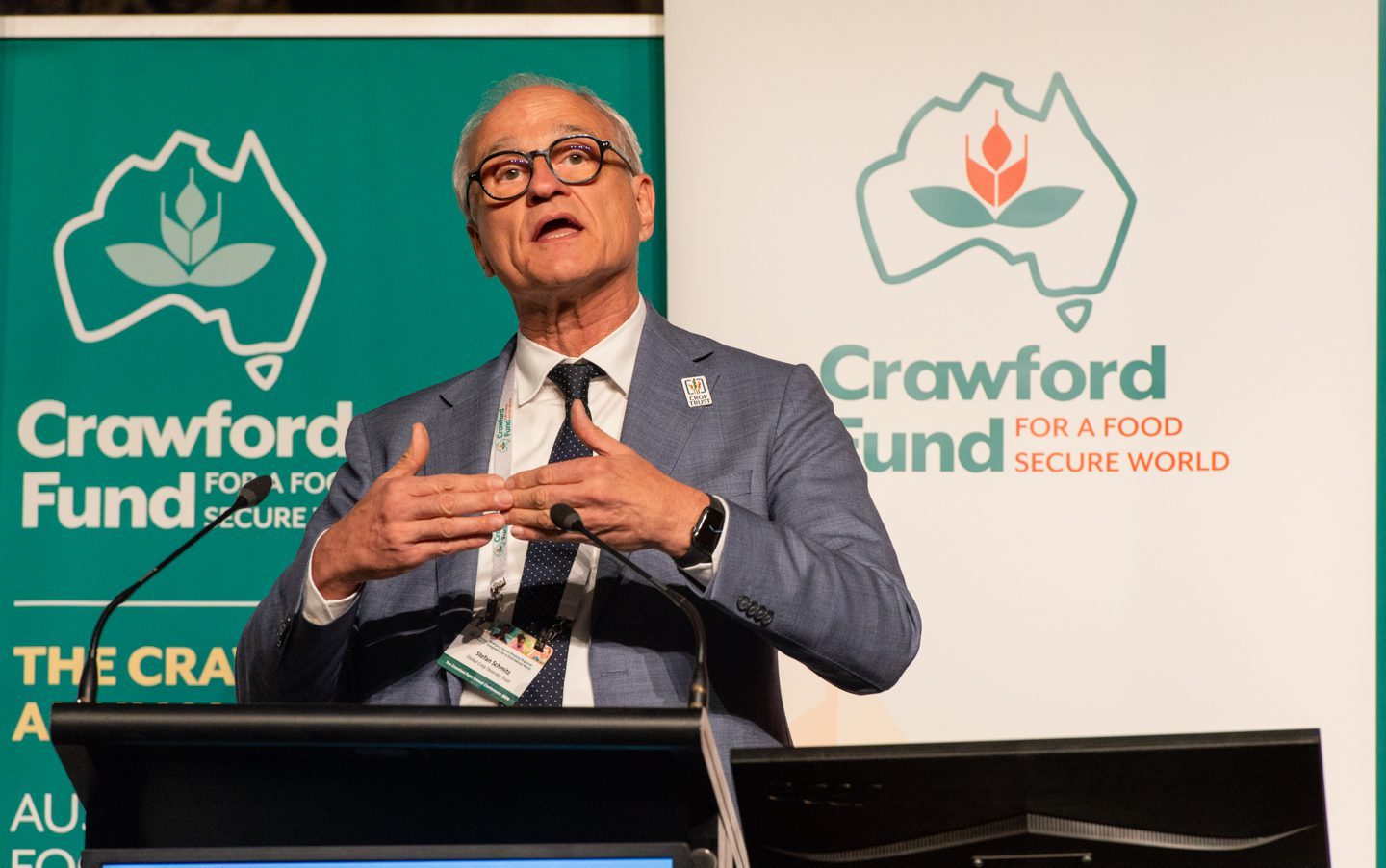
Crop Trust executive director Dr Stefan Schmitz gives his keynote address at the Crawford Fund’s annual conference in Canberra this week. Photo: Crawford Fund
FUTURE crop diversity is under threat if the move away from multilateralism results in a lack of commitment to seedbanks which underpin global food security, according to Crop Trust executive director Stefan Schmitz.
In his keynote address to the Crawford Fund for Food Security Annual Conference in Canberra on Tuesday, Dr Schmitz said the world has close to 900 genebanks, but a system to connect them was “still in its infancy”.
“We are not short of collections; we are short of connections,” Dr Schmitz said in has address, entitled Regional Cooperation for Food Security in an Uncertain World.
He stressed that the need to ensure a wide range of traits in a changing climate meant genebanks needed to be thought of as infrastructure, rather than individual projects.
“Projects are wonderful; projects deliver, but projects end, and seeds don’t.
“Seeds need care forever, and ‘forever’ has never once appeared as an option in a funding round.”
“Australia is writing its first national food security strategy; COP31 is just round the corner.
“I hope this will be an opportunity to change the way we view genebanks.”
Giving and receiving
Dr Schmitz gave two examples of Australia’s involvement in global crop diversity: a lucerne variety which has benefited farmers in Kazakhstan, and wild relatives of chickpea which offer options to improve cold tolerance in Australian varieties.
The lucerne example involved seed samples of 20 wild Medicago sativa species collected in 10 countries, stretching from Italy to Nepal.
Leading pre-breeding and evaluation was the Australian Pastures Genebank, managed by the South Australian Research and Development Institute.
“The SARDI team was part of an international effort to collect crop wild relatives before they disappeared — and much of that material was destined for genebanks.
“Nobody in that field knew exactly what those plants were for.”
Dr Schmitz said the directive to SARDI scientists to collect wild relatives was without a business case, an end-user, a problem statement, a theory of change, and a log frame.
“If you had walked up to those scientists and asked them: ‘What is the return on investment here?’ the honest answer would have been: ‘I don’t know yet’.”
Traits from those wild relatives fed into new varieties, including Tozimdi, which means “sustainable” in Kazakh.
With input from the Australian Pastures Seedbank, its development was funded by the Biodiversity for Opportunities, Livelihoods and Development (BOLD) project, launched in 2021 by the Crop Trust with Norwegian Government backing to follow the Crop Wild Relatives Project.
Dr Schmitz said the variety has helped Kazakh farmers and citizens counter “deeper and longer and more frequent droughts”, which keeps animals alive through seasons that would previously have broken the herd.
“Part of what made that variety possible was the diversity collected by scientists crawling around in the dirt…years earlier, for reasons they could not yet articulate.”
Wild relatives are also helping to broaden options for Australian growers, as exemplified most recently at Mount Barker in Western Australia, where a wild Cicer variety set pods in the cold at nearly three times the rate of domestic chickpea.
The trait came from a project supported by the Grains Research and Development Corporation, CSIRO, the Turkish Ministry of Agriculture and universities, and the US’ UC Davis.
Dr Schmitz said the trait has countered the problem Australian chickpeas have with cold, which stalls pod set, and pushes it into heat and terminal drought, with yield penalties as a result.
“That single vulnerability is a large part of why chickpeas sit in the warm north and struggle to move south and west, and you cannot breed your way out of it from inside the crop.
“The wild-by-domestic crosses show that the tolerance can be moved across.”
Dr Schmitz said genetically, the domesticated chickpea is “a narrow sliver of what the species once was”, but the wild relative from the hills of south-eastern Anatolia, where “cold is simply their normal”, has brought new options to Australian programs.
He said both the lucerne and the chickpea stories exemplify the global nature of interdependency.
“There is no version of this where one of us wins and somebody else loses.
“When it comes to food, we are not competitors who occasionally cooperate; we depend on one another, permanently.
“Collect, conserve, co-operate and everybody eats; don’t, and everybody’s options quietly shrink.”
What’s in a genebank?
Dr Schmitz likened the world’s genebanks to libraries, where traits that make crosses more tolerant to heat, drought and salt, or resistant to a pest that has yet to cross your border, or that can better store iron or zinc in staples eaten by people who cannot afford supplements.
…not widely understood…truth…of plant breeding…you cannot invent a trait that does not already exist. You can only find it, usually in a genebank, and move it.
“And here is the uncomfortable truth at the centre of plant breeding, which I want to say plainly because it is not widely understood outside this room: You cannot invent a trait that does not already exist.
“You can only find it, usually in a genebank, and move it.
“Gene editing doesn’t get you out of this.
“Gene editing is a magnificent pair of scissors; it is not a fabric shop.
“Someone, somewhere, at some point, has to have kept the cloth, which means the raw material of every future harvest is already, right now, either in a cold room somewhere — or gone.
Endowment an investment
Dr Schmitz said the cost to secure the essential operations of the world’s most important international crop collections, in perpetuity, takes about US$34 million per annum,
This sits against collective annual government expenditure of about $842 billion per annum, or $1.6M per minute, on agricultural support in the 54 countries the OECD tracks.
“To secure the whole system permanently, the Crop Trust needs an endowment of about $850M.”
Dr Schmitz said such a one-off, not annual, payment is about one thousandth of what the world spends on agricultural support in a single year, and the trust is “almost halfway there”.
“Our Endowment Fund does something that sounds almost heretical in a development context: we don’t spend the money.”
He said its contributions are invested so the capital can stay intact to pay for the essential operations of the world’s most important crop collections.
“In an era of squeezed budgets, the most radical thing you can do with a development dollar is to refuse to spend it.”
He said this approach aims to make the trust “immune to the next budget cut, the next election, the next reorganisation, the next crisis that pulls attention somewhere else”.
He suggested that when funders invest in breeding projects, they should channel at least a small portion of the funds, a “legacy contribution’” into long-term mechanisms.
“Stop budgeting crop diversity as a project and start treating it the way you treat a port, a road, or a research station. It is not an activity; it is the foundation the activities stand on.”
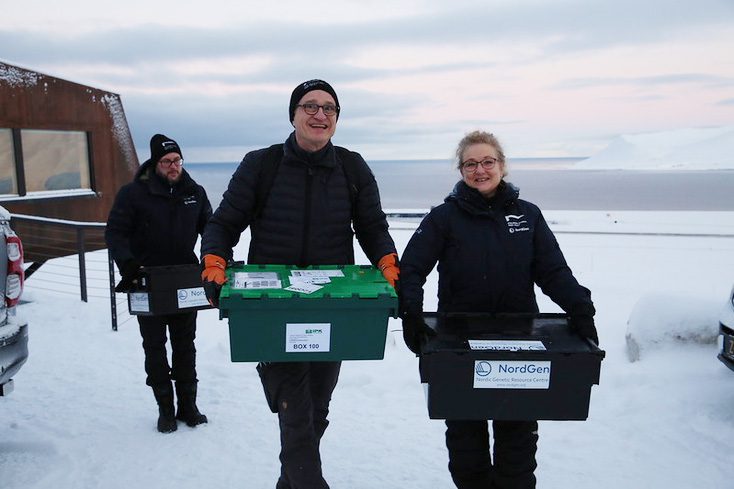
Stefan Schmitz and Nordgen representatives deliver seed to the Svalbard Global Seed Vault in February 2022. Photo: Crop Trust
Dr Schmitz stated the case for genebanks as being part of a beefier infrastructure, and drew the analogy of a power station on its own being just a building, but becoming infrastructure upon its connection to a network.
He sees three tiers of genebank infrastructure:
- Between genebanks: shared standards and data, so a breeder can search the world’s collections once instead of writing 900 letters;
- Between genebanks and agriculture, because storing an accession does not by itself improve a single farmer’s income or diet; and,
- Between genebanks and society, as exemplified at events like the Crawford Fund’s conference.
“Fund the nodes and you have nearly 900 genebanks; fund the connections and you have a system.”
Dr Schmitz said “we are all being told the same thing at the moment, in slightly different accents: the world is fragmenting; aid budgets are tightening; attention is moving somewhere else; multilateralism is out of fashion.”
He said this was happening amid greater climate pressures, meaning greater demand on the science around food security, but with reduced resources.
“The drought does not read the aid statistics; the fungus does not check whether the project has been extended; sea water moving into a taro patch in Kiribati is entirely uninterested in which department got restructured last quarter. “
He said the question, therefore is no longer “how do we do more”, but what should be protected first, and how can science make sure it never has to be rescued again.
Where Australia sits
Australia has two national genebanks — the Australian Grains Genebank at Horsham in Victoria, and the previously mentioned Australian Pastures Genebank — which together hold more than 284,000 unique seed samples.
Most of their material was requested and imported over decades through the International Treaty on Plant Genetic Resources and its Multilateral System.
Through its two genebanks, Australia has deposited more than 65,000 samples into the Svalbard Global Seed Vault, the ultimate food-security backup facility in the Arctic.
“In depositing those samples deep in the permafrost there, Australia did not just contribute to safeguarding its own agriculture, but everyone’s.
“Australia is not a donor to this system; Australia is a shareholder in it.”
Dr Schmitz said the Crawford Fund has a “lovely” term for this: the boomerang effect.
“You invest in agricultural research beyond your borders, and the benefit comes back: new varieties, stronger biosecurity, better trade, better scientists.
“Crop diversity is the purest boomerang there is; it has been coming back for 80 years.”
Aside from broadacre crops, Dr Schmitz referenced Australia’s ongoing support of Fiji’s Centre for Pacific Crops and Trees — CePaCT — that makes material available across the region.
Through its Endowment Fund, the Crop Trust has recently becoming a supporter of CePaCT through its our Endowment Fund, made possible by a contribution from New Zealand.
“That is regional integration, a cold room in Suva that will still be running when everyone in this hall has retired.”
“Every partnership makes the next shock survivable, and the harvests that feed the world in 2060 are being decided now, in rooms like this one, by people who will never taste them.”
Grain Central: Get our free news straight to your inbox – Click here
HAVE YOUR SAY