
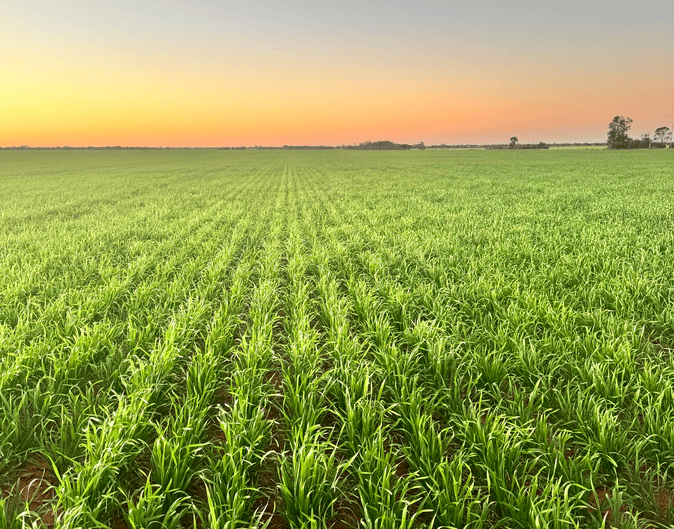
Sundancer wheat on pea stubble in the western Riverina of NSW. Photo: Aaron Hutchinson
THE SPREAD between northern and southern grain markets has widened further this week, reflecting the stark contrast in seasonal conditions between the regions.
Provided widespread frost stays away in coming weeks, the Victorian and South Australian wheat and barley crops are on track for bumper yields.
In the north, yield prospects for most cereal crops will be average at best, and another week without rain means some growers are looking at cutting crops for silage, while New South Wales is a mixed bag.
Southern growers are starting to forward sell new-crop wheat, and some are gearing up for an abnormally early start to the haymaking season.
| July 30 | Today | |
| Downs barley | $412 | $418 |
| Downs SFW | $400 | $420 |
| Downs sorghum | $365 | $367 |
| Mel barley | $340 | $335 |
| Mel ASW | $373 | $370 |
Indicative prices in Australian dollars per tonne.
Northern concerns build
Asian demand for Australian wheat has picked up in response to shipping difficulties for volume out of the Black Sea amid the ongoing Ukraine-Russian war.
The north is therefore seeing some increased demand for containerised wheat from the trade as growers’ concerns about the upcoming harvest build.
Plenty of current-crop wheat is still sitting in northern NSW and southern Queensland, and Sunrise Commodities managing director Scott Merson said NSW growers were waiting for bids to lift from around $385/t to even consider selling.
“They can see $400 coming ex farm for wheat; that’s what they’re holding out for,” Mr Merson said.
Unpriced barley is in short supply in the northern market, and its big premium over southern barley, and an even bigger one over Western Australian barley, once again has the market talking about a vessel or two coming into Brisbane.
The Bureau of Meteorology forecast points to at least 25mm of rain in the coming week for SA, Vic and southern NSW, shrinking to a single-digit event for the NSW-Qld border area.
With mild to warm temperatures expected in coming days in northern NSW and southern Qld, more advanced cereal crops will start to mature with little moisture beneath them.
“As soon as this heat turns up…it’s concerning for the winter crop, and for the sorghum plant; I don’t know how much will go in.
“Guys on the northern Downs are saying they’re not sure they’re going to get anything from this [winter] crop, and some of them are talking about cutting it for silage.”
Instead of showing the usual inverse between current and new-crop, the Dec-Jan ASW market is trying to crystalise at upwards of $435/t, and new-crop barley is bid at $425/t.
Northern consumers know there is plenty of grain left in eastern Australia, and are looking at options to get it in new-crop slots from the south, while the trade mulls over the possibility of WA supply.
Fuel prices, which lifted when the Federal Government on August 3 ended its excise relief, are a factor, and are encouraging northern consumers to source locally, particularly as southern carriers are likely to get busy early with their own harvest.
Further discouraging northern grower sales of cereals is the rally in the chickpea market, with two handysize cargoes due to load in Brisbane this month buying any grower interest in cash selling.
Traders in the south are reporting interest from southern Qld and northern NSW in buying hay from the south.
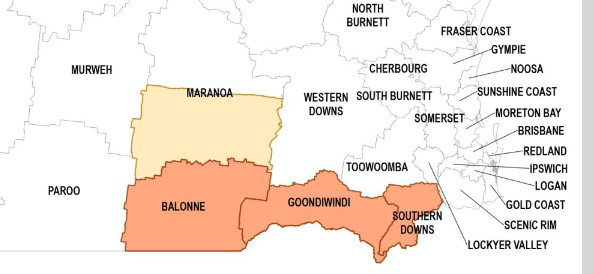
Drought-declared regions of Qld. Source: Qld Government
The Qld Government’s latest drought-declaration map shows the need is greatest in local-government areas where summer and winter crops are grown, and where cattle are bred and backgrounded to target weights for feedlot entry.
Drought declarations are in place for three shires — Balonne, Goondiwindi, and Southern Downs — as well as the southern half of the Maranoa Shire.
Southern hay gets close
In Victoria, Wilken Grain trader Andrew Kelso said a kick in demand for export wheat has been supportive of the southern market.
“I get the sense there’s buying interest from Asia, both in bulk and in containers,” Mr Kelso said.
With SA understood to be out of wheat to export in volume, and NSW hanging on to what it has in case the season in its northern half cuts out, Mr Kelso said Vic appeared to the go-to, along with Western Australia.
As the Vic crop strides towards an early harvest, Mr Kelso said renewed export interest has been a welcome development.
“Everyone thought it was going to be very slow for the back end of the year.”
Speaking from the Mallee Machinery Field Days at Speed in Vic, Mygrain broker Andy Brown said crops look “amazing”, and 25mm or so forecast for the weekend should cap off their in-crop rain requirements.
“I’ve never before heard a Mallee grower say ‘I’d rather have 15mm of rain than 30mm’, but we’re hearing it this year,” Mr Brown said.
Mallee crops are weeks ahead of where they normally are in early August, and contractors are preparing to cut the earliest hay crops next week.
“Yields on the hay will be unbelievable; on an oat crop, they’re talking about 9-10t/ha when it’s normally 5-6t/ha.”
While crop phenology says some oats and then barley and vetch will be ready to cut for hay this month, drying in windrows will be difficult due to days being much shorter than the usual haymaking months of September and October.
“I don’t know how they’re going to cure it.”
Mr Brown said top-dressing of crops is just above over for most growers, and fungicide and some trace elements like zinc are being applied to maximise crop health and yield potential.
New-crop canola is down more than $65/t from its season high two weeks ago, and Mr Brown said some growers used the peak to advance sales to as much as 15-20 percent of expected canola production.
With the canola market’s ebb, he said some growers were starting to show interest in forward selling a small amount of wheat.
Concern about frost this and next month remains high.
“That’s the only thing that can stop us now.”
Grain Central: Get our free news straight to your inbox – Click here
HAVE YOUR SAY