
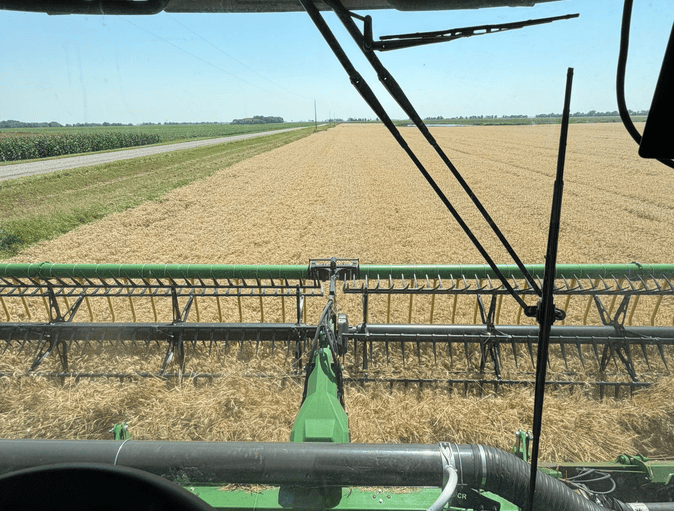
Harvesting wheat last week in the North Dakota-Minnesota border area. Photo: Matthew Krueger, KD Krueger Farms
HARVEST of this season’s wheat crop across the United States continues to make good headway as the campaign expands into the far northern winter wheat production areas and the later spring wheat crops progress through grain fill under extremely hot weather conditions.
All eyes will be on USDA again this week when the August chapter of this season’s World Agricultural Supply and Demand Estimates is released on Wednesday. And the wheat focus will not only be on the US numbers, with reductions to output and exports in the EU quite likely, and a reassessment of the shipping task out of the Black Sea region also warranted as the attacks on export infrastructure in both Russia and Ukraine continue to escalate.
Harvest advance
The winter wheat harvest program advanced by five percentage points in the week to August, finishing at 86 percent completed. This compares to 85pc at the same time last year and is bang on the average harvest pace over the past five years.
The only states at less than 90pc completed are all located in the Pacific Northwest (PNW), with Idaho, Montana, Oregon and Washington sitting on 31pc, 29pc, 73pc and 50pc completed respectively. Unlike many crops on the drought-stricken Plains further south, the PNW crops are generally in good shape, with high yields and strong test weights reported. However, there have been localised reports of low protein and poor falling numbers.
Spring wheat bright
Among the six key US spring wheat states, the crop had completed heading in all but Montana and North Dakota by the beginning of last week. In total, 98pc of the crop had completed heading, up from 92pc a week earlier and marginally ahead of the 97pc five-year average.
The August 2 crop ratings had 55pc of the spring wheat crop classed as good or excellent, up slightly from 53pc a week earlier, but well ahead of the same time last year when 48pc of the crop fell into the two top-rating classes. There was a notable improvement in the South Dakota crop rating, jumping from 27pc good to excellent on July 27 to 43pc on August 2. The Montana rating also rose from 43pc to 55pc.
The spring wheat harvest is well advanced in South Dakota and Washington, but has only just commenced in Idaho, Minnesota, Montana and North Dakota. At the beginning of last week, the program was just 5pc completed, compared to 2pc a week earlier and a five-year average of 8pc.
USDA July report US 1970 low
In the July supply and demand update from the USDA, US wheat production was pegged at its lowest level since the 1970-71 marketing year. This is primarily driven by lower winter-wheat production, with spring wheat output expected to remain closer to last year’s levels.
The USDA’s July wheat production projection of 41.8 million tonnes (Mt) is 22.6pc lower than the 2025-26 harvest of 54Mt and will more than likely be revised lower again when the August report is released later this week. The harvested area of 13 million hectares (Mha) represents just 75pc of the planted area, compared to 15.1Mha last year, which was 82.1pc of the planted area.
Kansas is on course for its smallest winter wheat harvest since the 1950s, with the state’s farmers expected to produce a crop of 5.3Mt, 43.5pc lower than the 2025 harvest of 9.4Mt. The wheat crop in Nebraska is forecast to be 57pc lower than last year, and the state’s lowest wheat output since 1917, while Colorado farmers are projected to harvest that state’s smallest wheat crop since 1965. In Oklahoma, total output is substantially below the 10-year and historical average, cementing it as one lowest-yielding and earliest harvests since 2014.
HRW hardest hit
Hard Red Winter wheat output has been decimated by severe drought across most of the key production states. The USDA’s July estimate of 12.8Mt is 41.4pc lower than the 2025 harvest of 21.9Mt, making it the smallest HRW harvest since the 1957/58 season.
While domestic consumption of HRW is expected to fall from 12.4Mt in 2025/26 to 11.2Mt in the current marketing year, exports will be hit the hardest by the reduction in supply. The USDA’s July HRW export forecast of 5.7Mt in 2026/27 is down from 8.7Mt last season.
HRS, SRW and WW seen better
Normally around half the size of the average HRW crop, this year’s Hard Red Spring wheat harvest is expected to be just 900,000t lower at 11.9Mt. Much better growing season conditions in the Northern Plains mean that the SRW crop is only expected to decrease by 4.8pc compared to the 2025/26 harvest of 12.5Mt.
However, a series of heat domes across the Northern Plains over the past month may see production decrease in the USDA’s August update. A recent spring wheat crop tour by the Wheat Quality Council returned a yield projection of 3.2t/ha compared to the USDA’s July estimate of 3.9t/ha.
Supplemented by imports of 1.8Mt, domestic consumption of SRW wheat is expected to rise by 7.3pc season-on-season to 7.9Mt, with both food and stockfeed sector demand increasing. Exports are also projected to rise slightly from 6.3Mt last season to 6.5Mt in 2026/27.
While this year’s SRW wheat output is forecast to be 18.6pc lower than last year at 7.8Mt, it is primarily driven by a smaller harvested area. Projected yields are down, but not nearly as much as for HRW. The decrease in supply means the USDA decreased both domestic consumption and export estimates in the July update by 2.8pc and 17.8pc, respectively, to 6.1Mt and 2.7Mt.
The final major wheat class in the US each year is White Wheat, with the USDA pushing production 4.1pc lower year-on-year to 7.4Mt, on the back of reduced yields and a lower harvest area. While domestic use has been pencilled in for a 5.6pc fall, the export projection is unchanged at 5.4Mt.
HAVE YOUR SAY