
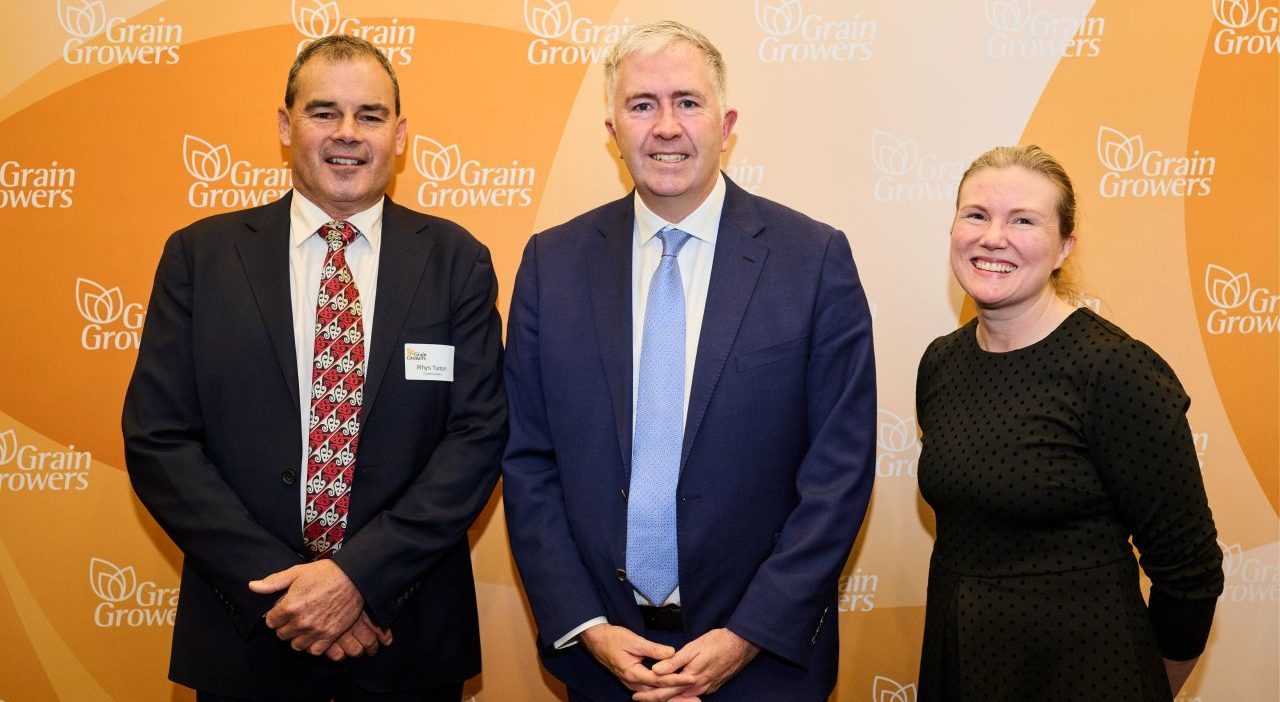
Assistant Minister for Resources, Regional Development, Agriculture, Fisheries and Forestry Anthony Chisholm (centre), pictured with GrainGrowers chair Rhys Turton and CEO Shona Gawel, launched 2026 State of the Australian Grain Industry Report. Photo: GrainGrowers
THE AUSTRALIAN grain industry has posted another successful five years on the back of grower ingenuity, innovation and resilience, according to GrainGrowers’ 2026 State of the Australian Grain Industry Report.
Released every five years and the only one of its kind produced for the Australian grain industry, the report analyses data from a range of sources and identifies trends, risks and opportunities for the sector.
The report said over the period examined, Australia’s grain production rose 45 percent, from 44 million tonnes (Mt) in 2020-21 to 64Mt in 2025-26, and the sector’s 37,000 growers across 18,000 farms jointly made an average per-annum economic contribution of $27 billion.
It also showed the volume of grain produced has continued to grow faster than the area of land farmed.
GrainGrowers chair and Western Australian grower Rhys Turton said despite an ever-changing growing and operating environment, the report showed continued productivity growth, with Australia’s five largest grain production seasons on record occurring in the past six years.
“These long-term productivity gains are underpinned by growers’ ability to adopt new technologies, maintain sustainable farming practises and expertly manage climate volatility,” Mr Turton said.
“Importantly, the volume of grain grown has increased significantly while the area planted has only increased modestly, which shows growers are making the most of every hectare.”
But the past five years have not been without their challenges as new trends emerged which were far less pronounced five years ago.
“The risks posed by global volatility have heightened in recent years, driven by geopolitical tensions, ongoing supply chain disruptions and a renewed rise in protectionist and interventionist trade policies in key markets.
“It has never been more important for the industry to work with government to address the challenges and support growers in realising the opportunities before them.”
Mr Turton pointed to the war in the Middle East and its impact on Australia’s supply chains.
“The immediate impacts of the conflict were particularly concerning for growers as they prepared to plant their winter crop and we saw government move quickly to address the short-term issues.
“Since then, commitments have been made as part of the Budget to increase onshore storage and refining of fuels, increase onshore fertiliser production and support the development of low-carbon liquid fuels.
“It is critical these long-term commitments are delivered on to address critical supply chain vulnerabilities and protect Australia’s food security, while also leveraging the proven locally-produced feedstocks to support a new domestic biofuel industry.”
The report said Australia in global markets is responsible for 10pc of wheat exports, 20pc of both barley and canola exports, and 40pc of chickpea exports.
Source: GrainGrowers
HAVE YOUR SAY