

Weather:
The French heat alert has escalated sharply — 22 departments were on orange alert yesterday, now nearly 80 are, with temps pushing toward 40°C.
Still a corn/sunflower/sugar beet story, not wheat.
Overnight severe storms hit Nebraska and the Dakotas — hail to 4 inches, gusts near 100mph reported, more severe risk lingering today.
Ukraine harvest progress (49pc done, 26.1 million tonnes (Mt) ) and Danube low-water Black Sea logistics — same drivers as yesterday, nothing new to report there today.
Markets
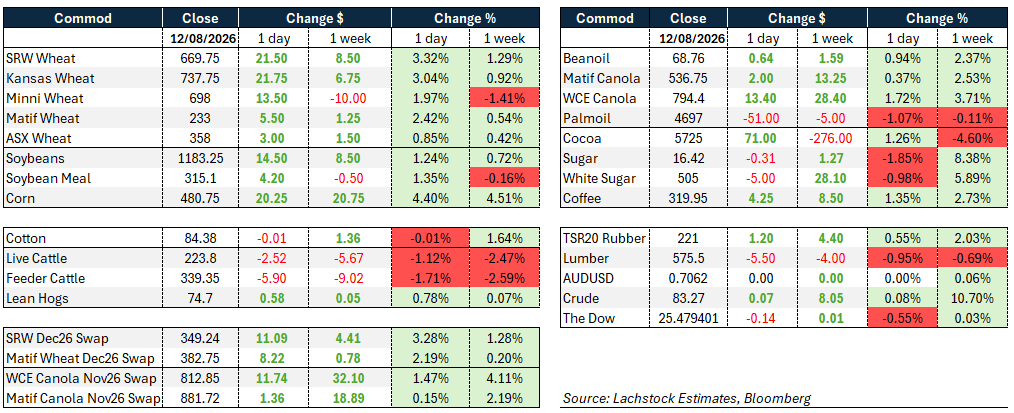
Wheat jumped across Chicago, Kansas and Matif after Ukrainian drone strikes knocked out three major grain terminals at Novorossiysk, reviving Black Sea supply fears that overshadowed a largely uneventful WASDE for the complex.
Corn was the WASDE standout, rallying over 4pc as a lower than expected 180.7 bpa yield outweighed a 1.4 million acre increase, pulling stocks to use down near the 10pc mark some are now calling bullish.
Canola and beans firmed in sympathy with the US complex, canola also drawing support from solid pre-harvest export and crusher demand.
Softs were mixed on the week, with cocoa down sharply even after a firm session, while sugar and coffee both pushed higher and AUD and equities were little changed.
Day Ahead – Australia
Well, no one likes a gloater – but I told you so. The idea that Russia and the Ukraine would take their foot off the pedal and suddenly stop bombing certain targets was fanciful. If anything, the Ukraine doubled down, specifically targeting Novo. Long story short, Black Sea supply will be messy – not nothing, just messy.
Maybe CBH gave us a clue as to what all this means for Australian wheat – increasing both old and new crop bids yesterday despite the break in global values.
Worth pointing out that Australia is in a vastly different situation to the EU/North Africa. Our wheat consumers don’t generally grow their own so if Black Sea is hard to get, options are limited.
Firmer across the board.
 Wheat: Wheat was already double-digit higher into WASDE on the back of overnight strikes on Novorossiysk, then held the bid through the session as the report itself did little to change the picture.
Three of Russia’s largest grain terminals at the port — United Grain’s NKHP, Demetra’s NZT and KSK — halted operations after a mass drone attack collapsed a loading gallery and damaged silos; a state of emergency was declared in the city and loading activity across the port came to a near-complete stop per Kpler ship-tracking data.
SovEcon’s Andrey Sizov flagged Russian exports could fall to their lowest in nearly a decade if the port stays down for an extended period, while ProZerno already had August shipments tracking under half the five-year average before the strikes.
USDA’s own changes were comparatively tame: HRW cut ~8mil bu, SRW unchanged, HRS trimmed just 2mil despite Dakota heat stress — we’d flagged risk of a 15-20mil cut given conditions there, but a 3bpa ND yield reduction was offset by ~250k added acres and a higher MT yield.
No fresh spring wheat read until end-September, and we still see downside risk to that number given the weather pattern; for now USDA is carrying the third-highest HRS yield on record.
World changes were similarly modest — Canada +1Mt, EU -2Mt, UK -1.5Mt, offset by Kazakhstan/Ukraine increases — and Chinese wheat import expectations held at 6Mt despite chatter of fresh Chinese interest this week.
Matif finally found an export bid on domestic feed demand; at current discounts to corn it’s a wonder EU buyers waited this long. Novorossiysk aside, the broader BSEA risk premium looks sticky — this isn’t a one-and-done disruption, and Black Sea flow uncertainty could persist well beyond the immediate repair timeline.
Other grains and oilseeds: Corn was the standout, USDA delivering a friendlier-than-expected national yield of 180.7 bpa versus trade ideas around 182.5 and some pre-report chatter as high as 185-186.
The acreage offset — 1.4mil more harvested acres to 88.6mil — actually lifted production 13mil bu from July to 16.013bil, capping what could otherwise have been a limit-up session, but new-crop carryout still fell to 1.653bil from 1.790bil, putting stocks/use near 10pc, a level some are now willing to call bullish.
Exports old and new were both raised 75 million bushels. Offshore, the EU crop was cut 3.5Mt — some had braced for 5-7Mt — with EU import estimates only lifted 1Mt in response, while Ukraine corn exports were trimmed just 1Mt versus the USDA attaché’s own 9MT cut last week; Chinese corn imports eased 1Mt to 5Mt.
Beans were a quieter story: yield at 52.7, just under the 53 record and in line with expectations, with the acreage bump adding ~45mil bu against a 30milbu crush increase that left carryout up only 10mil to 320.
Notably, USDA left export sales forecasts unchanged from July despite China’s pledged 25Mt purchase commitment — StoneX’s Arlan Suderman noted that pledge isn’t yet reflected in the balance sheet, so there’s scope for upward revision once (if) it shows up in the data.
Canola caught a bid on the back of the corn/bean yield surprises despite the acreage offsets, with solid export and crusher demand ahead of harvest also supportive; a lack of any real Prairie weather threat kept a lid on the upside. Volume was 44,375 contracts, down slightly on Tuesday’s 47,264.
Macro: US CPI excluding food and energy rose 0.2pc month over month in July, with headline inflation up 2.5pc year over year.
The print matched expectations but prices are still running hotter than pre-Iran-war levels and faster than wage growth, and the market has pared back near-term hike risk to around a 40pc chance for September rather than removing it entirely — Bloomberg Economics framed it as modest enough to lower September hike odds but not low enough to write off completely.
That’s consistent with an underlying view that inflation is moderating and that tariff/energy price shocks haven’t broadened out, but weaker recent labour market data adds to the case for the Fed staying on an extended hold; the July PCE deflator plus August CPI and payrolls prints before the September meeting remain live swing factors.
Softs were the mover away from grains — cocoa gave back sharply on the week even after a firm session, while sugar and coffee both pushed higher weekly, coffee helped along by reports of Colombian earthquake disruption to exports.
AUD and the Dow were both flat to marginally softer on the day. Crude ticked up fractionally but is up over 10pc on the week.
Local: Through the west of the country canola bids were back yesterday, A$855/t and GM $842. Cereals were stronger, with current season APW well bid at $360 and CGX trades occurring up to $365, while new season barley was $324 FIS Albany.
In the east, canola was back $5 to $810, wheat was $355 and barley $306 track Geelong. It will be interesting to see what old crop wheat bids do today, with Ukrainian drone strikes causing significant damage to Russian port infrastructure and a state of emergency declared. MATIF wheat caught a bid overnight on renewed export interest.
Some models are calling for another follow-up rain event in around eight days across much of SA, Vic and SNSW. We are getting picky — it would be nicer to see it arrive in September — but it will continue to build what could be record crops nonetheless. Hard to believe new crop hay is around $475/t delivered Darling Downs Jan+.
Queensland cattle grids remain under pressure, with heavy cows and grassfed steers down another 20c/kg this week and around 80c/kg since mid-June. Processors are well covered into early September, while softer export demand, Chinese tariffs, weaker US beef values and higher freight costs weigh on returns. Southern grids are now carrying a sizeable premium to Queensland, which may encourage southern buyers to push further north if freight allows.
HAVE YOUR SAY