

Weather:
Midwest rain continues into next week with a storm track forecast to move directly over the Corn Belt, beneficial for filling soybeans and reproductive corn but adding to flooding risk in already-saturated pockets of Indiana and the Ohio Valley
Europe is under a fresh 32-35°C heat wave benefiting corn, soy, sugar beet and sunflower with only patchy relief by week’s end
Australian conditions are set for more of the same – there will be increasing talk of being “too wet” in parts of Vic – but take it, especially given what this season was billed to be for most of the country.
Markets
Black Sea infrastructure remains under sustained attack from both sides, with Russian and Ukrainian port capacity structurally impaired regardless of any near-term truce headline.
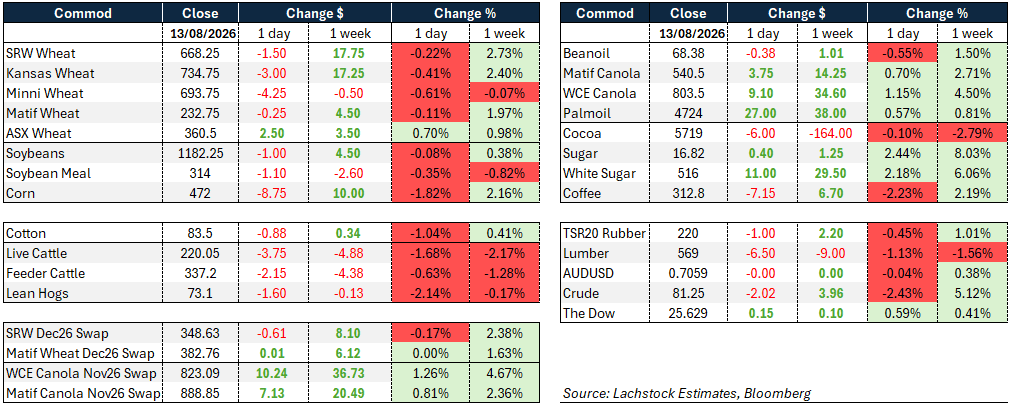
Wheat chopped on an unconfirmed Ukraine-Russia ceasefire offer for civilian-target strikes but closed little changed, with Black Sea shipping flows still the real story — Ukrainian exports down 76% y/y and Russian August volumes tracking under half the five-year average.
Corn reversed hard on a bearish Conab update, Brazilian output revised well above USDA, even as US demand data and ongoing Midwest rain risk kept a floor under the week’s gains.
Soybeans were directionless into the Pro Farmer tour, with Chinese demand — 1.5m tons combined sales plus a daily flash — doing the heavy lifting.
Canola pushed through C$800 on tight old-crop country demand ahead of harvest, outperforming a softer Chicago oilseed complex.
Day Ahead – Australia
Too much of a good thing in parts of the country with yields coming back in some crops such as lentils in the wimmera. Amazing.
I am amazed how quickly the market removes risk premium – port gets bombed, market goes up, Turkey says “Stop it fellas” market pukes back out. Regardless on your view of demand – if you bomb an elevator – it will need to be repaired which, in that environment, is no mean feat.
Maybe the market is right though – maybe demand is so bad that a broken elevator and astronomical freights dont matter.
Wheat: Frenetic boredom. WU finished unchanged, KWU eased 0.25c, MWU off 3.75c, with implied vol in WU jumping to 34.83% from 32.93%. Paris followed the same script, Sep up €1.00, Dec off €0.25.
Wheat was double digits higher intraday on a Reuters headline citing an unnamed source that Ukraine had offered Russia a mutual halt on Black Sea civilian-target strikes; neither side confirmed, WU shed 20c off the highs in minutes before drifting back to flat.
Actions still speak louder than the headline — strikes continued both directions overnight, with Russia hitting Ukraine’s Danube port at Izmail and Ukraine’s drone attack forcing three of Novorossiysk’s largest grain terminals offline, prompting Russian Railways to temporarily bar cargo into the port.
Russian cash wheat fell $1 to $221.
ProZerno now sees Russian August shipments near 2.5m tons, under half the five-year seasonal average, while Ukraine’s rail operator confirmed export volumes down 76% y/y to just 201.7kt so far this month — this at the peak of Ukraine’s wheat harvest, with storage filling and no clear outlet.
Germany’s DRV cut its 2026 wheat harvest estimate to 20.55mmt, down 11.2% y/y, citing heatwave and rainfall deficits.
US export sales were soft at 256k vs 250k expected and below the pace required, with Mexico, South Korea and Indonesia the top buyers and an unnamed destination cancelling 143k.
Interfax separately confirmed Thursday no formal ceasefire framework exists despite Turkey’s earlier call for a pause — consistent with the view that a durable truce, given the depth of animosity and the months of reconstruction needed on damaged port infrastructure, remains a low-probability near-term outcome even if a headline-driven pause materialises.
Other grains and oilseeds: Corn – yes, no, wait…. sorry — up 20c+ Wednesday, CU lost 8.75c Thursday to $4.72¼ as Conab lifted Brazilian output to 143mmt, roughly 3mmt above USDA’s WASDE figure, on improved safrinha performance; Argentine estimates diverged sharply, Rosario going 70.5mmt vs BAGE holding at 64mmt.
Gulf corn is now the highest-landed origin into North Africa and NE Asia even as Midwest rain continues, some areas arguably oversaturated — Indiana logged a preliminary two-day total above 11 inches, NWS calling it catastrophic flooding, with USDA good-to-excellent ratings already trailing year-ago levels (corn 61% vs 72%, beans 62% vs 68%), leaving little cushion to absorb further damage.
US export demand held up better than the price action suggested: old-crop sales 411k vs 150k expected, new-crop 925k, Mexico/Spain/Colombia the buyers. Beans were a coin-flip session, SU fractionally higher, SX off 1c, crush (Sep) down 7.25c to 267, in a sub-10c range. Combined bean sales beat at 1.835m vs 1.5m expected, China taking 1.511m plus a 125k daily flash sale pre-open; meal and bean oil sales both missed.
Pro Farmer tour begins Monday and will dominate the next leg of price discovery on pod counts.
Canola extended Wednesday’s rally, Nov WCE through the psychological C$800 mark on solid end-user demand into harvest, tempered by softer Chicago beans/soyoil and a lower crude tape; Matif rapeseed and Malaysian palm oil both firmer in sympathy.
Macro: Fresh signs the Fed stays on hold in September: July PPI came in softer than expected, pulling the market-implied probability of a rate hike next month to around 35% from roughly 60% pre-labour-report, with July CPI/PPI pointing to a ~0.2% m/m core PCE print due later this month — consistent with an extended pause barring a disinflation setback in the August CPI and labour data still to come.
On the Iran front, Washington is pivoting from military escalation back to economic squeeze — sanctions plus the naval blockade on crude exports — with officials framing Tehran’s economy as “strangled” amid 77% inflation and a rial down over 10% since the war started; analysts remain split on whether decades of sanctions history make this durably effective, and a next move against major Chinese banks financing Iranian oil purchases (China takes >90% of Iranian exports) carries its own diplomatic risk ahead of a planned Trump-Xi meeting in September.
Locally, Albanese pushed (“Pushed” – sure mate) Trump in a 40-minute call to drop or at least not extend the 12.5% tariff imposed on Australian exports in July, flagging the bilateral trade surplus and the FTA; Trump agreed only to “consider” it.
Albanese also got a “full steam ahead” assurance on AUKUS after a US defence official this week stopped short of guaranteeing the submarine delivery timeline.
Local: Through the west of the country bids were firmer yesterday, with canola +$5 to $860 and GM $850 for new season. Current season wheat was $370 with strong demand, while barley was $327 FIS Albany.
In the east, canola was $813 and GM $773, wheat was $358 and barley $306 track Geelong.
Slow going for barley on the east coast, with exports easing and new Chinese business subdued. Feed demand is steady at best, while growers who had been holding inventory as an El Niño “drought hedge” are now looking to sell through Vic and NSW, adding further pressure to the market.
HAVE YOUR SAY