
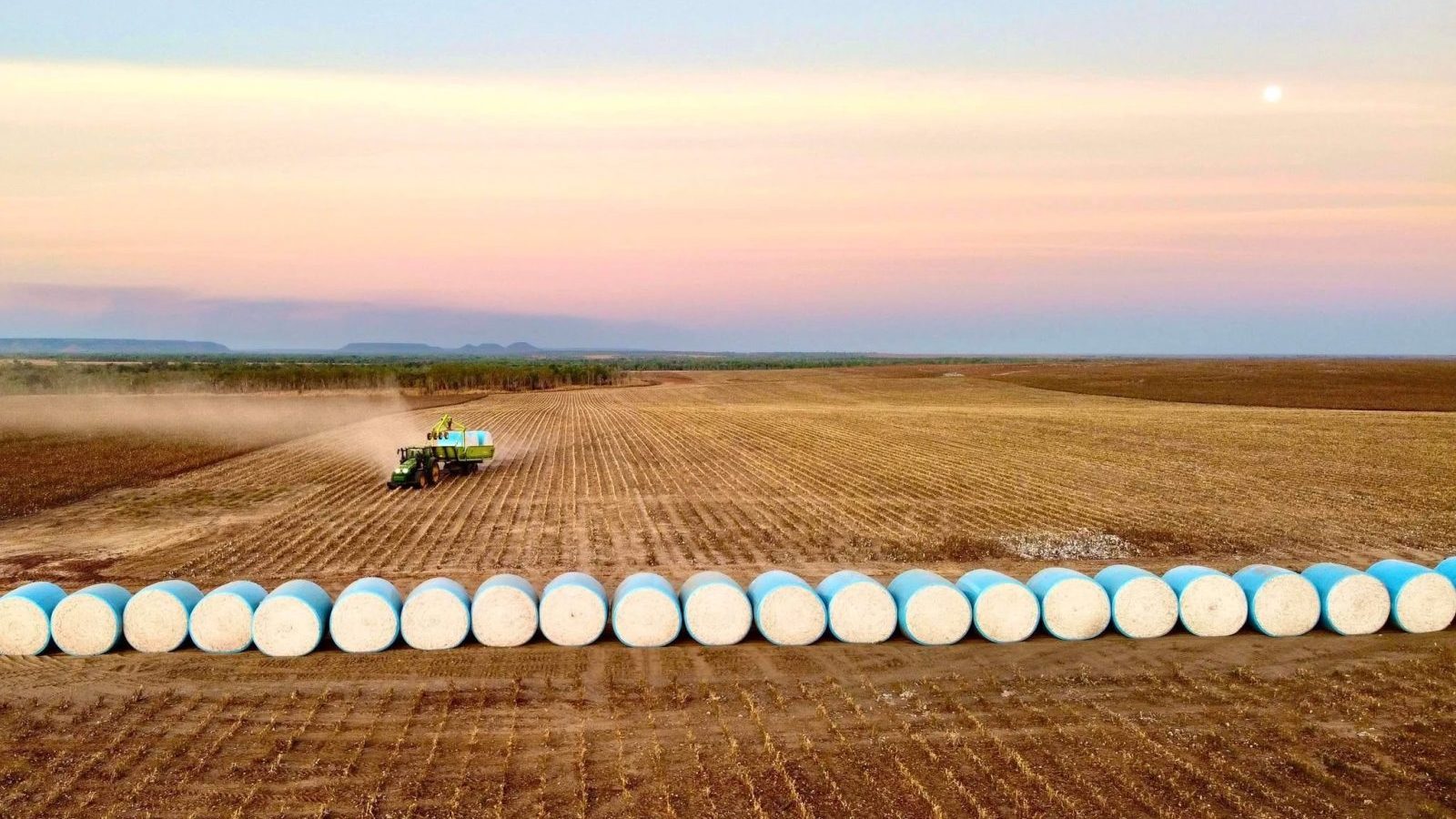
Cotton production in the Northern Territory. Source: Northern Cotton Pty Ltd
NORTHERN Australia’s cotton industry continues to gain momentum, despite a prolonged and severe wet season in 2025-26.
Amid the wet conditions, growers planted about 5000ha in the Northern Territory, 10,000ha in the Ord Valley and more than 5000ha in northern Queensland.
Government across all three jurisdictions appear to be backing ambitions for expanded broadacre cropping, with cotton often at or near the centre of regional goals.
The Western Australian Government has set 55,000ha as its target of irrigated cropping in the Ord, while Queensland and the Northern Territory have each set targets of more than 100,000ha.
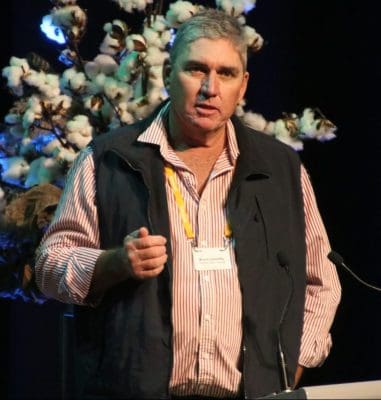
The late Bruce Connolly speaking at the 2022 Cotton Conference.
Growers and farm managers from four key regions across the north shared updates at the recent Australian Cotton Conference.
Speakers included Radford Agriculture’s Patrick Montgomery, who works at Etta Plains Station, north-west Qld; Salvetti Farming’s Jason Salvetti, Far North Qld; Tipperary Group of Stations farm manager Angus Marshall, NT; and Kimberley Agricultural Investment farm manager Luke McKay from WA’s Ord Valley.
Mr Marshall also paid tribute to the late Bruce Connolly, former farm manager at Tipperary, who died earlier this year.
Mr Connolly was on the board of Cotton Australia and NT Farmers and was a pioneering force in introducing cotton to NT.
“It’s hard to put into words how much of a loss Bruce was for not just the Northern Territory but northern Australia,” Mr Marshall said.
“Bruce laid the platform for the re-emergence of cotton in the Northern Territory and not just cotton but broadacre farming in general.”
Patrick Montgomery, NW Qld
Radford Agriculture’s Mr Montgomery has been working at Etta Plains, located 130km north of Julia Creek, for five years.
The Findley family, originally from the Wee Waa region of northern New South Wales, purchased Etta Plains in 2019 with advice from Chris Radford.
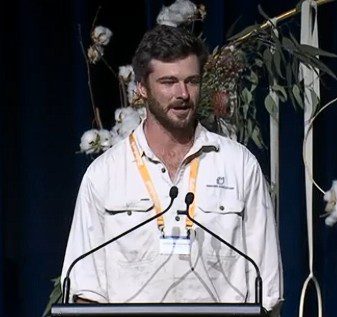
Patrick Montgomery.
He said they planted a 170ha irrigated pilot crop in the first year, which yielded more than 10 bales/ha and encouraged them to continue the operation.
“Today we’re up to 2000ha of developed irrigation, which we’ll push out to 8000ha, and then [with] the surrounding dryland, we’ve currently got 3300ha,” Mr Montgomery said.
“We’re also farming another property, Woodlands, which is to the north-east of Julia Creek and we’ve got another 1800ha of dryland there.”
He said the production focus was cotton in rotation with chickpeas, sorghum, and mungbeans.
“At the moment we’ve got chickpeas in about 1500ha and we’ve just finished harvesting the sorghum.”
He described the region as similar to Moree in its cropping potential and “black cracking clays”, but said growers faced challenges from wet-season rainfall variability and the higher costs and delays of transporting parts and farm supplies to the isolated area.
“We think we’ve basically got 85 percent of the blueprint.
“We’re getting commercial yields that you get in the Moree region; we’re just not getting them as consistently.
“I think that 15pc, if we can just get them more consistently, then it makes our region just as viable as any other region.”
He said it currently cost about $100/bale to transport raw cotton to gins at Emerald and Dalby.
“It’s hurting our gross margins a bit.
“There’s a push for a gin to be built in the region, and if we’re able, then we’d be able to conduct all the transport ourselves.
“At the moment, we’re on backloads from trucks going Brisbane to Darwin, or Brisbane to Cloncurry.”
He said “a good airstrip”, such as a gravel strip, was a game-changer by helping transport supplies in and out, particularly during the wet season.
“Having a good airstrip makes a big difference up there.”
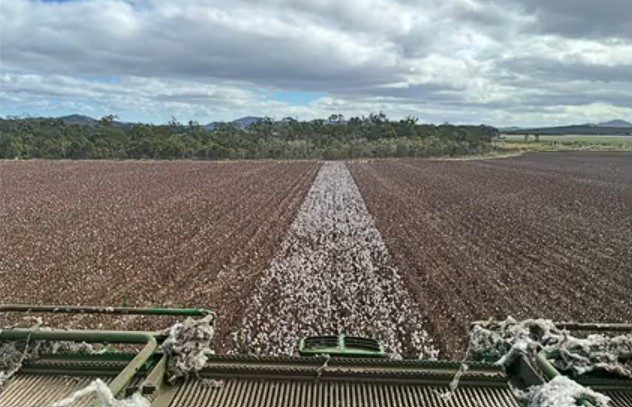
Picking cotton at Salvetti Farming west of Cairns. Photo: Jason Salvetti
Jason Salvetti, FNQ
Mr Salvetti farms at Dimbulah, about two hours’ drive west of Cairns, and is also president of the FNQ Sustainable Cropping, which has graziers, farmers, mixed farmers, and agribusinesses in its membership.
He said across the past two seasons, the region’s growers planted about 1500ha of cotton, mostly “in rotation with their existing farming business”, which generally consists of both cattle and sugarcane.
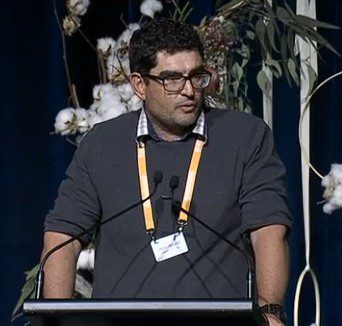
Jason Salvetti.
“Growers that are committed to growing cotton in the Far North Qld area are also committed to working out how the cotton puzzle will fit together in Far North Qld,” Mr Salvetti said.
“In 2024, we saw record yields with some cotton going up to 11b/ha using as little as two megalitres of water per hectare, while dryland growers achieved yields up to 9b/ha in some fields.
“We worked it out; we knew exactly what we were doing…and then this year came along.”
He said the 2025-26 season delivered more than 1060mm of in-crop rain, with most damage caused by frequency from rain on 54 of 84 days.
“Unfortunately, we did see a decline in yields because of that, but it wasn’t as bad as we thought.”
Mr Salvetti said the season reinforced lessons learned during 2024 including that “crops established at least four weeks before the start of the wet season that can get to about eight-ten nodes fare significantly better than those that are planted closer to the start of the wet season”.
“This year early crops planted in December…about three weeks before the start of the wet, yielded close to 9b, while crops planted later in December, closest to the start of the wet season, yielded 6b and crops planted in January, after the start of the wet season, averaged possibly between 3-4b with some growers even contemplating whether or not it was worth picking.
“One of the challenges that we do have in the north is that we aren’t trying to find the 1pc gains, we are trying to find the 40pc gains and that’s where crop establishment is going to get our gains.”
He said despite the impacts of 2025-26 season, optimism prevailed in the region, with growers believing “we are close to cracking the code”.
“The growers I have spoken to speak positively about the industry, about our future and, as we continue to grow cotton and work towards a reliable strategy for growing cotton, we can see a future in cotton.”
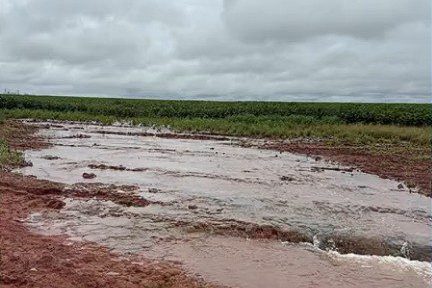
Water draining at Tipperary after one of the wettest seasons in 30 years. Photo: Angus Marshall
Angus Marshall, NT
Mr Marshall has been the Tipperary Group of Stations farm manager for about 18 months, taking on the role during “one of the biggest wet seasons in 30 years”.
He described it as “a baptism of fire”, beginning with a tropical cyclone that brought 125mm of rain, followed by prolonged monsoonal activity, and ending with another cyclone in March that dumped about 850mm of rain that month alone.
“We had one person employed full time driving around pulling tractors out of the mud,” Mr Marshall said.
He said picking finished on August 2 with about 5000ha grown across NT, which was “back a bit on previous years after a tough season”.
He said the season was an opportunity to remember that the region needs “a long-term vision”.
“I’m quite confident that in 10 years’ time, we’ll have a farming system there suited to the north and generating some pretty good revenue.”
Mr Marshall’s vision centred on building a farming system around cotton and nurturing Tipperary’s soils to deliver the best returns.
“The Northern Territory, particularly up where Tipperary is without rainfall, has the recipe for acidification with synthetic fertilisers and leaching.
“It’s a pretty bold statement, but in my opinion, a cotton monoculture is unstable in this environment and, it’s probably not news to anyone else, a cotton monoculture is fairly well unsuitable anywhere.”
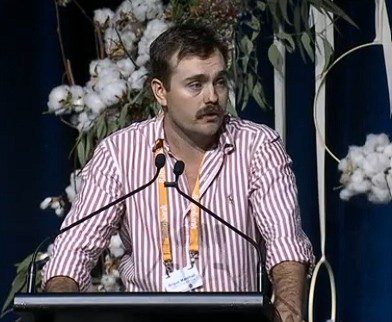
Angus Marshall.
He said the team is working to investigate the fundamentals of soil nutrition in the region, including comprehensive soil mapping of the farming area.
“We’re actually irrigating some of these acid soils with water that comes out of a limestone aquifer.
“It’s quite hard water, but has a lot of calcium, so it’s essentially liquid lime.
“What we’re seeing is basically crops under these irrigators are maintaining a pH of around six, whereas others are declining.”
Dry-season crop under consideration
Mr Marshall said “intensification” was “the big opportunity” for NT cotton and broadacre cropping.
He said this season, the company planted 50ha of cotton during the wet season on April 22 under permit.
“One thing about the dry season, it’s incredibly consistent.
“We do run into some cooler temperatures around this time of the year, but our average temperature is around 24 degrees.
“In my opinion, irrigation will significantly de-risk the current rain-grown model.
“It opens up the opportunities for other crops…that we may not be able to grow in the heat of the wet season, so things like chickpeas and other temperature-sensitive crops.”
Luke McKay, Ord Valley, WA
Kimberley Agricultural Investment has been cropping in the Ord Valley since 2012 and led the return of commercial cotton production in 2018, and Mr McKay is KAI’s farm manager.
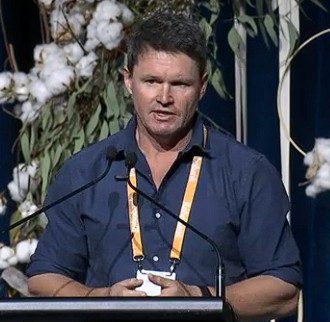
Luke McKay
He said the Ord cotton and broader agricultural industry was now transitioning from the “pure trial phase and into industry development”.
“We’re constantly refining the system and trying to improve that and wring the best out of it,” Mr McKay said.
“It’s more about being really sharp on our cost of production, our cost-of-sale execution, cost of logistics so that we build a resilient industry.
“If our cost of production is too high, we’ve got no buffer to…ride out fertiliser shocks and flood events and stuff like that that knock you around.”
He said the current focus was getting the “scale efficiencies into the system” to ensure the industry did not grow too fast and become unsustainable.
“Adding hectares ad hoc is good and it obviously has benefit going forward, but trying to make sure we’re aligned with ginning capacity, timing for when we’re ginning, how long we’re ginning for, and then the export that comes off the back of that.
“It is part of that bigger picture that needs to be taken into account; scaling is the solution, but it is a big challenge.
“Generally, the hurdle that’s pulled them undone is they’ve tried to scale to be too big, too quick.”
He said the new gin had its first year, with 90,000 bales going through it in 2025.
“The gin configuration can be scaled up to 250,000 bales and that’s obviously dependent on how long your ginning season wants to be.”
He said another key element of scaling was ensuring all the stakeholders were supportive including “making sure that approvals are in place, capital’s available, resourcing it with staff and machinery and getting that timing right in the process”.
Mr McKay said the plans had also been supported by the state government and traditional owners.
“That’s the sort of engine room of trying to get our farming system up and running and that expansion and resilience.”
Grain Central: Get our free news straight to your inbox – Click here
HAVE YOUR SAY