

Weather:
US Corn Belt – Active, showery pattern continuing through this week and into next, with fronts pushing showers into the Southeast; Southern Plains (Texas, Oklahoma) stay hot and dry.
Black Sea / Europe – Europe faces a damaging heat and depleted soil-moisture combination, with temperatures up to 15°F above normal in France and Germany.
China contends with flooding from Typhoon Dolphin.
Markets
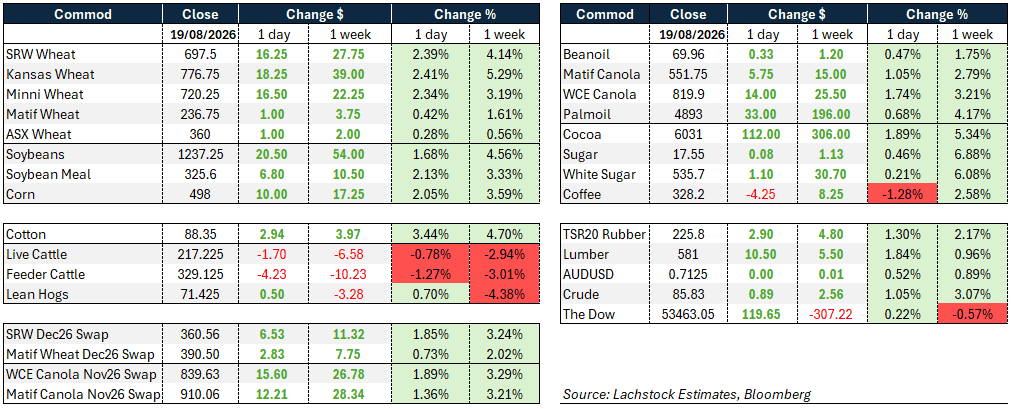
Wheat leads gains on Black Sea disruption – Chicago wheat closed up 2.39 percent to 697.5c (+4.14pc week), with Kansas up 2.41pc and Minni up 2.34pc, as Russian port closures at Novorossiysk and Taman push August exports to their lowest since 2010.
Corn breaking out on yield disappointment – December corn up 2.05pc/2.1pc as Pro Farmer tour results confirm below-trend yields in Indiana (-5.3pc) and Nebraska (-8.8pc), with CZ26 eyeing the 500c level ahead of harvest.
Canola firm but production outlook diverging – Matif and WCE canola both up over 1pc on the day (2.79pc/3.21pc on the week) as Canadian harvest gets underway, though AAFC (21 million tonnes) and USDA (22.5Mt) are showing a widening gap on 2026-27 production expectations.
Risk-off undertone in macro – Dow down 0.57pc on the week despite the modest daily gain, as Trump’s Iran “economic warfare” declaration adds to Hormuz-related risk premium already in the market, while Treasury doubles its long-bond buyback size to calm rising yields ahead of Warsh’s Jackson Hole speech.
Day Ahead – Australia
Offshore down on Tues night, local market down – Offshore up last night, so do we see broad price support. The fact the market has traded somewhat aggressively both sides of unchanged with basically no difference in fundamentals creates some questions. AI driven capital flow into Ags is certainly a partial explanation – something that will exert more and more influence in our markets. Headline buying, lack of headline selling is not new but the tight trading windows are.
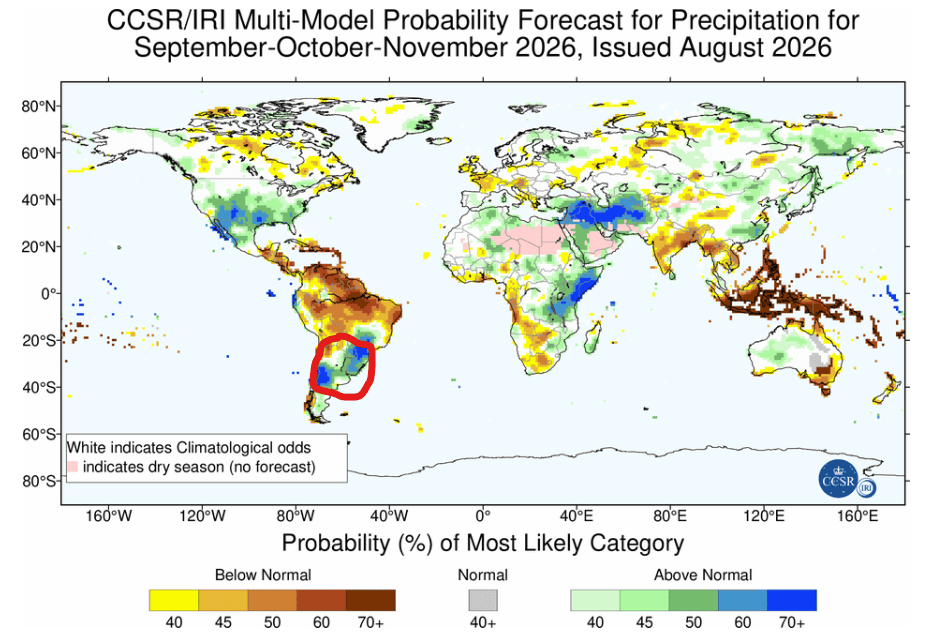
Signs that South East Asia demand is switching to Australia are starting to pop up but the hangover from a massive Argy crop has arguably given them a buffer. Worth noting that Argy production looks pretty good so far and El Niño is generally good for Argy wheat production.
 .
.
Wheat: Wheat decided to worry again, with December CBOT rallying 15.75c and Kansas wheat spiking 18.25c as Russian port disruption continues to bite.
SovEcon now has August Russian wheat exports at the lowest since 2010, with all grain terminals at Novorossiysk closed for vessel loading and Taman shut as well, while several more bulk carriers have been hit by drones in recent days and freight availability remains severely constrained.
Rusagrotrans is projecting just 1.8Mt Russian wheat exports for August versus a five year average of 4.8Mt, and if the region can’t get flows moving it’s looking like a total bust for the month.
At least five grain ships have been attacked near Novorossiysk and Tuapse as Russia and Ukraine step up strikes on each other’s commercial shipping in the Black Sea, a region that between the two of them accounts for more than a quarter of global wheat exports, with the timing landing right in the middle of harvest.
Ukraine’s own wheat exports could fall to between 5Mt and 10Mt in 2026/27 if its Black Sea ports stay blocked, according to ASAP Agri.
The parallel being drawn in the trade is the Strait of Hormuz, closed for six months now with no resolution, and the read is that the Black Sea could be tracking the same trajectory the longer this drags on.
Other grains and oilseeds: Corn is breaking out alongside wheat, up 2.1pc to 498c, with the Pro Farmer Crop Tour continuing to find yield disappointment.
Indiana corn came in at 183.5 bushels an acre, down 5.3pc on last year, while Nebraska fell 8.8pc to 163.6 bpa, and early western leg samples out of Iowa are also running below last year’s crop tour numbers.
Soybeans added 1.68pc on the day to 1237.25, with beans riding the same production worry wave as sub 52 bushel yields show up in some fields and crush spreads weaken.
There were no daily bean sales reported, though tomorrow’s export sales report is expected to show old and new crop combined near 1.3Mt in beans.
Matif canola closed up 1.05pc on the day and 2.79pc on the week at 551.75, with WCE canola up 1.74pc/3.21pc to 819.9.
The Canadian harvest is only just getting under way, with early planted canola combined in Manitoba and most of the crop still being swathed, and futures are expected to hold above C$800 a tonne until selling off the combine starts in earnest.
The threat of 50pc US tariffs on Canadian goods weighed on values through the week before a delay to those levies sparked a turnaround on Wednesday, and Trump has since said Canadian tariffs on US farmers will effectively disappear as part of the emerging deal.
There’s a genuine split in the production outlook, with Agriculture and Agri-Food Canada forecasting the 2026-27 canola crop at 21Mt against 21.8Mt last year, while the USDA is sitting well above that at a record 22.5Mt.
Crop conditions are described as mixed across the Prairies, ranging from very good to poor depending on the region.
Palm oil firmed 0.68pc on the day, with the Malaysian Palm Oil Council expecting prices to hold above 4,600 ringgit into September on tight supply and trade flow disruption.
EU import data continues to show the season’s slow start, with soybean imports down 27pc year on year to 1.41Mt and soymeal down 27pc to 1.98Mt, while rapeseed imports are up 31pc to 0.47Mt.
China’s Sinograin sold around 308,000t imported soybeans, or 85pc of what was on offer, and India’s monsoon planting has largely recovered after a dry June, with pulses, oilseeds and cotton sowing progressing satisfactorily.
Macro: The AUD was little changed on the day at 0.7125, up 0.89pc on the week, while the Dow added 0.22pc on the day but is down 0.57pc on the week after last week’s slide, and crude firmed 1.05pc to 85.83.
Trump escalated rhetoric on Iran, announcing what he called an unprecedented economic warfare and isolation campaign, warning that any country allowing its financial institutions, businesses, airports or government entities to provide any lifeline to Iran will face serious consequences itself, keeping the Hormuz risk premium firmly in play alongside the Black Sea disruption already driving grain markets.
On the bond side, the US Treasury is doubling the size of its longer dated buyback operations from US$2 billion to at least US$4 billion for the quarter starting 9 September, aimed at improving liquidity at the long end after heavy selling pressure tied to geopolitical risk and rising term premia pushed yields higher.
Longer dated yields fell sharply on the announcement, with the 30-year around 15bp off its recent intraday high of 5.336pc, and the next major catalyst for markets will be Fed Chair Warsh’s speech at Jackson Hole next week, where he’s expected to favour a smaller Fed balance sheet and less forward guidance rather than anything overtly hawkish on rates.
Elsewhere, record European heat has strained public health systems and cost France an estimated €15 billion, Rhine water levels remain near record lows despite a small recent uptick, and traders are increasingly positioning for a potential Super El Niño event from September through January, which Citi flagged as a meaningful risk to global agricultural production through above normal temperatures and shifting rainfall patterns.
Local: Through the west of the country, bids were back A$10/t on canola yesterday to $880 and GM $860, while wheat was steady at $382 and barley $330 FIS Albany.
In the east, canola was back $10 to $822 with GM $785, wheat was $360 and barley $305 track Geelong.
Barley remains slow, with growers looking to move on-farm inventory that had been held as a drought hedge — not just from last year, but in some cases from years prior across Victoria and SNSW. Export business is next to nothing at the moment as we wait for China to hopefully re-engage, resulting in a very dour market.
Wheat interest is now much stronger than barley for old crop, a complete flip of the script. With BSEA exports disrupted for what is becoming a critical length of time for global consumers, we are seeing buyers re-engage with Australian exporters. This is supportive for those still holding old crop and would be welcome if it flows through to new crop, but if history is anything to go by, it remains prudent to sell into these rallies.
HAVE YOUR SAY