
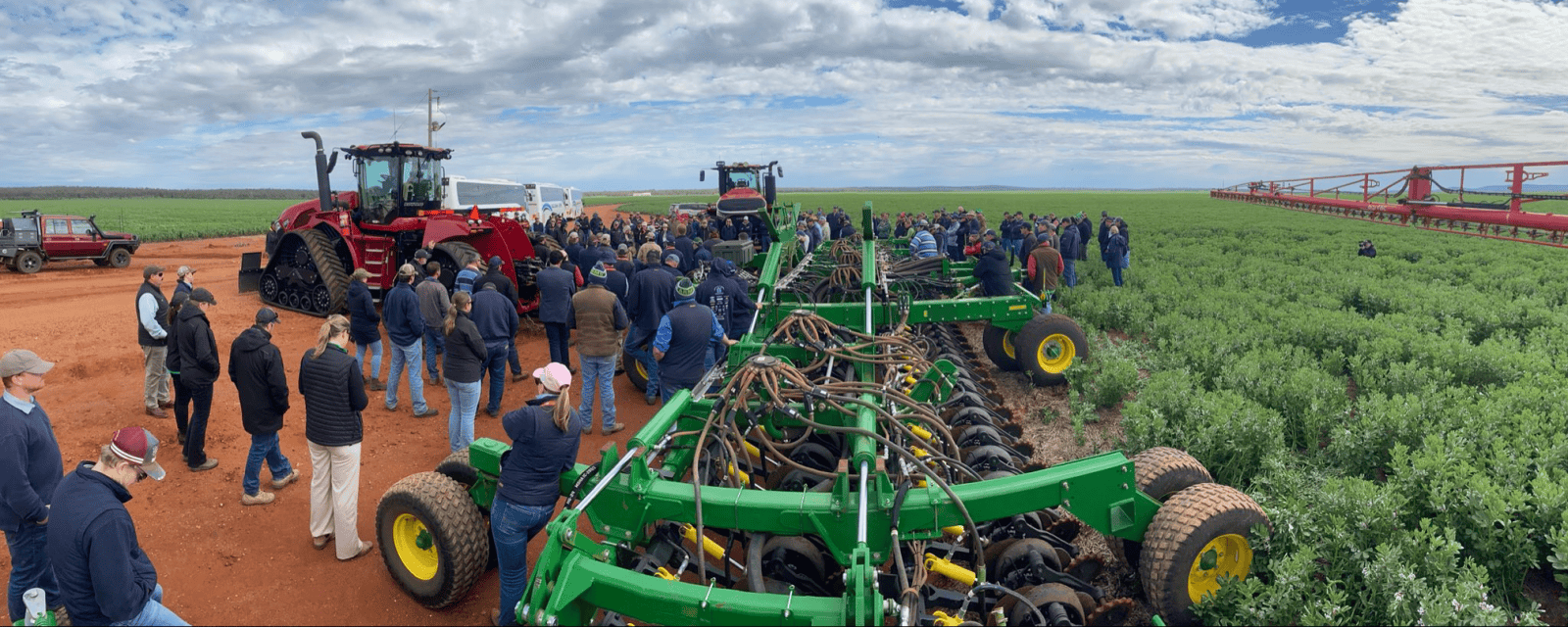
Andrew Ritchie and the team at Excel Farms hosts WeedSmart Week delegates at Ballandry near Griffith yesterday. Photo: Chris Davey
BIDS for wheat and barley in the northern region have dropped by up to $15 per tonne this week, despite production prospects sliding for most of its crops as they near maturity.
Trade sources say the drop reflects consumer confidence in what is expected to be a bumper southern crop, and their adequate coverage into next quarter.
The impact of war on Black Sea grain shipments, and reduced availability out of a drought-affected Europe, have seen new-crop values firm in the south, where forward sales of its big export surplus are shaping up evens or even a premium to prompt values.
| Aug 13 | Today | |
| Downs barley | $420 | $405 |
| Downs SFW | $425 | $410 |
| Downs sorghum | $370 | $375 |
| Mel barley | $330 | $335 |
| Mel ASW | $375 | $375 |
Indicative prices in Australian dollars per tonne.
Harvest nears in north
Queensland’s harvest is expected to start in the next week or two, but dry conditions over winter have yield expectations as average at best in most districts.
As production prospects drop due to a number of crops being grazed out or cut for silage or hay, consumers are in no hurry to buy.
“The smaller feedlots are wanting to lock in more grain through to the end of year, but the big boys are comfortable,” one trader said.
Growers in the northern region looking for a cash sale are emptying their chickpea storages into the buoyant market, which is maintaining strength to trade at the equivalent of $800/t delivered Brisbane.
They are holding on to wheat, still plentiful, and barley, which has become hard to find on farm in Qld and northern New South Wales.
On the border, Knight Commodities Goondiwindi-based broker Gerard Doherty said indications were that production for the region could be down by more than half on last year.
“There have definitely been quite a few crops cut, there’s the odd crop being sprayed out, and quite a bit has been grazed,” Mr Doherty said.
“Some crops are okay, but plenty of them aren’t.”
From around Dubbo south, seasonal conditions improve markedly, and Mr Doherty said this is the reason for the consumer’s confidence in sitting out of the market.
“Barley has really lost its mojo, and depot bids for it and wheat are down about $10-$20.”
The Bureau of Meteorology’s eight-day forecast points to 15-25mm of rain along the border’s grain-growing regions, and at least 25mm for the rest of NSW.
“It’s very common when you see a forecast like this for consumers to go quiet, and then there’s the chance we don’t get much rain north of the border.”
“Barley and wheat sellers have been constant in the rally we’ve seen this month, and just in the past couple of days they haven’t been prepared to follow the market.”
Mr Doherty said harvest pressure in the south is expected to direct any grain the north needs either on boats or trucks.
“We’re capped at the moment,” Mr Doherty said of values up until Christmas, when eastern and South Australia’s harvest is expected to end.
“Whether its road or ocean freight, we’ll have a decent cap in the market until Christmas.”
El Niño remains of concern in the southern as well as the northern market.
“It certainly won’t be the northern grower selling.”
One trader said the delivered Downs market for new-crop wheat was shaping up at around $420/t, $10/t under barley.
“That gives you a wide drawing arc,” the trader said, adding that both wheat and barley were pricing into the Downs from on-farm storages as far south as the Victorian border.
More rain forecast for south
South from the northern Riverina of NSW, canola crops are at or past peak flowering, and shorter-season cereals are starting to run to head.
Consecutive rain keeps falling, and a further 10-40mm is sitting on the forecast for growing areas across NSW, Victoria and South Australia to consolidate prospects for bumper yields, provided widespread frost does not wipe out a chunk of potential.
“If it keeps raining, happy days: if it cuts out, look out,” Peters Commodities Wagga Wagga-based trader Peter Gerhardy said with regard to frost risk.
Mr Gerhardy described the market as relatively flat.
“I’m not being swamped by sellers…and consumers are not too concerned; they’re letting the grain come to them.”
A surge in export business, largely because of difficulties for Asia and Africa in procuring volume out of the war-torn Black Sea, remains the most likely kicker for wheat values.
“There’s a bit of old-crop wheat around, and there’s a flood of old-crop barley being offered up,” one trader said.
“There’s not a lot of consumer activity because most are covered.”
Multigrade contracts are getting growers started on new-crop sales for wheat, which could well feature below-average protein as a function of the mild growing season to date, and urea’s expense earlier on.
The weak protein outlook is thought to be prompting some growers to hang on to last year’s wheat as a blending option to lift the average from the upcoming harvest.
Some parts of the south are waterlogged, a good problem to have for crops with so much yield potential.
Grain Central: Get our free news straight to your inbox – Click here
HAVE YOUR SAY