

Weather:
NOAA confirmed July as the hottest month on record, with Midwest crops facing daytime highs near 110°F and, more critically, elevated overnight lows.
Rabo Research’s Stephen Nicholson pointed to a decades-long rise in overnight low temperatures denying crops post-heat recovery time, disrupting pollination for a large share of this year’s corn crop.
The US Drought Monitor showed easing dryness across the Northern Plains while drought expanded through the southern US, a continued pressure point for corn and wheat.
Prairie temperatures in the low-to-mid 20s Celsius are allowing Saskatchewan harvest progress, with 4 percent of the province’s crop off and only 1pc of southwest canola combined.
Markets
Pro Farmer Midwest Crop Tour scouts found Illinois corn yields at 184.2bu/ac, down 7.7pc on last year’s 199.6bu/ac, with soybean pod counts also below last year’s tally, lending support to corn and the wider grain complex.
RCM Alternatives’ Doug Bergman flagged elevated volatility with a bias toward higher prices as the Russia-Ukraine war continues to strangle Black Sea shipments, with Rusagrotrans reportedly tracking Russia’s August wheat exports at a 16-year low.
Crude firmed as the US-Iran conflict remains stalemated, with Trump’s threatened economic pressure on Iran lifting the broader energy complex and European gas to a five-month high amid storage at the lowest seasonal level since 2009.
ICE canola clawed back early losses to close higher, supported by strength in Chicago soyoil and Malaysian palm oil plus a firmer loonie and constructive Canada-US trade tone, though soft Chicago soybeans, soymeal losses and weaker European rapeseed capped gains.
Day Ahead – Australia
No major developments in the BSEA overnight. Australian wheat continues to be called on to fill gaps, with more freight enquiries yesterday for Victorian exports. This remains supportive for old crop and is starting to slowly bleed into new crop values.
Canola likely a little softer today, wheat firmer and barley sideways.
 .
.
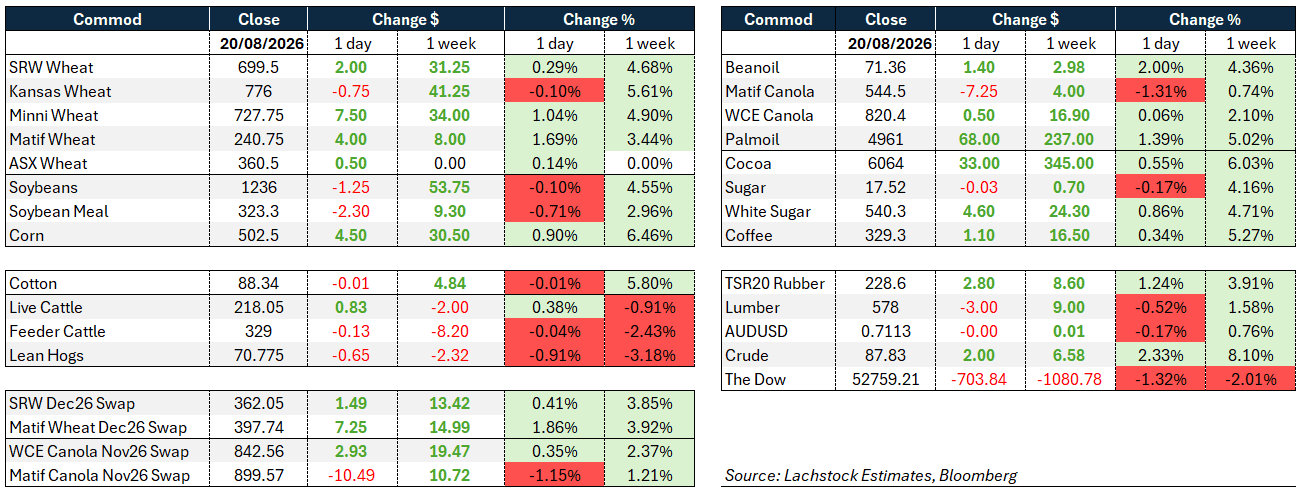
Wheat: Chicago wheat firmed again, riding the same crude-driven war premium lifting corn as the US-Iran standoff drags on with no resolution in sight.
Black Sea disruption remains the dominant supportive theme: RCM Alternatives’ Doug Bergman flagged elevated volatility with a bias toward higher prices as the Russia-Ukraine war continues to strangle Black Sea shipments, and Rusagrotrans is reportedly tracking Russia’s August wheat exports at a 16-year low.
Kansas wheat lagged the complex on the day despite holding a firm weekly gain, while Matif and ASX wheat tracked the broader firmness with comparatively modest moves.
Other grains and oilseeds: Corn led the complex higher after Pro Farmer Midwest Crop Tour scouts pegged Illinois corn yields at 184.2bu/ac, down 7.7pc on last year’s 199.6bu/ac, with Illinois soybean pod counts also below last year’s tally at 1,430.4 pods per 3ft-by-3ft square versus 1,479.2.
Soybeans nonetheless slipped on the day despite the bullish tour read, with the crude/ethanol tie doing more for corn than beans directly.
Canola erased early losses to close higher on ICE, supported by sharp gains in Chicago soyoil and firmer Malaysian palm oil as crude’s rally spilled into vegetable oils, alongside a firmer loonie and a constructive tone in Canada-US trade talks; mixed Chicago soybeans, soymeal weakness and losses in European rapeseed capped the upside.
Prairie harvest is progressing slowly, with Saskatchewan at 4pc complete and only 1pc of southwest canola combined.
Livestock softened on the week, with feeders and hogs both pressured.
Macro: Crude extended its sharp weekly rally as the US-Iran war remains mired in stalemate, with Trump’s threatened “economic D-Day” against Iran lifting the broader energy complex; European gas jumped to a five-month high on the same theme, with continental storage at just 62pc full, the lowest seasonal level since 2009 records began.
Equities sold off hard, the Dow shedding over 700 points on the day as escalating Middle East risk and a fresh record US national debt figure of $40 trillion weighed on sentiment.
AUDUSD held little changed on the day but firmer on the week, still contending with the broader risk-off tone.
Local: Through the west of the country, canola was stronger, up A$10/t to $890, while GM was $875, wheat $385 and barley $333 FIS Albany.
In the east, canola was firmer at $835 with GM $800, wheat $360 and barley $306 track Geelong.
New crop delivered barley markets remain steady, with Geelong/Melbourne bid $328, Goulburn Valley $309, Griffith/Hanwood $308 and the Darling Downs $400 Jan+.
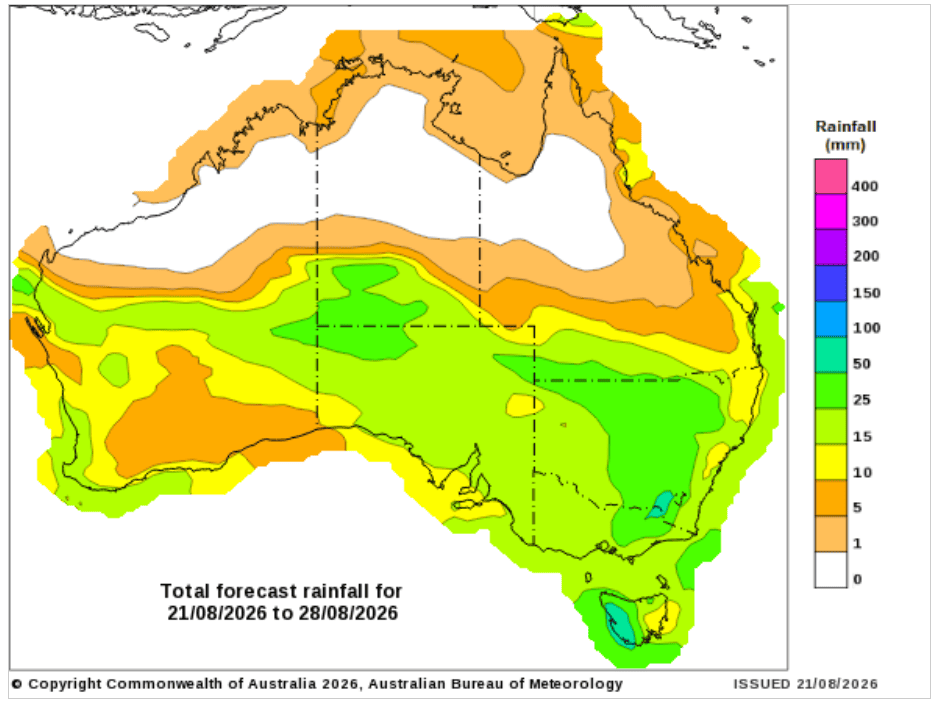
Longer-range rainfall forecasts are showing moisture pushing into NNSW and SQLD, which would help salvage/improvement of winter crops and provide greater confidence for summer crop planting. If it eventuates, it would also likely see a weakening Downs feedgrain market.
HAVE YOUR SAY