

Weather:
Weather remains a mixed influence, with dryness across parts of Europe and the US worth watching ahead of winter crop planting. French maize conditions remain historically poor at just 29 percent good-to-excellent, while favourable rainfall has improved crops across Morocco and Tunisia. Looking further ahead, El Niño risk is building for Brazil, with concerns it could weigh on 2026/27 soybean production.
Markets
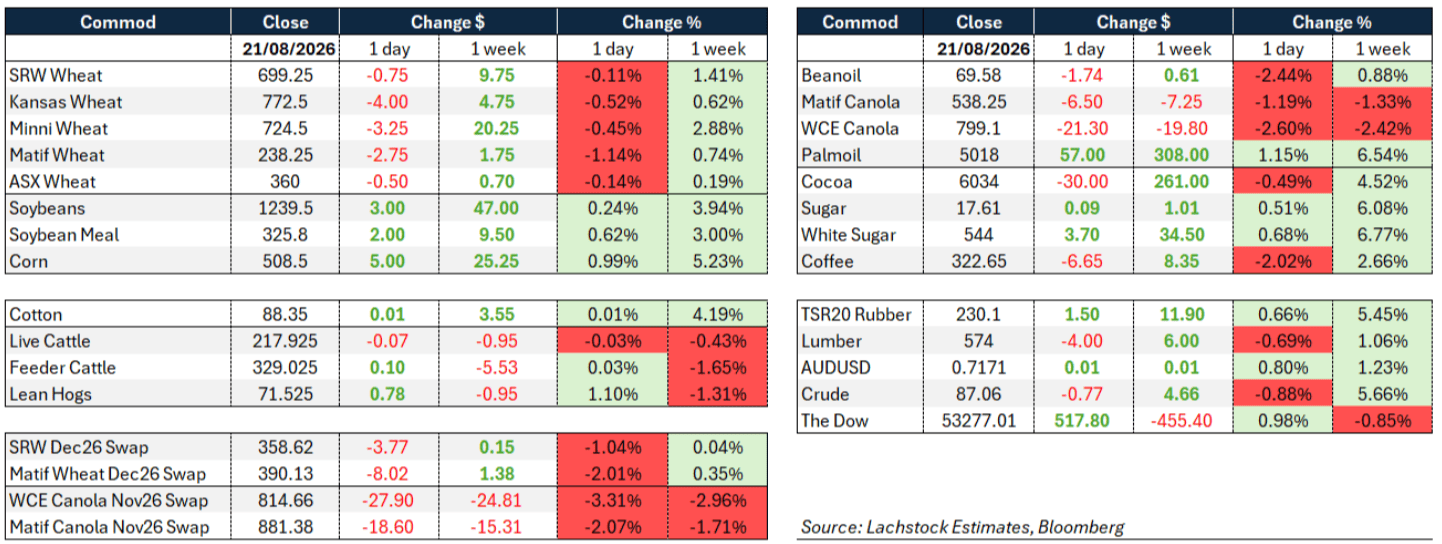
Wheat markets finished softer on Friday despite the ongoing Black Sea risk. Chicago wheat was mixed to lower, with Kansas down around 4c and Minneapolis off 3.25c, while Matif Sep fell €3.75 and Dec €2.75. The broader wheat story remains supportive, however, as Black Sea export flows stay heavily disrupted and buyers increasingly look to Australia, the US and Argentina for replacement tonnes.
Corn finished around 5c higher after Pro Farmer’s US yield estimate of 173.2bu/ac came in well below USDA, while soybeans gained around 3c on strong export sales to China and unknown destinations. Soymeal firmed, soyoil fell sharply and canola also weakened on profit-taking ahead of harvest. Outside agriculture, equities ended the week firmer, US 10-year yields rose to 4.73pc, oil edged higher and gold rallied 2.5pc as Middle East tensions and US fiscal concerns remained in focus.
Day Ahead – Australia
Softer start to the week with Australian prices facing pressure on all fronts with a stronger Aussie dollar, good rains moving through SA today then into Vic and NSW and softer global markets Friday. Russian wheat is cheap we just can’t get it out- works for us.
Heading to the Dowerin Field Day this week? Please drop in and catch up with Dougal & Matt at: Site # 67A (26th & 27th August).
 .
.
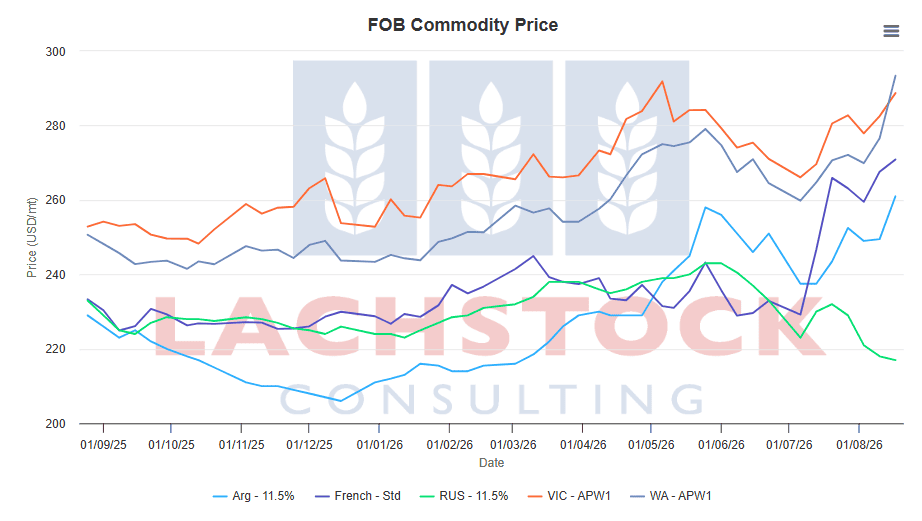
Wheat: Black Sea disruption remains the key bullish story, with grain flows running at a fraction of normal levels as attacks continue across the region and vessel loadings are postponed or cancelled.
Asian buyers are already looking to Australia, the US and Argentina for replacement tonnes, with an estimated 10–15 million tonnes (Mt) of wheat demand potentially needing to be redirected if Black Sea exports remain constrained.
Chicago wheat has rallied more than 17pc since early July, although futures finished softer Friday with Matif Dec also down €2.75 and Russian cash steady around US$215/t.
SovEcon trimmed its Russian wheat crop estimate to 88.2Mt, while longer-term concerns are building around Russian and Ukrainian plantings given poor grower cashflow, fuel availability and damaged logistics.
North African production has provided some buffer, with improved crops across Egypt, Morocco and Tunisia reducing immediate import pressure.
The longer Black Sea disruption persists, the greater the risk consumers are forced to chase alternative origins and push global wheat values materially higher.
Other grains and oilseeds: Corn was firmer after the Pro Farmer tour estimated US yield at just 173.2bu/ac versus USDA’s 180.7, raising the prospect of a much tighter US balance sheet if final yields land in the 175–178 range.
Lower Ukrainian corn availability makes it difficult to offset a smaller US crop through reduced US exports, increasing the potential rationing requirement; USDA also reported 205kt US corn sold to unknown destinations.
US soybeans were supported by strong export demand, with 712kt sold to China and 720kt to unknown destinations, while Pro Farmer estimated a record 53.3bu/ac soybean yield.
Soymeal firmed while soyoil came under pressure as uncertainty around US small refinery exemptions weighed on biofuel demand expectations.
Canola weakened on profit-taking, with speculative funds carrying a large long position ahead of harvest; pressure also came from softer Chicago soyoil and European rapeseed.
Agriculture Canada lifted its 2026/27 canola crop forecast 600kt to 21.6Mt, while Canadian weekly exports fell nearly 50pc to 116kt. Brazil’s soybean outlook is also being watched, with COFCO flagging possible El Niño production risks.
Macro: Middle East tensions remain a major inflationary risk, with US pressure on Iran increasing concerns around oil supply and continued restrictions through the Strait of Hormuz.
Crude and global gas markets remain well supported, with Russian refinery attacks further tightening diesel markets and North Asian LNG prices around double pre-conflict levels.
US economic activity remains strong, with the August composite PMI rising to 56.0, although easing input-price pressures offered some encouragement on inflation.
US fiscal concerns are building as debt exceeds US$40tn, FY2026 deficit forecasts rise to US$2.1tn, and debt interest now accounts for around 15pc of government expenditure.
US Treasury yields finished higher, while gold rallied strongly as investors increased safe-haven exposure amid fiscal, geopolitical and currency uncertainty.
US–Canada trade tensions escalated after talks broke down, with both sides imposing fresh tariffs, adding another layer of uncertainty to an already volatile global trade environment.
Local: Canola was softer to end the week in the west with bids around A$880/t while GM $870, wheat was firmer $390 and barley $329 FIS Albany.
In the east canola was back bid $828 while GM $788, wheat was steady $360 and barley $306 track Geelong.
Record lentil production expected in SA with near on 1Mt forecast, Vic production strong- hard to see a reason to rally with the global picture just as bleak.
HAVE YOUR SAY