

Weather:
Weather remains mixed globally. Drought in western Iowa is limiting US corn yield potential, while heat and dryness across Europe have pushed EU corn yields well below average. India’s monsoon has also been running 13 percent below normal, adding some concern there.
Markets
Corn remains the strongest story, with lower US and European yield expectations tightening the global feed-grain outlook. Wheat is also finding support from ongoing Black Sea export disruptions and slowing Ukrainian shipments, although India’s return to the export market is capping some of the upside. Oilseeds are the weak link this morning, with canola likely to feel the pressure from the sharp sell-off across global vegetable oils and crude.
Day Ahead – Australia
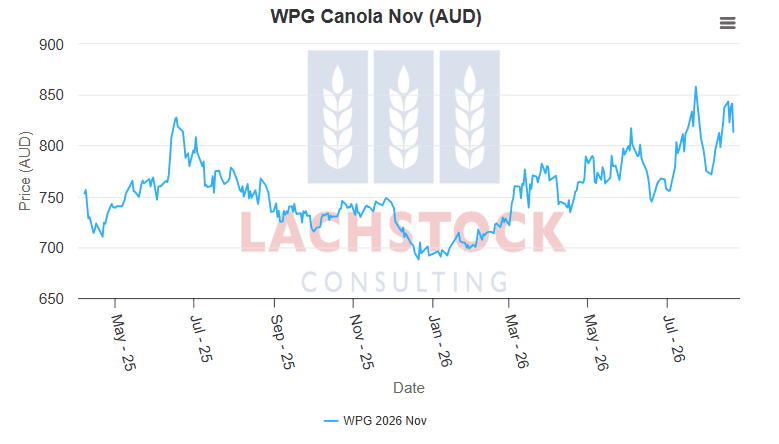
Cereals are largely steady today with limited direction from global markets. Canola will be softer following last night’s sharp sell-off, led by soyoil and crude, while good rainfall through SA and into Victoria should also keep some pressure on local prices.
 .
.
Wheat: Wheat markets were mixed overnight. Chicago finished fractionally higher, Kansas lost 5¼c and Minneapolis fell 3¼c, while MATIF was firmer with September +€4/t and December +€0.75. Russian cash wheat held around US$215/t.
India has lifted its long-running wheat export ban, potentially adding another supplier back into the global market. Indian domestic values remain above export parity for now, although a further rise in world prices could bring Indian wheat into play, particularly into Bangladesh.
Black Sea risks remain firmly in focus. Russia struck a dry-cargo vessel at Odesa and also targeted fuel tanks and storage facilities around Pivdennyi, while Ukraine says grain exports remain possible but heavily restricted.
Ukrainian grain exports fell 11.4% week-on-week to 188kmt, with August exports reportedly almost 69% below last year as attacks continue to disrupt Black Sea ports and shipping.
US wheat inspections were stronger than expected at 426kmt, although the export pace remains 26% behind last year. Spring wheat harvest reached 62%, while Canadian wheat conditions are reportedly deteriorating late in the season.
Wheat is being pulled in both directions: India’s return adds potential supply pressure, while Black Sea disruption and a tightening global feed-grain balance continue to provide support.
Other grains and oilseeds: Corn was the standout market, with December futures rising 1.4% to US$5.15½/bu, the highest close since July 2023.
Pro Farmer estimated the US corn yield at just 173.2bu/acre, well below USDA’s 180.7bu/acre estimate and around 5% below last year. Lower yields were reported across much of the Corn Belt, with drought in western Iowa limiting its ability to offset losses elsewhere.
US corn conditions also fell to 57% good/excellent, below expectations of 60%, versus 71% last year and a 62% five-year average. A Pro Farmer yield near 173bu/acre could push US ending stocks towards just 1bn bushels, significantly tightening the balance sheet.
Europe added to the bullish corn story, with MARS cutting EU yield expectations 5% to 6.61t/ha, around 7% below the five-year average.
Soybeans were weaker despite a relatively solid Pro Farmer yield estimate of 53.3bu/acre, with November beans falling 1.2% to US$12.24¼/bu. Weakness in soybean oil was the main drag, while meal strengthened relative to corn.
Canola had a sharp sell-off, falling more than C$28/t as crude oil and Chicago soyoil weakened. Soybean oil dropped more than 2c/lb after the US EPA extended the deadline for refiners to meet biofuel blending requirements.
European rapeseed and Malaysian palm oil were also weaker, with palm oil retreating from a 20-month high as lower crude and vegetable oil prices triggered profit-taking.
Ukraine’s 2026/27 rapeseed crop forecast was revised 7.5% higher to 3.85mmt, with exports now forecast at 2.26mmt.
Macro: Global equities eased, led by technology stocks. The S&P 500 fell around 0.2%, Euro Stoxx 50 lost 0.2%, while the US 10-year Treasury yield fell 4bp to 4.70%.
The US dollar strengthened, with the DXY moving above 99, while gold gained around 0.9% to US$4,643/oz amid renewed concerns over US fiscal sustainability.
US Treasury Secretary Scott Bessent announced plans for a major campaign to economically isolate Iran, warning countries that continue trading with Tehran that they could face US sanctions.
Oil nevertheless fell around 2% to US$85.30/bbl, with alternative Gulf export routes helping offset some Strait of Hormuz disruption. Security risks remain elevated around both the Persian Gulf and Red Sea.
European and Asian natural gas prices strengthened on Middle East supply concerns, with German storage sitting around 51% full, a record seasonal low.
US-Canada trade tensions also escalated after negotiations broke down, with the US imposing 50% tariffs on some Canadian imports.
Markets are now focused on Fed Chair Warsh’s Jackson Hole speech and upcoming US PCE inflation data, with the Fed expected to remain on hold for now .
Local: Canola was softer to start the week through WA, bid A$865/t for conventional and $850 for GM, while wheat was $388 and barley $328 FIS Albany.
Through the east, canola eased to $812 and GM to $774, while wheat held steady at $360 and barley at $305 track Geelong.
Barley remains slow going, with growers keen sellers but limited exporter interest continuing to pressure bids. Even northern markets are feeling it, with Darling Downs barley now offered slightly below $400/t .
HAVE YOUR SAY