
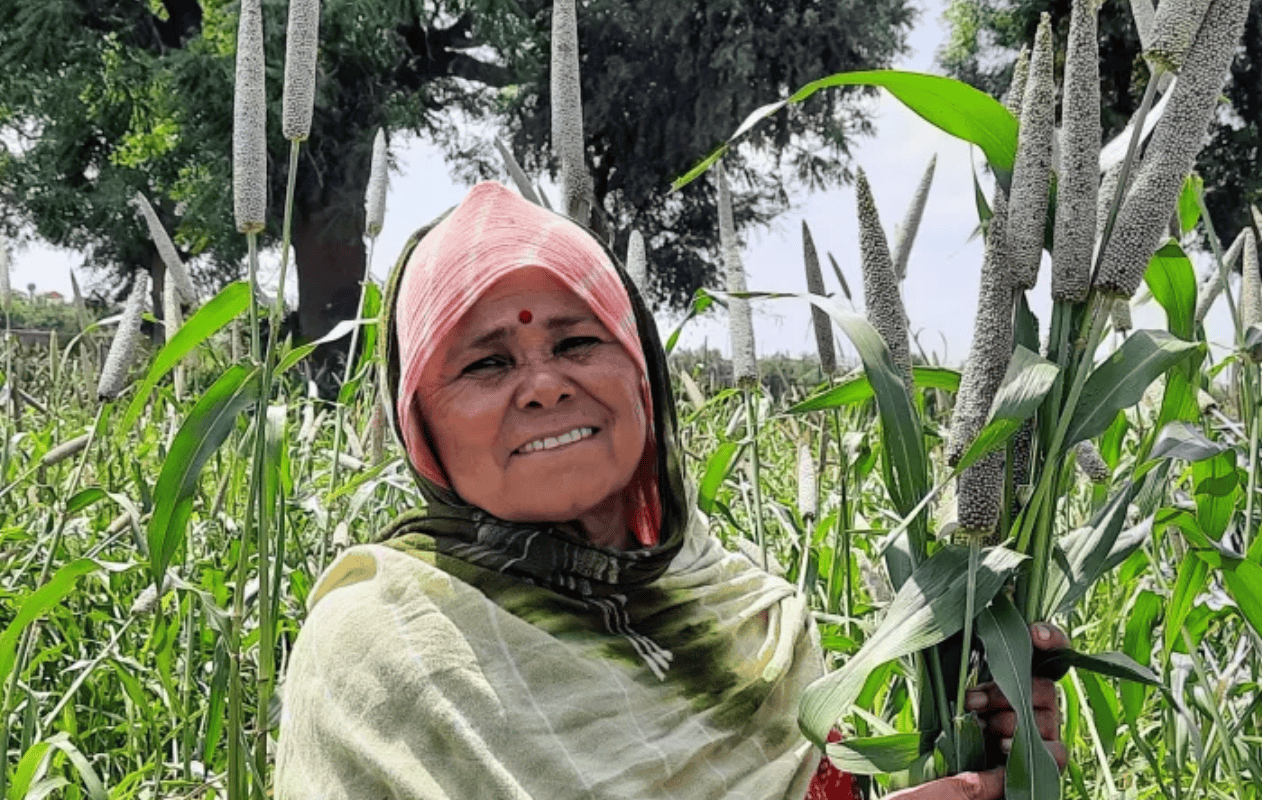
Millet is one of India’s key kharif crops, and its area this season is well down. Photo: ICRISAT
INDIA has lived and farmed by the rhythm of the southwest monsoon for generations. While its timing and intensity may have constantly varied, the broader weather pattern has long been predictable and consistent enough for farmers and businesses, cities and the government to plan around the annual phenomenon.
The monsoon usually sweeps in from the Indian Ocean in early June each year, bringing much of the country’s annual rainfall, before commencing its retreat in September. It is critical for replenishing water reserves in a nation of more than 1.4 billion people, where around half of the farmland lacks irrigation, and about half of the population relies on farming for its livelihood.
India’s monsoon is in danger this year, with hotter and drier conditions forecast across much of the world as a stronger El Niño weather system takes hold. With the country hit by prolonged dry spells, wild cloudbursts, and deadly floods, climate swings now expose the pitfalls of planning and working around historical weather patterns.
Natural phenomena
Various natural phenomena, including El Niño and La Niña, influence global climate patterns. Both originate in the Pacific Ocean, which covers nearly 46 percent of the earth’s water surface and 32pc of its total surface area. They have far-reaching consequences for global weather patterns, including India’s critical monsoon season.
El Niño weakens moisture-laden winds, causes erratic, deficit rainfall events across the Indian subcontinent, generally lasts for several months, and occurs every two to seven years. La Niña, by contrast, brings normal to above-normal precipitation to India during the southwest monsoon season and below-normal temperatures during winter. High pressure (cool air) over the eastern Pacific and low pressure (warm air) over the Indian Ocean push moisture-laden winds toward India. Under normal conditions, the southwest monsoon accounts for about 75pc of the country’s annual rainfall.
Science shows changes
Madhavan Nair Rajeevan, a climate scientist and former secretary in India’s Ministry of Earth Sciences, says changes in the monsoon’s behaviour are visible. Average seasonal precipitation, he said, has not shown a systematic long-term change and the monsoon remains a robust natural phenomenon. But the timing, intensity and distribution of rainfall are all noticeably different.
Rajeevan states: “We are witnessing an increase in short-duration rainfall extremes, longer dry spells, and changes in the frequency, intensity and distribution of monsoon weather systems.” He believes the rise in extreme rainfall is more than natural variability; rather, “It represents a structural shift in the monsoon system.”
The problem is not necessarily that India is receiving above or below-normal precipitation. It is the way the rain is arriving: longer dry spells are followed by short bursts of intense precipitation that can overwhelm drainage systems, swell rivers and cause localised flooding and landslides.
The performance of this season’s monsoon has been extremely varied since its onset on June 4, with some states facing large rainfall deficits while others have received considerably more rainfall than normal. It finally covered the entire country by July 9, after a contrasting two-month start: a weak and erratic June followed by a strong recovery in July.
According to the Indian Meteorological Department (IMD), the delayed and erratic onset led to a nationwide rainfall deficit of 35.4pc: 107mm against the long-term average of 165mm. The lack of moisture heavily impacted rainfed agricultural regions of central and northwest India, delaying planting of this season’s kharif crops.
A strong monsoonal recovery followed in July, delivering 283mm nationally compared to the long-term average of 281mm. This moisture surge significantly narrowed this season’s cumulative rainfall deficit to just 11.5pc nationally by the end of July. However, despite this surge, the kharif crop sowing campaign remains sluggish.
The August pattern has also been erratic, with a dry second week erasing almost all the gains made in a wet first week of the month, pushing the cumulative precipitation deficit for the 2026 monsoon back to 10.5pc nationally as at August 15, IMD data reveals.
Farmer, water reserves
However, this doesn’t tell the full story. India faces widespread drought despite extreme rainfall and floods in parts of the country, with satellite and soil moisture surveys revealing mounting crop stress as the kharif crop enters its critical reproductive phase in many regions.
India’s farmers depend heavily on rainfall timing, with the kharif cropping season running from June to October. It is the biggest of the two major cycles and is dominated by rice, which occupies the largest area of any single crop in India each season. Long dry spells can disrupt sowing and reduce soil moisture, critical for crop development. Official data released by the Ministry of Agriculture and Farmers Welfare up to July 24, 2026, put the total planted area at 78.7 million hectares (Mha), 4.9pc or 3.9Mha lower than the 82.6Mha sown at the same time last year.
Coarse grains suffered the steepest decline, contracting 11.9pc to 14.2Mha, with the pearl millet and corn area each around 850,000ha lower than late July 2025. The pulse area dropped by 7.5pc to 8.5Mha as seasonal variability impacted moisture-sensitive crops such as pigeon pea and moth bean. The rice area shrank by 2.6pc, or 620,000ha, to 23.4Mha.
Water levels in the country’s major reservoirs are also a concern, especially for the next wheat crop, planting of which generally commences in October. According to India’s Central Water Commission, the water storage status of India’s 166 major dams stood at 44.4pc of total capacity as at July 30. This is 65.4pc of the level at the same time last year, and 93.0pc of the long-term average.
HAVE YOUR SAY