
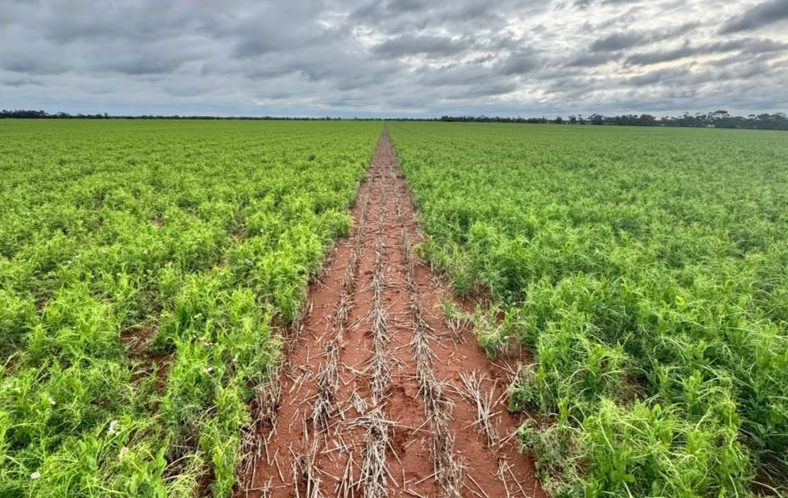
Field peas thriving in the western Riverina. Photo: Aaron Hutchinson
THE southern wheat market has bucked this week’s softening trend, supported by buying for export cargoes as Asian customers look to shore up uncertain supplies from the Black Sea.
Rain in eastern Australia in the week to yesterday has lifted production prospects for some northern cereals, and made the south’s big barley crop look even bigger.
Northern consumers are comfortable the region’s wheat carry-out, and southern new-crop production will see plenty of grain available.
Narrowing the spread is the outlook for new-crop freight rates, at least 25 percent above levels available earlier in the year due to expensive diesel.
| Aug 20 | Today | |
| Downs barley | $405 | $400 |
| Downs SFW | $410 | $405 |
| Downs sorghum | $375 | $375 |
| Mel barley | $335 | $325 |
| Mel ASW | $375 | $380 |
Indicative prices in Australian dollars per tonne.
Northern rain freshens some crops
Some crops in northern New South Wales and pockets of southern Queensland have had one or two drinks in the past week to bolster their yield outlook.
This has enabled some growers to gear up for an early start to sorghum planting, but has not been enough to flush much current-crop tonnage into the market.
Northern NSW rainfall in the week to 9am yesterday included: Gunnedah 32mm; Moree 38mm; Mungindi 30mm; Narrabri 39mm, and Quirindi 36mm.
In Qld, falls for the week included: Dalby 7mm; Felton 17mm, Roma 18mm and Surat 19mm
“We have some growers wanting to sell sorghum, and some wheat and barley too; growers want to sell a bit of it, not a lot of it.”
Woodside Commodities managing director Hamish Steele-Park said cottonseed values have eased in the past week in response to recent rain, which has not been enough to bolster the new-crop production outlook.
“While rain has put some water into dams, water allocations are still very limited, and most are calling the cotton crop in 2027 around 3 million bales, down significantly from this season,” Mr Steele-Park said.
Ginning in most valleys is expected to finish by the end of next month.
Indicative values for cotton ex gin are $545/t in the Gwydir Valley, $540/t in the Murrumbidgee and $515/t in the Macquarie Valley.
“There have been no exports year to date, so demand is very one-dimensional this year; it’s domestic only.”
AgVantage Commodities director Steve Dalton said northern NSW crops are a long way from turning, so will happily soak up the rain.
“The western areas don’t have the crop in to benefit, and that’s where the rain missed,” Mr Dalton.
“Growers are saying crops are hanging in there; the test will be if it doesn’t rain and the weather warms up.
“The bid side of the market went very quiet last week on the back of that forecast.
“I think buyers don’t want to be on the wrong side of the market.”
Given the reduced winter-crop area in the ground in the dry north, and the modest yield outlook, Mr Dalton said the north’s consumer demand will have to be supplemented from the south, and that will put a floor in the northern wheat and barley market.
“If [the grain price is] low and freight is high, I don’t see how it comes down too much.”
The wildcard for consumers is how much the interruption to shipping caused by the war between Russia and Ukraine will stimulate African, Asian, and Middle East demand for prompt shipment.
“Consumers are coming to Australia for supply.
“Domestic markets in southern Queensland are going to need to compete.
“They’re going to have to stay at a level that can drag it north and pay the freight bill.”
South soggy in parts
Horsham-based Mygrain broker Andy Brown said growers would be happy for the tap to turn off for a few weeks.
“It’s wet, unbelievably wet, in places,” Mr Brown said.
“There may be some more rain next week, which we don’t really want.”
Consecutive rain is causing a few fungal disease issues, but crops are generally in fine health ahead of spring’s arrival next week.
So far, the only casualty of the season appears to be vetch that was sown with hay in mind.
“A lot of vetch is going rank now, so there might be a case for brown-manuring it.”
Rainfall recorded in the 24 hours to 9am yesterday in the southern half of NSW includes: Ardlethan 34mm; Cootamundra 38mm; Parkes 35mm; Temora 64mm, and Young 39mm.
In Vic, rain was more widespread but generally lighter, and ranged from 4-5mm in Ouyen, Murrayville, and Sea Lake to 25mm in Sea Lake and 28mm at St Arnaud.
Mr Brown said export demand for current crop wheat “is kicking along really well”, based on at least two cargoes loading at Vic ports for prompt shipment.
The southern barley market is showing signs of supply-side pressure, but freight to get it into the northern market on a long run of, for example, 1400km from the Vic Mallee to southern Qld’s western Downs has quashed northern interest.
“It’s over $400 delivered; it might cost you $270/t ex farm and $140/t to get it there.”
Yield estimations for the top end of barley crops are sitting at north of 9t/ha, based on tiller counts and plant-available water.
“There’s a massive crop coming.”
Grain Central: Get our free news straight to your inbox – Click here
HAVE YOUR SAY