
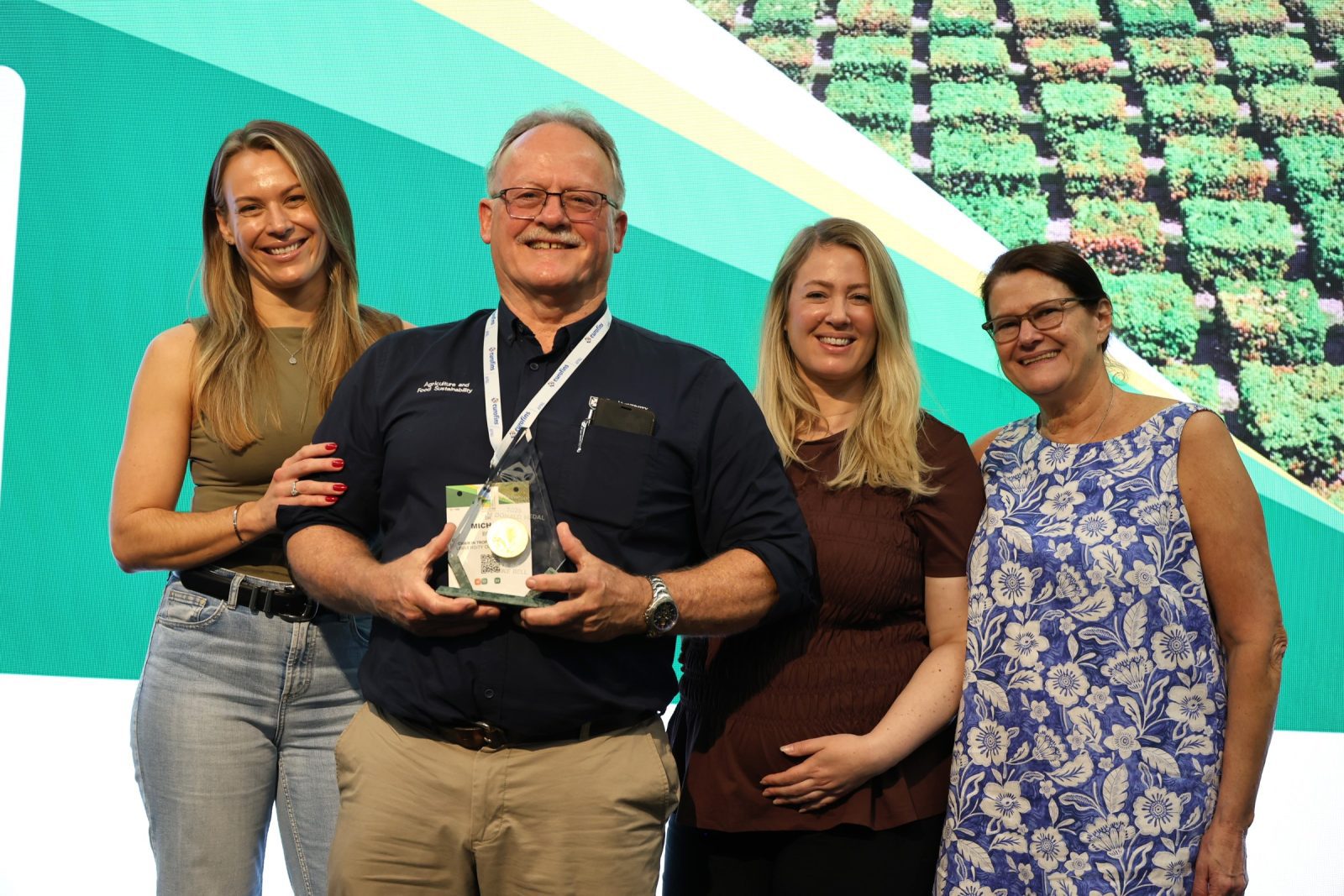
CM Donald Medal winner Professor Mike Bell with wife Barb and their daughters Kristy and Sihanie.
AFTER 48 years in the agronomy game, Mike Bell is still displaying a youthful enthusiasm for his chosen field, and his passion for teamwork and communication, coupled with his considerable contribution to science, were recognised by Agronomy Australia this week when he received the 2026 CM Donald Medal.
As arguably the most prestigious award available to Australian agronomists, it will sit alongside Professor Bell’s two Grains Research and Development Corporation awards, the 2007 Northern Seed of Light and the 2016 Recognising and Rewarding Excellence, as testament to his body of work, still under construction.
“This award recognises not just an outstanding scientist, but someone who has consistently connected research with the needs of farmers and farming systems,” Agronomy Australia president Muhammad Soehil Mazhar said in presenting the CM Donald Medal.
“What stands out is not only the quality and breadth of Mike’s research, but his ability to translate complex science into practical recommendations that make a difference on the ground.
“His contribution to Australian agriculture and to the people who work within it has been exceptional.”
Hot start
In accepting the award, Prof Bell delivered the Donald Oration entitled An accidental agronomist: The changing dynamic of agronomic research 1979-2026.
It gave a rundown on his career to background his thoughts on what lies ahead for the agronomist in a field awash with information of varying degrees of relevance, and in an uncertain funding landscape.
As an Honours graduate of The University of Queensland, the young Mike’s first job was in sorghum and legume agronomy research funded by the Western Australian Department of Agriculture.
It took him to Kununurra, and saw him working from 1979 to 1983 with researchers and growers in the Ord region, and conducting trials on Block 318.
“We called it Desperate Downs because it looked pretty desperate at times,” Prof Bell told the 250-strong audience gathered in Darwin for Agronomy Australia’s first ever conference in the tropics.
In his time in the Ord, the legume of promise for the developing farming region was identified as peanuts, a focus of his work in his next role, as a Queensland agriculture department researcher at Kingaroy from 1983 to 1990.
During this time, his research landscape expanded considerably.
“With the move to Kingaroy, I moved away from just plants into soils.”
That included some of the horrors of a challenged farming system, including soilborne diseases, soil constraints, compaction, poor structure, and run-off issues, as well plummeting organic carbon.
Further study beckoned and, with departmental support, he signed up for a PhD at the University of Guelph which saw him spend 1990 to 1993 in Ontario, Canada, looking into the potential for peanuts as a replacement for tobacco.
More spheres
The then Dr Bell returned to Australia to find the likes of GRDC, the Federal Government, and national resource management organisations “were coming on board” to support further study, as state departments previously had.
Dr Bell’s research moved into salinity, including the “hydraulic circus” to measure salinity and drainage in the soil profile via pits.
These were fitted out with an array of equipment that delivered what he described as “the Titanic moment”, when the water table rose to within 15cm of the surface.
“We had the two wettest seasons we’d ever had.
“That broke us, and we buried it”.
Tropics-based cropping beckoned again with Dr Bell’s involvement in the Sugar Yield Decline Joint Venture, funded by the Qld Government, the Bureau of Sugar Experiment Stations, the Sugar Research and Development Corporation, and CSIRO.
It led to the introduction to sugarcane farming of a legume phase, made possible by crops like soybeans, and regular encounters with parties who wanted sugarcane trash for bioenergy.
However, Dr Bell and his peers believed that trash needed to stay in the field to mulch the soil, and those looking to use it for bioenergy feedstock got short shift.
“They said: ‘how much can we take? We said: ‘Nothing’.”
Cross-sector use relations improved, and he went on to undertake research into recycled organics in grains and sugar, as well as contributing to Australian Centre for International Agricultural Research projects in south-east Asia, and getting involved in “the dark arts of nitrogen management”.
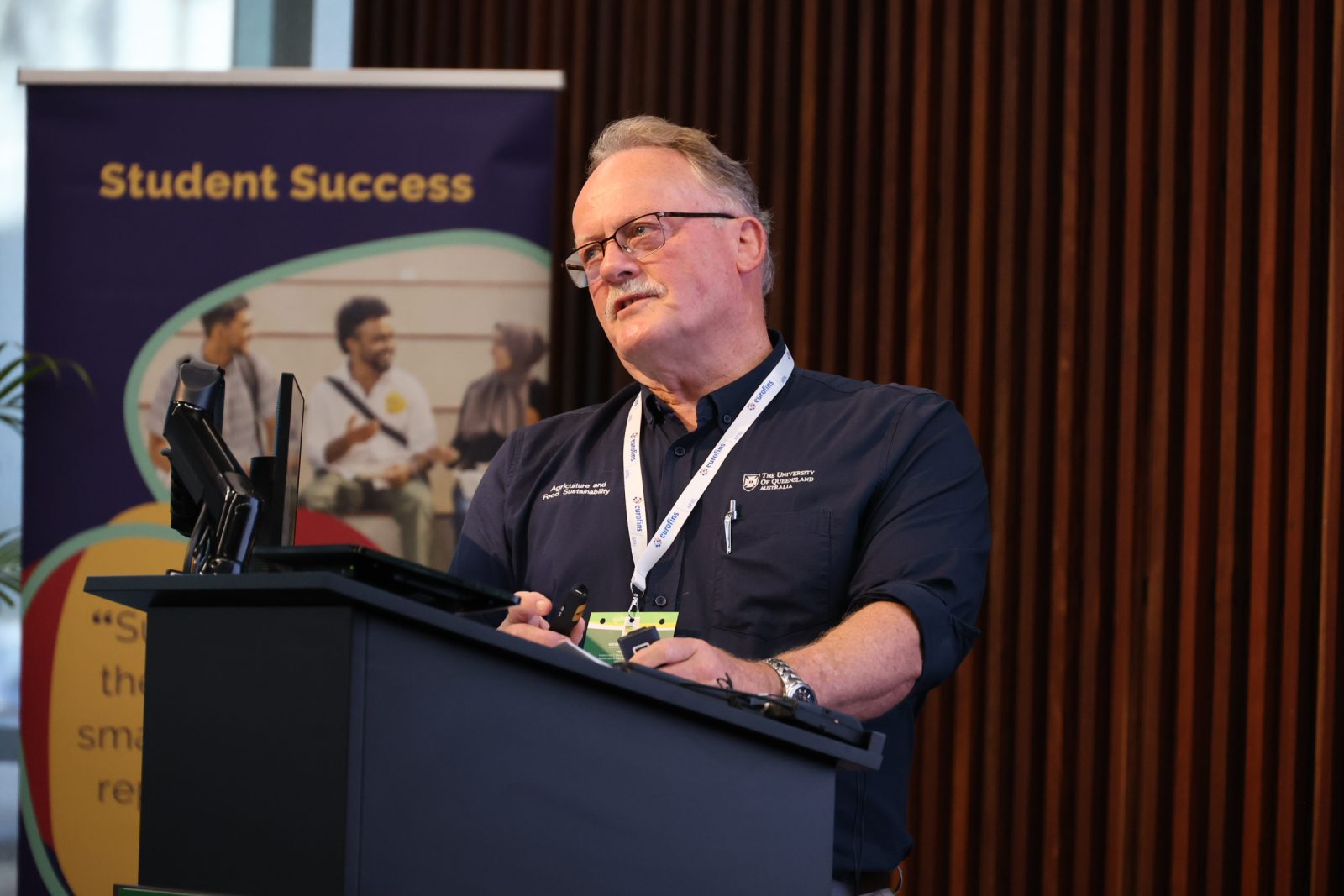
Prof Mike Bell delivering the 2026 Donald Oration.
As Professor Bell, he has for many years been Chair in Tropical Agronomy at The University of Queensland and Qld Government-funded Queensland Alliance for Agriculture and Food Innovation, where he has led research looking into a range of topics, including managing mobile nutrients like phosphorous and potassium, and nitrogen-related emissions.
Since joining QAAFI, Prof Bell has increasingly focused on improving nutrient and water-use efficiency across grains, cotton, and sugarcane systems.
Whatever he has been a part of discovering, he has been happy to share, as evidenced by his 79 presentations at GRDC Updates across northern Australia in the past 20 years alone, and contributions to many a research publication.
The development of agronomy’s human capital and the strengthening of the agricultural research community have also been dear to Prof Bell, and he has supervised eight PhD students and one Masters student, and mentored numerous early and mid-career scientists and agronomists in Australia and internationally.
Concern for the future
In his oration, Prof Bell expressed his concern about what project-based funding means for the future of agronomy, and how it offers little opportunity for “experiential learning”, which he said helped him develop his skills as a research agronomist.
“As you see, I made all sorts of stuff-ups on the way through, but that’s what we learn from.”
Prof Bell said grant continuity is a problem for staff retention because researchers need to think about their next jobs if they cannot count on the kind of job security that has underpinned his career.
“People on a three-year grant…start looking after two years, and you can lose them any time thereafter, so that’s a big problem.
“Short-term contracts aren’t great vehicles for capacity-building because everyone’s worried.
“You’re locked into a short-term contract with milestones [so] that’s all you look at, and then you’re looking for another job opportunity.
“You don’t see the things going on around you as well as you could.”
He also identified shifting of the cost burden for agricultural research from agencies to industry as “a huge challenge”.
Nothing replaces the human
Prof Bell said he can see the agronomist’s role expanding into one where “so much information out there” from both AI and real-life research is filtered for relevance to ensure growers look to results from growing environments comparable to their own.
“That’s the role of the agronomist…to try and put a reality check on things.”
“I heard Tim Neale from DataFarming…the other day saying: AI tends to hallucinate at times [and] if it can’t find any explanations…it makes them up.
“He said that your role is to actually interrogate the AI. Where did you get that information? How did you make that decision? A lot of people just take the interpretation and run it.”
Prof Bell said while robotics are “getting very good” at performing tasks like precision spraying, they are not the same as “eyes on the paddock”, and only humans in real time can observe, interpret and speculate across all the factors that make up farming.
He sees the agronomist’s integration and problem-solving skills as being “more in demand than ever”, and is encouraged by GRDC’s willingness to invest in capacity-building in the sector.
“It’s critical for the survival of our broadacre cropping industries.”
Fulsome praise
Prof Bell said his agronomy career has been made possible by support from the whole of industry, including farmers and research station personnel, as well as funding bodies including CSIRO.
“I’ve loved every minute of it; it’s never been boring.
“There’s always been something new.
“We’ve worked with wonderful colleagues in some of these multi-disciplinary teams and the challenges we’ve been able to address have been great.”
He gave special mention to the contribution of technical officers, and to the agronomists who are in touch with growers.
“Agronomists are our best friends: They’re the ones that say: ‘Have we got a site for you’.
“All the way along, we’ve done a lot with industry and, to me, that’s been hugely rewarding.”
Prof Bell also gave thanks to his wife Barb and their daughters Kristy and Sihanie, who were present in Darwin to see him receive the CM Donald Medal and present the oration.
“Being supported by a wonderful wife and family has been an absolutely critical part of my journey, and it’s something that I’m going to be forever grateful for.”
Grain Central: Get our free news straight to your inbox – Click here
Congratulations Mike on receiving the 2026 CM Donald Medal.
Well-deserved; you have made many great contributions to agronomy and the science of agriculture, during your long march since our Qld Uni days. Hope to catch up again in the not-too-distant future.
Best Regards
Ian Buck
Congratulations Mike and a personal thank you for your generous commitment to bringing along the next generation.
Congratulations Mike – thoroughly deserved and long overdue. Keep up the applied research.
Cheers
Bob Shepherd
DPI (volunteer)
Charters Towers
Huge congrats to Prof Mike Bell on the CM Donald medal award …..well deserved to you and many thanks by us all to Mike in agronomy roles of the Northern region