

Weather:
Weather remains supportive for grain markets, with another round of extreme heat forecast across the US Corn Belt, particularly the already-stressed western regions, raising concerns for late corn and soybean yield potential. Drought across parts of Europe is also adding pressure to corn production, keeping the global feed-grain balance tight.
Markets
The grain market didn’t just rally overnight — it launched. CBOT wheat went limit-up 45c, Kansas jumped 38c, corn hit fresh three-year highs and beans surged nearly 30c. The spark was renewed Black Sea war risk, with reports Russia could escalate attacks on Ukraine while grain exports from the region are already badly disrupted. Corn then added fuel of its own on tighter US supply and lower yield concerns, while Chinese soybean buying and stronger meal helped pull oilseeds higher too.
Day Ahead – Australia
Will be interesting to see how much of the overnight move is passed through locally, given the strong production outlook and more good rain across WA. Offshore demand for Australian grain remains active for Oct/Nov shipment, which should provide some support. History says these rallies have generally been worth selling into — the question is whether this time really is different.
 .
.
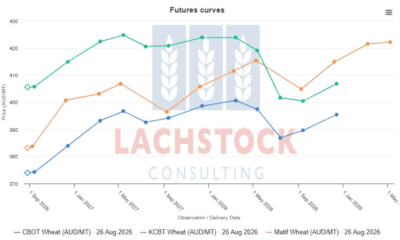
Wheat: Wheat was the standout overnight, with CBOT Dec limit-up 45c to $7.48¼, Kansas +38c and Minneapolis +28c, while Matif Sep and Dec both gained €8.50/t.
The move was driven by a sharp return of Black Sea war premium after reports Russia is preparing to escalate attacks on Ukraine as peace talks stall.
Export logistics are already heavily disrupted, with attacks on ports, vessels and infrastructure slowing both Russian and Ukrainian grain flows. MSC reportedly suspended service into Novorossiysk following Ukrainian drone attacks.
SovEcon cut its estimate for Russian August wheat exports by another 300kmt to 1.9mmt, warning grain will continue to back up domestically unless Black Sea and Azov logistics improve.
The key point is that this is still more of a logistics shortage than a production shortage. If disruption persists, global consumers will need to lean harder on alternative origins, but wheat could also give back some premium if tensions ease.
Other grains and oilseeds: Corn extended its strong run, with Dec +13c to $5.36½, making fresh contract and three-year highs as the market continues to price a tighter US balance sheet.
Pro Farmer’s 173 bu/ac yield estimate remains well below USDA’s 180 bu/ac, while talk of stocks-to-use slipping below 10% is encouraging fund buying and bringing rationing back into the conversation.
Reduced Ukrainian corn availability and drought concerns in Europe are adding another layer of support, while limited grower selling is helping keep nearby supply tight.
Soybeans also pushed higher, with Nov +28¼c to $12.66, helped by a 333kmt sale to China, stronger meal and renewed heat concerns across parts of the US Midwest.
Soymeal was one of the stronger parts of the oilseed complex as the market started to factor in potential disruption to Black Sea sunflower meal exports.
Canola reversed early losses and finished firmer as the Russia-Ukraine escalation outweighed weaker soyoil and palm oil. European rapeseed also closed higher.
Macro: US July PCE inflation rose 0.2% m/m, with core also +0.2%; annual core inflation remains elevated at 3.3%, keeping the market cautious on the Fed outlook.
US Q2 GDP was unchanged at 1.5% annualised, while real personal spending was flat in July, suggesting a relatively soft start to Q3 activity.
US bond yields and the USD edged higher after the inflation data, while gold eased under the pressure of firmer rates and currency.
In Australia, ANZ now expects the RBA to hike 25bp to 4.60% in November following a stronger-than-expected July inflation print and broader price pressures.
Oil remains caught between two competing themes: hopes that an Iran-Oman agreement could improve flows through the Strait of Hormuz, and concern that renewed Russia-Ukraine attacks could further disrupt energy infrastructure and tighten diesel supply.
That leaves macro markets still balancing sticky inflation, higher-for-longer rates and persistent geopolitical risk.
Local: All eyes offshore as the Russia/Ukraine situation deteriorates further, with Putin even raising the threat of nuclear escalation. Markets will be higher today — the bigger question is how much of the futures move gets absorbed by basis locally?
Good rain through WA overnight and continuing today — looks like wet-weather footy at the Dowerin Field Days!
China is starting to sniff around Australian barley again. Interest remains slow, but after a quiet period some interest is certainly better than none.
HAVE YOUR SAY