
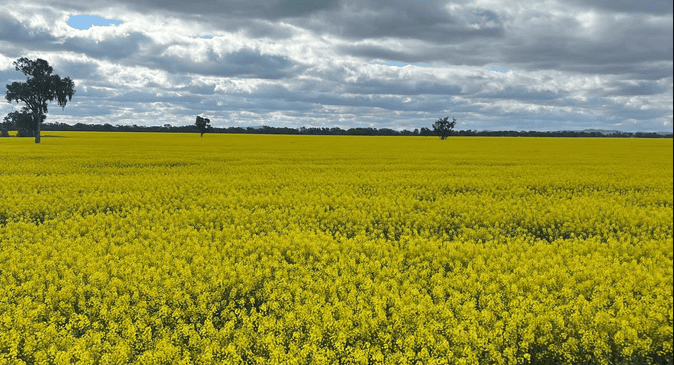
Canola in flower in south-western NSW. Photo: Barry Haskins
AUSTRALIA’S national commodity forecaster has lifted its forecasts for wheat, barley, and canola following a mild and wet winter across southern Australia.
ABARES forecast for the 2026-27 wheat crop now stands at 29.9 million tonnes (Mt), up from 26.7Mt seen in initial estimates released June, while barley is up to 16.4Mt from 14.1Mt, and canola has risen to 7.27Mt from 6.19Mt.
ABARES acting executive director David Galeano said there had been improvements to this year’s outlook over winter.
“Production in 2026-27 is expected to be supported by a wetter-than-expected winter in south-east Australia, and a smaller than anticipated impact on area planted and yields from high fertiliser prices,” Mr Galeano said.
“While the rainfall outlook for spring 2026 indicates large areas of eastern and southern Australia are expected to be drier than average, the advanced state of winter crops in the southeast and current stored soil moisture mean that crops will be less reliant on spring rainfall this year.”
After an excellent start to the season in Western Australia, South Australia, Victoria and southern New South Wales, most crops were sown within the ideal planting window into above average soil moisture.
Above average May-July rainfall in SA and Vic, along with mild temperatures has resulted in early emergence and establishment of crops.
This has resulted in the maturity of most crops being 3-4 weeks early, with well above average yield potential.
Conditions have been largely favourable in WA and southern and central NSW.
However, below-average July rainfall in WA has placed crops under some moisture stress, with most regions receiving just enough rainfall to maintain growth.
Limited stored subsoil moisture means that further rainfall during August and September will be crucial for current yield potential to be realised.
By contrast, conditions in northern NSW and most of Queensland are poor, with a significant decline in the area planted and below-average yield expectations.
Despite receiving above-average rainfall in May, it was not enough to offset the moisture deficit in many cropping regions, which have received limited follow up rainfall.
Despite significant uncertainty around the price and availability of fuel and fertiliser at the start of the season, it has not resulted in any significant impacts on production potential, with growers able to access inputs, albeit often at a higher price.
Growers in some regions have prioritised fertiliser application on canola at the expense of cereals but this is not expected to have a significant impact on total production volume, with seasonal conditions driving expected production outcomes.
| WHEAT | Jun 2 ha | Jun 2 tns | Sep 1 ha | Sep 1 tns |
| Qld | 710000 | 1320000 | 650000 | 1210000 |
| NSW | 2800000 | 7000000 | 3000000 | 7700000 |
| Vic | 1405000 | 4215000 | 1440000 | 4896000 |
| Tas | 11000 | 73000 | 11000 | 75000 |
| SA | 2000000 | 4664000 | 2050000 | 6000000 |
| WA | 4000000 | 9470000 | 3900000 | 10000000 |
| TOTAL | 10926000 | 26742000 | 11051000 | 2981000 |
Table 1: Initial and revised area and tonnage estimates for Australia’s 2026-27 wheat crop. Source: ABARES
| BARLEY | Jun 2 ha | Jun 2 tns | Sep 1 ha | Sep 1 tns |
| Qld | 150000 | 350000 | 155000 | 355000 |
| NSW | 900000 | 2300000 | 1050000 | 2900000 |
| Vic | 915000 | 2837000 | 950000 | 3401000 |
| Tas | 10000 | 57000 | 11000 | 60000 |
| SA | 880000 | 2178000 | 880000 | 2900000 |
| WA | 2100000 | 6400000 | 2100000 | 6800000 |
| TOTAL | 4955000 | 14122000 | 5146000 | 16416000 |
Table 2: Initial and revised area and tonnage estimates for Australia’s 2026-27 barley crop. Source: ABARES
| CANOLA | Jun 2 ha | Jun 2 tns | Sep 1 ha | Sep 1 tns |
| Qld | 5500 | 8500 | 5500 | 7500 |
| NSW | 650000 | 1050000 | 710000 | 1200000 |
| Vic | 550000 | 1183000 | 580000 | 1421000 |
| Tas | 5000 | 15000 | 5000 | 15000 |
| SA | 260000 | 533000 | 280000 | 630000 |
| WA | 2025000 | 3400000 | 2200000 | 4000000 |
| TOTAL | 3495500 | 6189500 | 3780500 | 7273500 |
Table 3: Initial and revised area and tonnage estimates for Australia’s 2026-27 canola crop.
Grain Central: Get our free news straight to your inbox – Click here
HAVE YOUR SAY