

Weather:
US weather remains the main agricultural concern. Corn and soybeans are heading into the finish with above-average September temperatures and below-average rainfall forecast across much of the Corn Belt. Soybean conditions slipped to 58 percent, while corn held at 57pc. Canada is broadly favourable for harvest, although rain through Saskatchewan and western Manitoba may cause some short-term delays.
Markets
It was more consolidation than reversal. Wheat gave back part of last week’s extraordinary geopolitical rally as Turkey floated another Black Sea deal, but futures recovered substantially from their lows. Corn continued to quietly grind higher despite enormous speculative length, while beans held together on weather and Chinese demand. Canola was the laggard as harvest pressure starts to bite.
The important point is that the drivers behind last week’s move haven’t disappeared. Black Sea exports remain compromised, US corn/bean finishing weather is deteriorating, and the Middle East has heated up again. That leaves markets vulnerable to some violent headline-driven swings.
Day Ahead – Australia
Wheat is likely to open slightly softer after the offshore pullback as local traders look for any excuse, although the resilience in US futures and continued Black Sea uncertainty should limit the downside. Barley should remain broadly sideways, with strong global corn supportive but local supply still capping values. Canola has a softer bias after another weaker Canadian session despite the rally in crude.
The AUD is largely neutral, so offshore moves should flow through relatively cleanly. Black Sea headlines remain the key wildcard, with any peace or corridor talk capable of knocking wheat around quickly, although actual export flows matter more than political noise. After August’s huge rally, expect volatility.
 .
.
Wheat: Wheat finally took a breather after last week’s explosive move, with Chicago Dec -10c, Kansas -6.25c and Minneapolis -6.25c, while Matif Dec fell €5.75/t.
The market still finished well off its lows, suggesting there remains plenty of underlying nervousness after Chicago gained 116.5c through August, including 84.25c last week alone.
Turkey is again pushing to broker some form of Black Sea grain agreement between Russia and Ukraine. The market reacted, but there is plenty of scepticism — the previous grain corridor took months of negotiation and this is unlikely to be an overnight fix.
Russia/Ukraine remain the dominant wheat driver. Headlines can knock futures around, but without a material improvement in Black Sea shipping the underlying export disruption remains.
US wheat export inspections were reasonable at 431kt, although cumulative shipments remain 28pc behind last year.
US spring wheat harvest is now 77pc complete versus 68pc five-year average, adding some seasonal supply pressure.
Other grains and oilseeds: Corn remains the strongest fundamental story. December futures managed another +1.25c despite weaker wheat and some month-end profit-taking, making fresh contract highs.
Funds are enormously long corn — the latest CFTC number showed roughly 377,000 contracts net long, with estimates suggesting current positioning could be closer to the historical record near 450,000.
US corn conditions were unchanged at 57pc good/excellent, but finishing weather remains a concern with hotter, drier conditions forecast across large parts of the Corn Belt through September.
Corn exports remain very strong: weekly inspections were around 1.50 million tonnes (Mt), leaving cumulative shipments roughly 25pc above last year.
India is also tightening on corn, with USDA’s attaché forecasting production at 50Mt, down from 55.09Mt, and stocks falling sharply to 4.12Mt.
Soybeans finished roughly unchanged after recovering early losses, helped by stronger crude and ongoing concerns around US finishing weather.
US soybean crop conditions dropped 2 points to 58pc, while hotter/drier weather and disease concerns continue to create uncertainty around final yields.
China remains an active buyer and US demand continues to underpin the market. Market commentary suggests Chinese buying has accelerated considerably ahead of the September Trump-Xi meeting.
Canola was weaker again, with profit-taking and the approaching Canadian harvest outweighing support from sharply higher crude and the recovery in Chicago soyoil.
Canadian harvest conditions look broadly favourable with temperatures in the low-mid 20s, although Saskatchewan and western Manitoba picked up rain. November canola did at least remain above its major moving averages.
Macro: The Middle East is back in focus, with the US and Iran exchanging direct strikes for the first time in around a month.
Oil responded immediately: WTI +2.9pc to around US$85.80/bbl and Brent above US$90/bbl, while equities weakened and bond yields rose.
Iran retaliated against US strikes with missile/drone attacks toward US forces in Jordan, while the UAE also intercepted an Iranian drone.
Iran is publicly trying to frame the latest flare-up as a limited confrontation and says it still wants negotiations, but equally says conditions for vessels around Hormuz could worsen.
The US is simultaneously increasing economic pressure on Iran, with Treasury Secretary Bessent signalling further sanctions and pressure on Iran’s trading partners.
The AUD was largely rangebound overnight, so there is unlikely to be much currency assistance or resistance for Australian grain pricing this morning.
Local: Canola started the week stronger in the west, with bids up A$10/t to $877 and GM at evens! Wheat was $396 and barley $336 FIS Albany.
In the east, canola improved to $818, while GM was bid $788. Wheat was unchanged at $369 and barley $296.
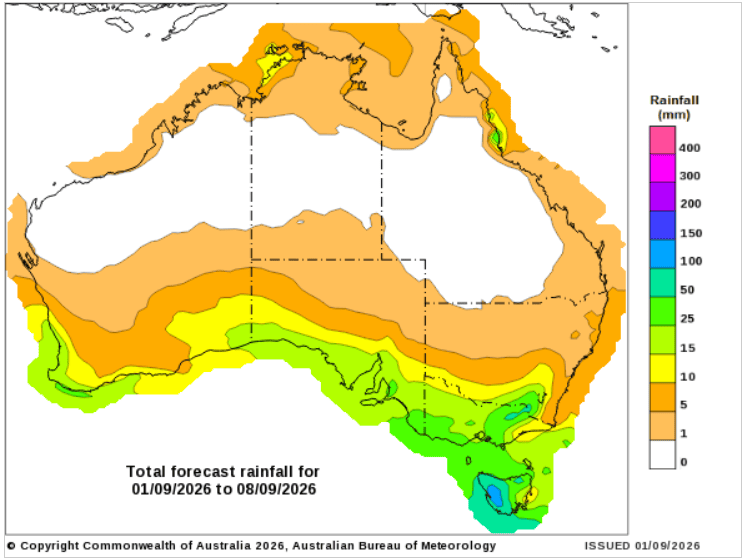
Basis in the east is well and truly starting to weaken, with Friday’s offshore rally largely failing to flow through into local bids. Canola starting to be weighed on by Canadian harvest pressure. With more rain on the forecast unlikely to improve.
Lentil bids remain around $615 delivered southern ports, with little reprieve in sight.
HAVE YOUR SAY