
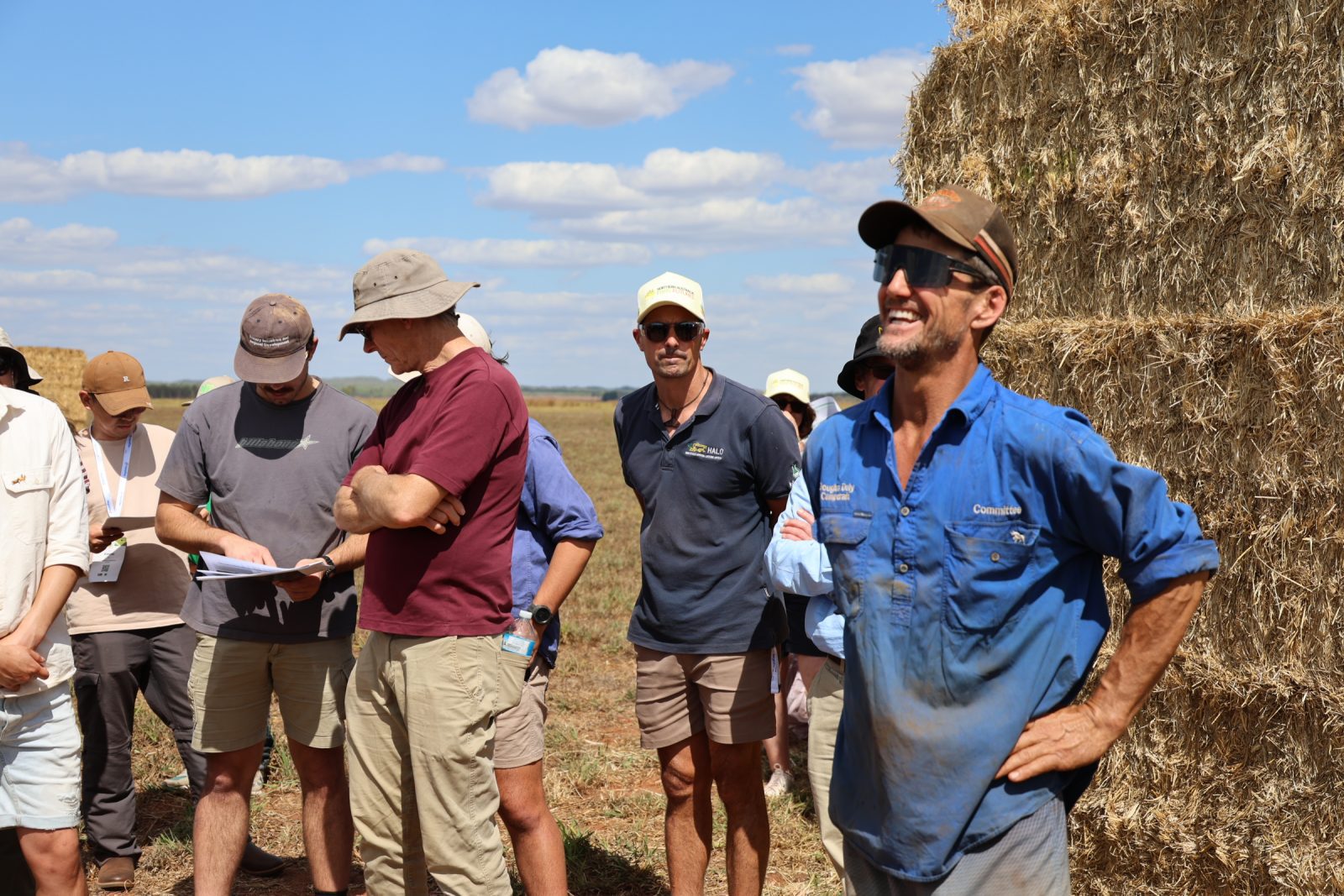
Chris Howie outlines his family’s mixed farming operation in the NT’s Douglas Daly region.
NORTHERN TERRITORY grit and a willingness to investigate and adapt are working together to create options for growers in the Douglas Daly region.
With its soil constraints, wildly variable rainfall, and costly paths to market, it is no easy task, and it made a fascinating subject for two busloads of delegates last week on field trip following the two-day Agronomy Australia conference in Darwin.
The booked-out event visited the NT Government’s Douglas Daly Research Farm, and the Howie family’s Bindaroo Pastures, which has found pasture seed and hay, all aimed at local cattle, to work best with its own Maneroo Station cattle operation.
Cotton remains a crop of promise for the region, and while the Howies are no longer growing it, others in the region are, and it remains one of many crops under investigation at DDRF.
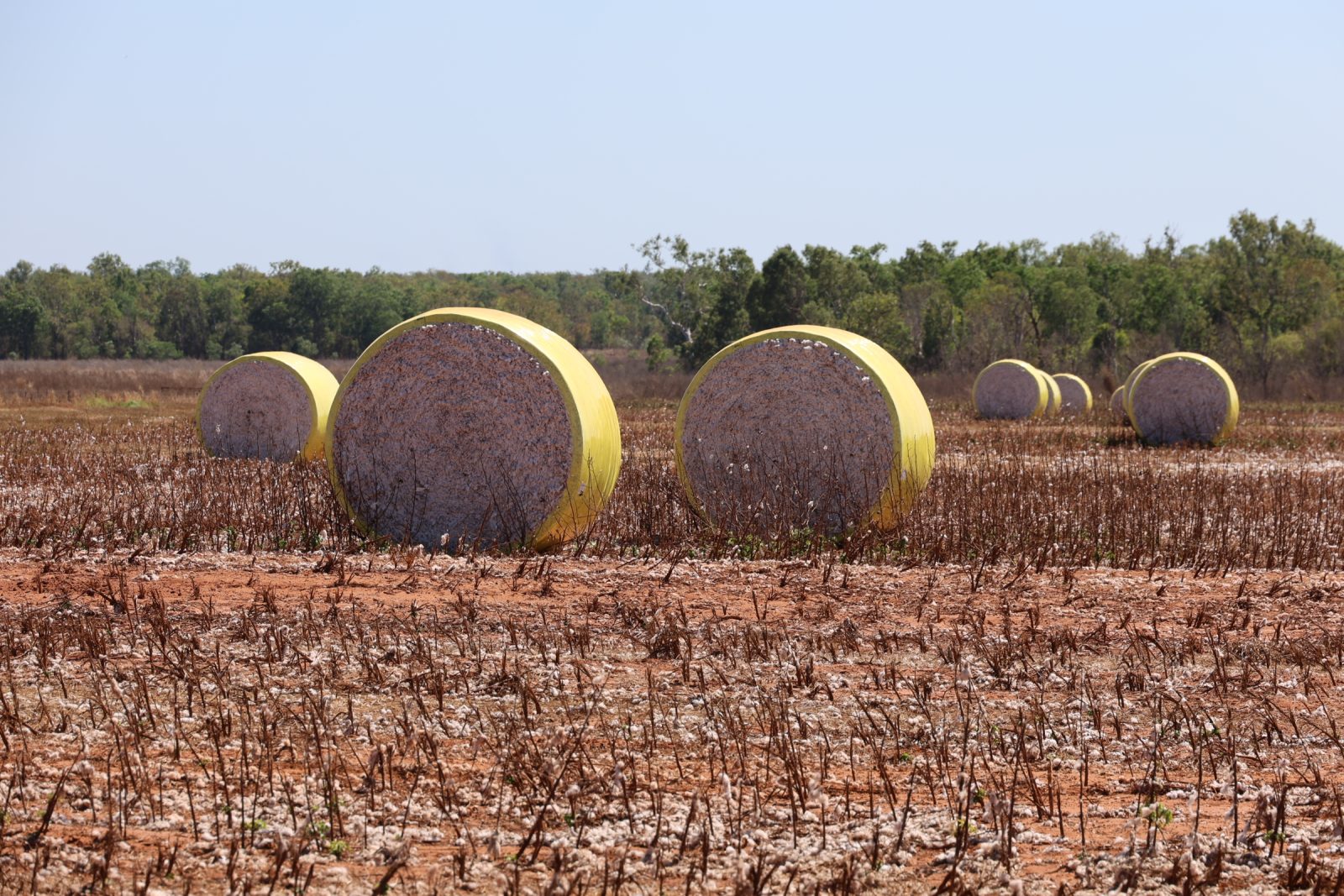
Cotton on the Douglas Daly Research Farm was planted in January and picked in July after the wettest of wet seasons. The modules will soon be carted to the Northern Cotton gin at Katherine for processing.
Hay, seed, cattle work for Howies
Chris Howie’s parents, from a mixed farm in Western Australia’s Albany region, arrived at Maneroo in the 1990s, and Chris and his wife Amanda, from a cattle property near Katherine, have continued to adapt.
“This was a cattle export depot; my father took on that job and I moved up too,” Mr Howie said.
“When I look back on the farming we used to do, it was pretty rough; we’ve been learning all the way.”
Early days involved Brahman cattle, hay, and machinery “brought up from down south”; since then, the Howies have grown cow peas, butterfly peas, NT legume Cavalcade, the hybrid NT Supreme grass, and Rhodes grass.
They’ve also given sorghum, mungbeans, and soybeans a crack.
“Soybeans grow very well [and] mungbeans are okay.
“The big problem is the market – it’s over east; it’s more a case of growing the crop you can use in the Territory.”
“They grow well, but the challenges are pigs and wallabies, and [variable] rainfall, and magpie geese.”
The Howies started growing cotton four years ago.
“There was a big push for cotton into the Territory as a dryland crop.
“It is a very intensive crop; there was a lot of help that came from east, and the department.”
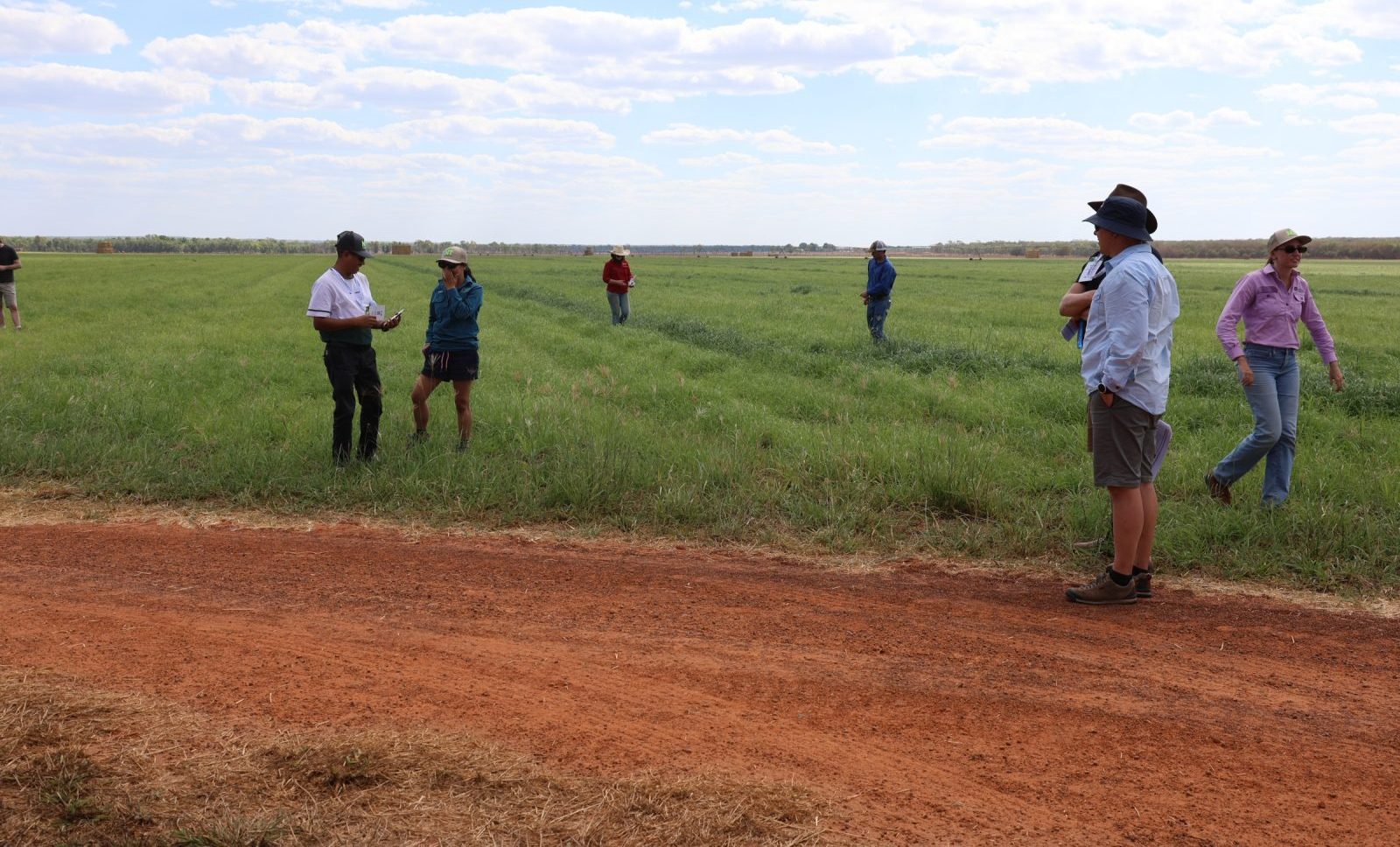
Agronomy Australia Conference delegates on the Douglas Daly field trip inspect the Howies’ Rhodes grass ahead of its next cut.
With dryland yields of 2-5 bales/ha, and 6 under irrigation, Mr Howie said “the sums didn’t add up” for cotton in their system at this stage.
“Our seed business was expanding, and we decided to grow with that.”
It includes cow peas, which are grown for seed and for supplementary fodder as needed.
Rhodes grass hay is a cornerstone of the operation, and the latest cut is being sold to an Adelaide River operation for mixing with lupins at $900 per tonne landed to finish cattle for live export.
On site, the Howies finish their own cattle.
“We’ve got a property south of Katherine with 1500 breeders, and 800-1200 weaners come here.”
With irrigation, they get several cuts of Rhodes grass hay over the dry season, and its protein rises from around 2-3 percent when grazed just after the wet to around 8-12pc towards the end of the dry.
Urea and fertiliser blends are used, and the result is around 3t/ha per cut.
The forage legume leucaena is also a valuable part of their grazing operation, with Amanda running the cattle component, and Chris the crops.
“Leucaena fattens cattle like nothing else.”
Silage may also work its way into the equation.
“Silage is a good option in The Territory I believe [but] we’d have to have a feedlot.”
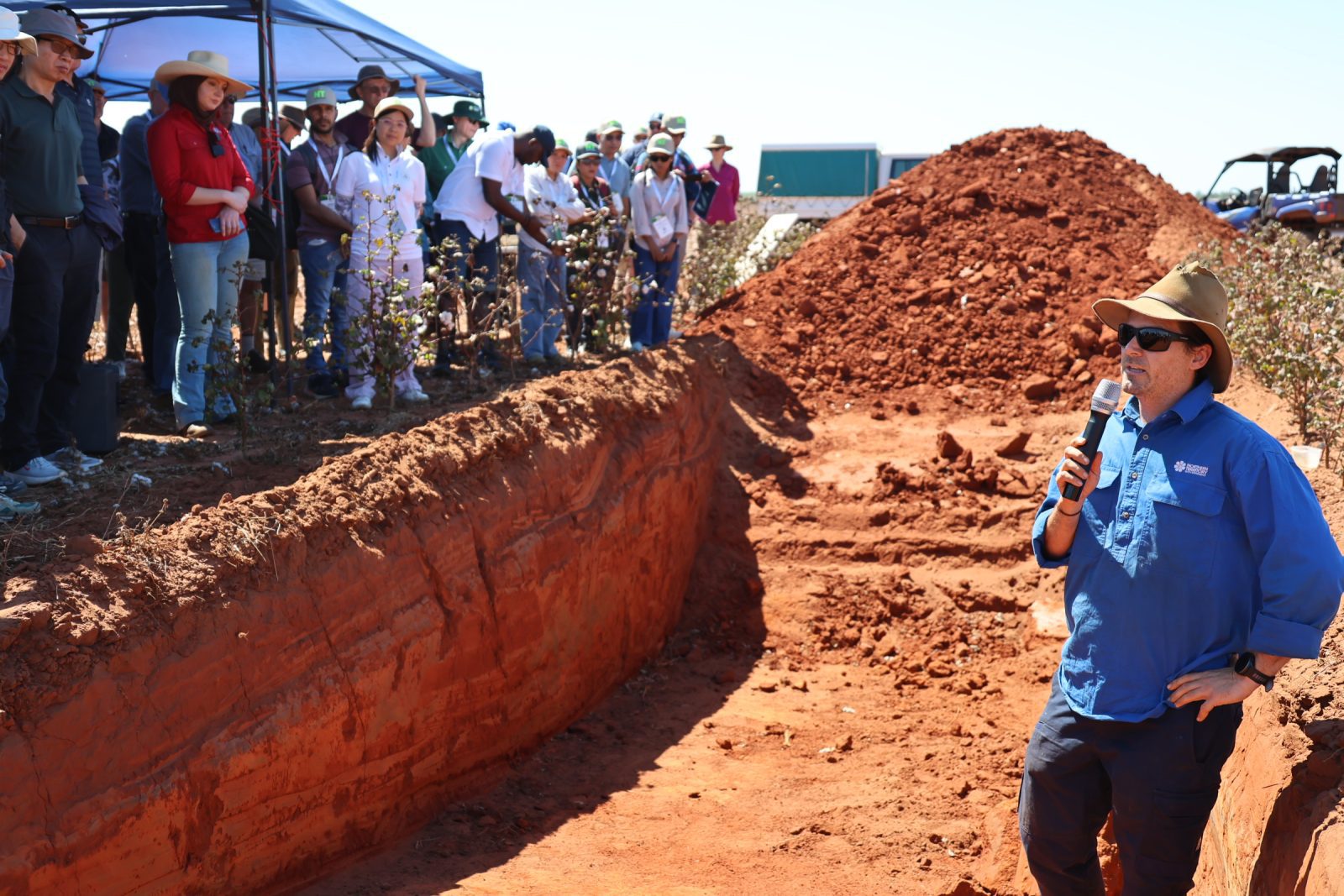
NT Government soil scientist Luke Finn.
Challenging soils
Douglas Daly soils have little to give to crops, and Mr Howie put it in a nutshell: “It’s pretty simple: I’m low in everything.”
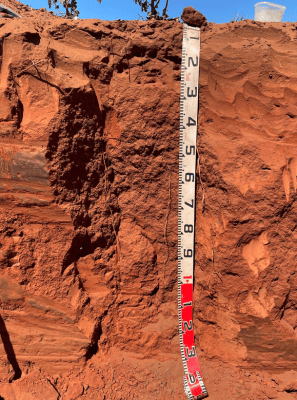
The soil pit at the Douglas Daly Research Farm shows some cotton roots getting below 1m. Photo: Luke Finn
More detail was given on challenges posed by the region’s soils at the Douglas Daly Research Farm, where NT Government soil scientist Luke Finn said soils ran the risk of acidifying after 30 years or of cultivation involving applied fertiliser.
However, locally available lime has potential to at least halt the drop in soil pH.
“Liming is not a practice that’s been used across the region but trials are in place,” Mr Finn said.
Cotton, which needs to yield around 3b/ha to break even, has a well-known appetite for applied nitrogen, and that is being watched for its impact on soil pH, and may be susceptible to high levels of aluminium in the region’s soils.
“We are really experimenting with cotton up here.”
Inspection of the soil pit at DDRF sparked plenty of discussion, and showed cotton roots which in the huge wet season which delivered more than 2300mm over a prolonged period got deeper than 1m in some cases.
Precision Ag’s northern regional manager Campbell Underwood also spoke from within the soil pit and said low cation exchange capacity as well as acidity was “having a massive impact on yield”.
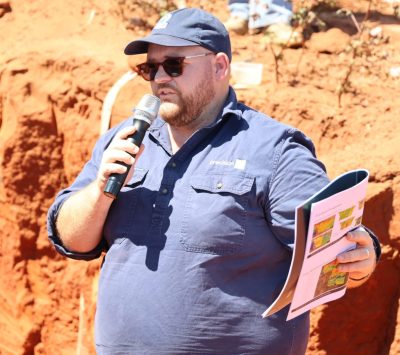
Precision Ag northern regional manager Campbell Underwood.
He said stunted roots, J roots at 5-10cm, and balding of root tips are evidence of tough conditions below the surface, and soils have “minimal buffering capacity”.
While some Douglas Daly soils have a pH of around 5.5, others are closer to 4, and cotton with its benchmark requirement of 25-30kg of nitrogen per bale must be paying the price.
“You lose 5pc of yield for every 0.1 unit below 5.5”.
“Going back a couple of years, I had a client growing cotton up here and after a couple of years [we saw] a massive decline in yields.”
New options sought
The NT Government has set a target of 100,000ha of new cropping country by 2030, but a rotation with which to farm it still remains very much under development.
As NT Government cropping group leader Edward Mwando explained, cover crops are a priority, as the widely held view is that less than 40pc groundcover at the start of the wet season exposes country to erosion damage.
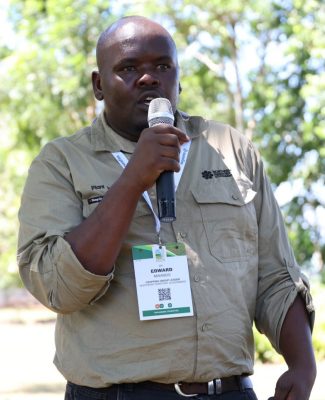
NT DAF’s cropping group leader Dr Edward Mwando addresses around 100 delegates on the Agronomy Australia field trip to Douglas Daly last week.
Dr Mwando said the NT Government’s Department of Agriculture and Fisheries was looking at cover crops including cow peas, teff, Sunn hemp, and millet, and sorghum, millet, soybeans, and maize to grow in rotation.
“Sorghum is turning out to be one of the best grain crops,” Dr Mwando said.
Spices, fennel, and non-shattering black and white sesame suited to machine harvesting are also under investigation in a system being developed to make the most of the wet season, and maximise nutrients.
“We need to move on now to understand what’s best to maintain pH after rain.”
Dr Mwando said that could be a split application of nitrogen, and double and single-skip cotton instead of solid plant.
“When water is good, solid is still performing the best.
“I cannot say that we have one clear answer; every season looks different, no two seasons are the same.”
NT DAF’s funding partners in cropping projects include: Charles Darwin University; Cooperative Research Centre for Northern Australia; AgriFutures; Cotton Research and Devleopment Corporation, and the Grains Research and Development Corporation.
Grain Central: Get our free news straight to your inbox – Click here
HAVE YOUR SAY