

Weather:
US weather remains supportive, with hot and dry conditions across the Corn Belt and Plains trimming corn and soybean yield expectations. Some rain is showing up in the 11–15 day outlook, while Canada remains focused on getting the Prairie canola crop harvested through recent wet and cool conditions.
Markets
Ag markets softened into the long weekend, with wheat leading the move lower as traders cut risk ahead of US Labor Day and positioned for Russia–Ukraine peace talks. Chicago Dec wheat fell around 20c/bu, Kansas lost roughly 13c and Minneapolis around 20c, while corn and soybeans also eased. Despite the pullback, Black Sea disruption remains the key driver and there was no clear resolution heading into the weekend.
Canola also finished lower, pressured by weakness in the Chicago soy complex and bean oil, although firmer European rapeseed and palm oil helped limit the downside. US corn and soybean markets continue to carry support from hot, dry weather and declining yield expectations, while Canada’s canola harvest remains slow through the Prairies.
Day Ahead – Australia
I expect wheat markets to open softer following Friday’s offshore move, although ongoing Black Sea uncertainty keeps things interesting. Canola is likely to be steady to slightly softer, with weaker ICE and soybean markets offset by support from strong crude oil and ongoing Canadian harvest uncertainty.
Interesting feedback from SA and Vic lentil growers that some of the biggest crops on record may not necessarily translate into record yields, with dense canopies restricting light penetration and potentially limiting pod set lower in the crop.
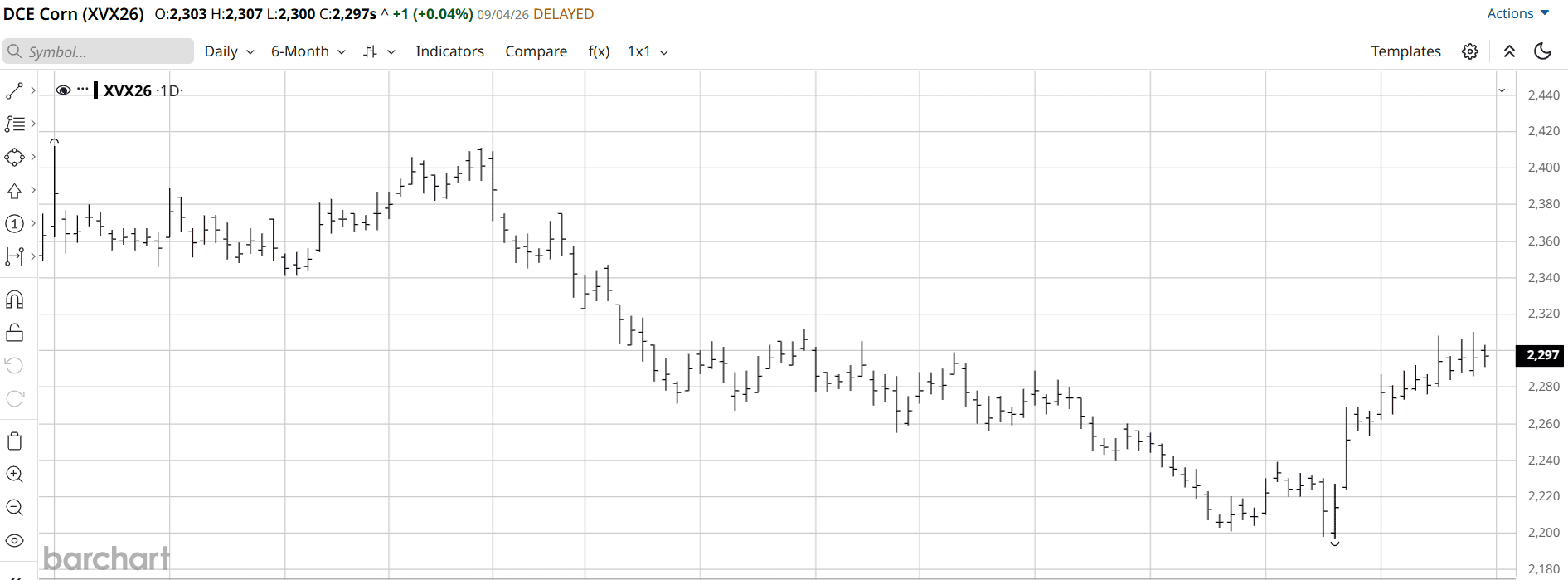
China corn prices rebound from August lows.
Source: Dalian Commodity Exchange (DCE) Nov-26 Corn Futures, via Barchart, 4 Sep 2026.
.
Wheat: Friday was a sizeable risk-off session. Chicago Dec fell around 20c/bu, Kansas 13c and Minneapolis 20c, with traders taking money off the table ahead of the long US weekend after an enormous week of volatility.
Peace hopes were the trigger, but the weekend hasn’t delivered peace. Witkoff and Kushner held lengthy meetings with Putin and then Zelensky. Both sides called the discussions constructive and further US-mediated talks are expected, but there was no ceasefire or material breakthrough and territorial issues remain unresolved.
That is important because Friday’s fall was largely pricing the possibility of diplomatic progress. With nothing concrete delivered, there is little reason yet to assume Black Sea grain flows suddenly normalise.
The physical wheat problem remains. Russian cash is still around US$214/t, but Russia is struggling to get enough wheat out, Ukraine’s deep-water capacity remains compromised and there is talk some EU ports could further restrict Russian grain movements. Asian consumers have already replaced at least 500kmt of Black Sea wheat with Australian and Argentine supply.
Funds are now part of the volatility story. Managed money flipped Chicago wheat back to a 14.7k contract net long, while Kansas length increased to 50.3k. That means the market is no longer carrying the comfortable speculative short that previously cushioned sell-offs.
Demand remains the weak point for US wheat itself. US 26/27 commitments of 8.66mmt are 31% behind last year, so America remains an expensive residual supplier. The bullish story therefore still rests primarily on Black Sea disruption forcing buyers elsewhere, rather than outright US export competitiveness.
Other grains and oilseeds: Canola finished softer Friday, dragged down by Chicago soybeans and bean oil, despite firmer European rapeseed and generally supportive palm oil.
The Canadian harvest remains a watch point. Saskatchewan is only 4% through canola harvest, with early yields around 38bu/ac. That is far too early to call the crop, particularly given the recent wet/cool harvest delays.
Canadian exports dropped to 58.3kmt for the week, but cumulative shipments are still ahead of last year. More importantly, domestic disappearance remains strong, with weekly use rising to 294.6kmt and YTD use around 1.07mmt versus 893kmt last year.
Soybean finishing weather is becoming more supportive. Hot and dry conditions across the US are pulling yield expectations lower, while the USDA continues reporting export sales — another 250.6kmt to unknown destinations was announced Friday after more than 500kmt of confirmed Chinese business during the week.
Corn also eased Friday, but the fundamental setup remains relatively firm: expectations for a smaller US crop, strong demand and the potential absence of normal Ukrainian October exports are keeping buyers interested.
The big outside-market support for oilseeds remains energy. Brent finished around US$96.28/bbl after rising more than 9% for the week. Shipping through Hormuz remains heavily disrupted, with reported vessel traffic sharply below normal, while the tanker conflict between Iran and the US has escalated.
Macro: The big macro surprise was US payrolls at +162k, miles above expectations around 65k, with another 55k jobs added through revisions to prior months.
That pushed expectations for a September Fed hike back above 60%, lifted Treasury yields and knocked US equities lower. The S&P 500 fell 0.4%, Dow 0.5% and Nasdaq 0.3%.
The AUD was around US72.05c. Higher US rate expectations are a headwind for the currency and, if the AUD comes under pressure, that would cushion some of Friday’s offshore wheat and canola losses in Australian dollar terms.
Inflation is again the headache. Strong employment is arriving alongside an energy shock, with Brent close to US$100/bbl and diesel prices surging. That gives the Fed considerably less room to look through above-target inflation.
The Middle East remains the larger macro wildcard. Iran and the US have moved into another retaliatory phase around oil tankers and naval assets, and Iran is now threatening a stronger response to further US attacks.
US grain markets are closed tonight for Labor Day. That leaves Australian physical markets trading today without a fresh Chicago lead. The next important US grain data comes Tuesday, while StatCan stocks are due September 8 and Canadian production September 16.
Local: Cereals were softer to end the week through the west of the country with wheat bid $385 and barley $330, canola was slightly firmer to $880 FIS Albany.
Through the east canola was a little firmer to $818, wheat was softer $365 and barley $298 track Geelong.
2-3 weeks left for most in the frost window, expect as we get towards to the back end of this that we will see growers ramp up selling and basis come under more pressure.
Dry week ahead which will be welcomed by most in SA and Vic with some warmer weather starting to come through, hay mowers will be getting greased, with lots of hay already on the ground in NNSW and SQLD.
HAVE YOUR SAY