
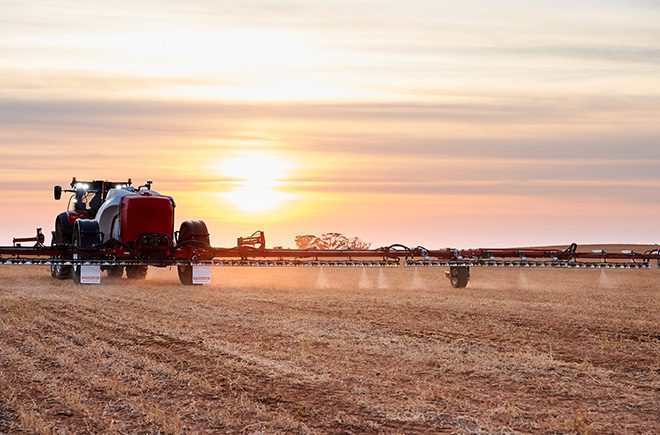
Maximum application rates of paraquat have been lowered under new APVMA regulations which enable it to still be used to spot spray weeds in fallow. Photo: Croplands
GRAIN Producers Australia has questioned the Senate’s decision to launch an inquiry into the continued use and regulation of paraquat less than three months after the Australian Pesticides and Veterinary Medicines Authority completed its extensive scientific review of the chemical.
This comes as Parkinson’s Australia has welcomed the inquiry, having long called for a complete ban on the chemical.
Following a vote in the Parliament’s Upper House on Tuesday, Senator David Pocock successfully launched an inquiry into the APVMA’s decision to allow continued use of paraquat in Australia, albeit under stricter provisions.
GPA research, development and extension spokesperson and Victorian grower Andrew Weidemann said the grains industry did not agree with every restriction imposed through the final decision, but respected the APVMA’s authority as Australia’s independent, science-based ag and vet chemical regulator.
The APVMA’s final decision retained paraquat for use in Australia while introducing significant new restrictions on application rates, permitted uses, and handling systems, and increased requirements for personal protective equipment.
“The APVMA imposed substantial new restrictions that will create practical challenges for grain producers, but it reached that decision through the regulatory process established to assess agricultural chemicals against the available scientific evidence,” Mr Weidemann said.
“We cannot support the integrity and independence of that system only when it delivers the outcome we want, because governments, parliamentarians, industry groups and other stakeholders must respect the regulator’s role, even when they disagree with a particular decision.”
The APVMA began its reconsideration of paraquat in 1997 and published a proposed regulatory decision in July 2024, followed by a three-month public consultation that attracted 171 submissions.
The regulator then considered the issues and scientific information raised through that process before making its final decision in June 2026.
The APVMA has published the material supporting its decision, including its final technical report, statement of reasons, and response to submissions, as well as a separate consideration of submissions dealing with paraquat and neurotoxicity.
Mr Weidemann said parliamentary scrutiny formed an important part of Australia’s democracy, and the inquiry must explain what evidence or regulatory failing justified revisiting a recently completed scientific assessment.
“The key information considered by the APVMA, together with its reasons for reaching the final decision, is publicly available and open to scrutiny, so it is reasonable to ask what this inquiry expects to uncover that the established regulatory process has not already examined.
“If new and credible scientific evidence emerges, that information should go to the APVMA so the regulator can assess it through the statutory process designed for that purpose.
“Re-examining a completed regulatory decision simply because some parties do not accept the outcome risks undermining confidence in the APVMA’s independence and creating a precedent in which science-based decisions become subject to political pressure.
“That would have consequences well beyond paraquat, because Australian agriculture depends on a regulatory system that assesses agricultural chemicals consistently, transparently and according to the best available evidence.”
The APVMA considered potential risks to human health, worker safety and the environment during its review and found that the weight of evidence did not show that exposure to paraquat through approved uses increased the risk of developing Parkinson’s disease.
Mr Weidemann said grain producers understood that paraquat was a hazardous chemical requiring careful handling and strict compliance with label directions, but it remained an important tool for controlling weeds, managing herbicide resistance and supporting farming systems that retained ground cover and reduced soil erosion.
“Growers do not want to use more chemicals than they need, and advances in application technology increasingly allow them to target weeds more precisely while supporting responsible chemical use and stewardship.
“The inquiry must clearly identify the problem it intends to resolve, the evidence the APVMA has not already considered and the outcome it expects to achieve without cutting across the regulator’s role.
“Australia established the APVMA to make these complex decisions using scientific evidence, and the integrity of our agricultural chemical regulatory system depends on allowing it to perform that role independently.”
GrainGrowers critical of ‘politicisation’
GrainGrowers chair and Western Australian grower Rhys Turton said any further analysis of the APVMA’s determination on paraquat must recognise the need for a robust regulatory framework which empowers independent regulators to make determinations based on scientific evidence before them.
“The politicisation of the APVMA’s paraquat determination through a Senate Inquiry undermines the regulator’s independence and ability to make decisions based on scientific evidence,” Mr Turton said.
“The ruling included revised assessments which will restrict some major application rates of paraquat and diquat, but, importantly, science-based evidence prevailed in important areas of the decision.
“The grains industry accepted the determination of the independent regulator and has been focused on ensuring growers have the information they need to comply.
“Australian growers need ongoing access to these tools of the trade to continue to produce grains and oilseeds which support Australia’s and the world’s food security.”
Paraquat an important tool: GPSA
On 1.2 million tonnes, South Australia is forecast to produce the bulk of Australia’s lentil crop this year, and diquat, part of the paraquat family, is an option other than glyphosate for growers to desiccate crops prior to harvest, and in other parts of the cropping cycle.
Grain Producers SA chief executive officer Brad Perry said the inquiry announced this week must not be used as a vehicle to attempt to undermine the APVMA because its scientific findings are politically inconvenient for some.
“This would create enormous uncertainty for Australian agriculture and weaken confidence in the entire regulatory system,” Mr Perry said.
“Science must remain at the centre of the APVMA.
“The independent regulator considers all credible evidence, understanding the difference between association and causation, and assess the risks associated with any chemical it reviews and approves.”
“South Australian grain producers take chemical safety extremely seriously.
“They use paraquat because it remains an important tool for controlling weeds, protecting conservation farming systems and reducing soil disturbance, not because they are indifferent to health or environmental risks.”
Welcomed by Parkinson’s Australia
Parkinson’s Australia has welcomed the establishment of a parliamentary inquiry into what it claims as APVMA’s failure to failure to ban a herbicide that is linked to Parkinson’s Disease and has been banned in 70 countries.
In a statement, Parkinson’s Australia said following an advocacy campaign, an inquiry will commence into the regulator’s decision.
Parkinson’s Australia and Mr Pocock’s office will continue to work closely together in the lead-up to the inquiry, the statement said.
Parkinson’s Australia chief executive officer Olivia Nassaris welcomed the launch of the inquiry and vowed to continue campaigning for a ban on paraquat.
“Parkinson’s Australia thanks Senator Pocock and is grateful for the support he received for this inquiry,” Ms Nassaris said.
“We cannot bury our heads in the sand about the use of paraquat and the evidence that shows its toxicity in neurons.
“Why else have about 70 countries so far, including the UK, the European Union, China – and just in July, India, – all banned the use of the chemical?
“The incidence of Parkinson’s is projected to triple by 2050, putting pressure on the health system and economy.
“We have to do something to stop it.”
Source: GPA, GrainGrowers, GPSA, Parkinson’s Australia
HAVE YOUR SAY