

Weather:
Wet weather remains the main issue across the Canadian Prairies, with further rain slowing wheat and canola harvest and increasing concerns around quality deterioration rather than outright production losses. In the US, HRW areas are finally forecast to receive decent rainfall, improving establishment prospects for the new winter wheat crop. Elsewhere, weather remains less immediately threatening, although El Niño concerns continue to hang over palm oil production, while Europe is still dealing with the consequences of earlier extreme heat on corn production.
Markets
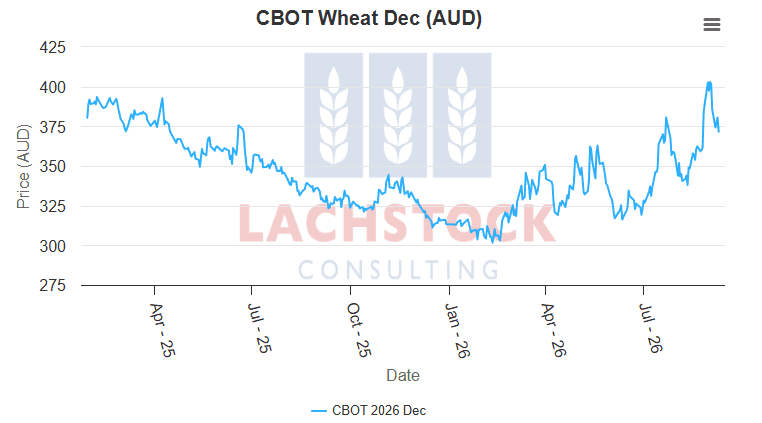
Despite another escalation in both the Black Sea and Middle East, Chicago wheat fell 18.25c/bu, Kansas lost 12.75c and Minneapolis 6c, while Matif Dec eased €2.50/t. The market looks tired after building a sizeable premium to world cash values, with Russian wheat around US$214/t and traders reluctant to add risk ahead of Friday’s WASDE. Corn and beans were also softer, although fresh US sales to Mexico and China continue to show demand underneath the market.
Oil was the standout. Brent pushed above US$100/bbl as US–Iran fighting escalated and attacks on shipping intensified around the Strait of Hormuz. Equities weakened and US bond yields rose as markets again wrestled with the inflation implications of expensive energy. For grains, crude remains supportive to oilseeds, but geopolitics alone is no longer enough to keep wheat moving higher.
Day Ahead – Australia
Offshore markets were lower despite further escalation on both war fronts, so expect local bids to open a couple of dollars softer today. With basis already weak, there is little buffer against the futures move and increased grower selling could add further pressure. Canola should remain relatively better supported with crude above US$100/bbl.
 .
.
Wheat: Wheat was hit hard despite ongoing attacks on Black Sea shipping infrastructure, with WZ -18.25c, KWZ -12.75c and MWZ -6c. The market appears increasingly reluctant to pay additional war premium without an immediate hit to physical availability.
Russian wheat remains cheap at around US$214/t, highlighting just how expensive US futures have become relative to world cash values and helping explain wheat’s inability to rally on every Black Sea headline.
SovEcon cut its 2026/27 Russian wheat export estimate by 3.2 million tonnes (Mt) to 41.4Mt, citing disrupted Black Sea terminal activity. September exports are expected near just 2Mt, with navigation unlikely to normalise in the coming weeks.
Pakistan has formally tendered for 750kt of 2026-crop wheat, CFR Karachi/Gwadar, with bids due 16 September. It will provide an important real-time test of where replacement world wheat is being offered.
Canadian wheat stocks at July 31 jumped to 6.65Mt from 4.24Mt last year, although heavy rain through the Prairies is now creating harvest delays and increasing quality risk.
The market remains extremely headline-sensitive. Trump again talked up the prospect of negotiations with Putin, meaning any genuine ceasefire progress could quickly strip war premium from futures even while physical Black Sea logistics remain compromised.
Other grains/oilseeds: Corn fell 5.75c/bu overnight and is now firmly waiting on Friday’s WASDE, with the market carrying a sizeable speculative long and a very wide range of trade ideas around US yield.
Argentina is providing the world with an important corn bridge, with August–September exports potentially reaching a record 10Mt, against a more normal 3Mt, following a government crop estimate of 71.7Mt.
Ukraine remains the bigger feedgrain wildcard heading into OND. Corn exports normally accelerate sharply through this period, and prolonged Black Sea disruption would leave Europe needing to source significant replacement feedgrain elsewhere.
ICE canola remains near three-year highs, with November settling at C$832.10/t, around C$7 higher on the week. Crude above US$100/bbl continues to provide a strong floor despite harvest pressure.
Canadian canola ending stocks were 1.9Mt, up 19pc y/y but around the five-year average. Domestic crush hit a record 12.9Mt, while early 2026/27 exports are running ahead of last year.
The risk for canola is positioning: managed money was around 104,000 contracts net long entering September. Fundamentals remain constructive, but that length could amplify any sell-off if crude turns lower or the Canadian harvest surprises positively.
Macro: Middle East tensions escalated sharply, with the US striking Iranian tankers and Iran retaliating against shipping near Hormuz. The renewed attacks pushed Brent above US$100/bbl and again raised concerns over the security of global energy flows.
Oil’s move is increasingly becoming a broader inflation story. The longer energy prices remain elevated, the greater the risk higher freight, fuel and input costs begin feeding into underlying inflation.
Equity markets weakened on the escalation, with the S&P 500 -0.5pc, Euro Stoxx 50 -1.6% and FTSE 100 -1.3pc.
US Treasury yields moved higher, with the 10-year up 5bp to 4.84pc, as markets remain cautious ahead of upcoming US inflation data.
China’s August CPI increased to 0.8pc y/y from 0.5pc, while PPI rose to 3.8pc from 3.5pc, adding to signs cost pressures are rebuilding and potentially reducing the urgency for further monetary easing.
Today’s focus shifts toward inflation expectations, while agricultural markets are increasingly waiting on Friday’s USDA WASDE before committing fresh capital.
Local: Canola was a little stronger through the west yesterday at A$883/t, wheat was mixed around $385, while barley eased to $326 FIS Albany.
In the east, canola was $830 with GM at around a $27 discount, wheat was $356 and barley $296 track Geelong.
New-crop malt barley spreads remain wide relative to recent years at around $8–15, depending on variety and state. I expect these spreads to narrow, with the soft growing season and large crops likely to support high malt selection. Current-season spreads are closer to $3.
ABARES lentil national production is forecast to increase by 5pc to a second consecutive record of 2.3Mt in 2026–27, more than double the 10-year average to 2025–26. This reflects continued expansion in area planted and excellent conditions in major growing regions of South Australia and Victoria, over supply and old crop stock is weighing heavily on markets.
HAVE YOUR SAY