

Weather:
NOAA’s Climate Prediction Center has above-average heat moving out of the Corn Belt, with North Dakota, South Dakota and Minnesota seeing near-normal temperatures and above-normal precipitation in the 6-10 day window, before the 8-14 day outlook shows that heat returning to the northern Plains.
The current El Niño system is strengthening, with the CPC now assigning greater than 90 percent odds of a “very strong” event through the Northern Hemisphere fall and winter, typically bringing milder northern-US winters and a more active southern-US hurricane season.
Forecasts for possible weekend frost across the northern Canadian Prairies added support to ICE canola, with Statistics Canada’s first 2026-27 production estimates due September 16.
India’s cumulative monsoon rainfall sits 15pc below normal as of September 9, a lagging finish that keeps pressure on the subcontinent’s oilseed and grain balance sheets.
Markets
Friday’s WASDE is the singular focus, with corn and soybean yields “the gem of the report” and estimates spanning a wide enough range to guarantee volatility regardless of the print.
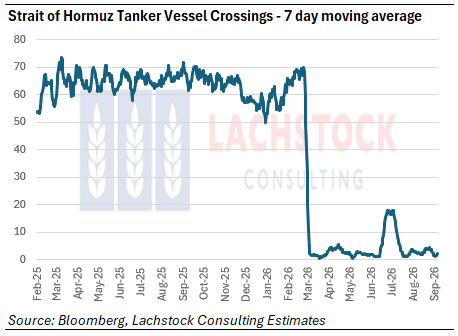
Middle East escalation pushed oil above US$100/barrel and Brent past $107, with the Houthi seizure of Mocha and continued US-Iran strikes showing no sign of near-term resolution.
The US Treasury’s underwhelming buyback results compounded oil-driven inflation fears, sending short-end yields sharply higher and rippling into Australian and NZ bonds overnight.
China’s step-up in US soybean buying — near 1 million tons this week and talk of lower tariffs ahead of the Trump-Xi meeting — is providing a demand offset even as Brazilian oilseed inventories tighten.
Day Ahead – Australia
Trumpy promising every citizen $5000 if they win the mid-terms is wild. Despite the fact it would add $1.3 trillion to the out of control debt it probably works. While it is near impossible for him to pull that off, it would be pretty inflationary. However, it was the US bond rally that forced the AUD lower.
Melb will be consumed by the NFL today (49ers win after being down for most of the game – my prediction) and a WASDE out tonight will keep things pretty quiet today I expect.
 .
.
Wheat: Chicago SRW December settled at $741.25, up 12.50c (1.72pc) on the day but down 13.00c (-1.72pc) on the week, with Kansas HRW (818.75, +12.50c/1.55pc day, +3.25c/0.40pc week) and Minneapolis HRS (762.5, +14.50c/1.94pc day, -3.00c/-0.39pc week) both firmer in a pre-report bid ahead of Friday’s WASDE. Matif Dec added €0.50/t to 245.25 (+0.20pc day, -1.41pc week) while March gained €1.00, and Russian cash slipped to US$210/t as the Black Sea export bottleneck grinds on.
One estimate has Russian September wheat exports missing 1 million tonnes (Mt) versus 4.6Mt a year ago, with world wheat trade for Q1 potentially down 10Mt against the USDA’s 12.2Mt cut for the year.
ASX wheat was the outlier, down 6.50 (-1.81pc day, -3.42pc/-12.50 week) to 352.5.
Implied vol in WZ went out at 36.51pc versus 36.31pc Wednesday. SRW Dec26 swap firmed to 380.98 (+2.53pc day, -1.11pc week) and Matif wheat Dec26 swap to 399.81 (+0.85pc day, -0.99pc week).
Weekly export sales of 375,000t are expected tomorrow alongside the report, and Ukraine/Russia continue trading strikes on port and energy infrastructure — Novorossiysk, Nika-Tera at Mykolaiv, and Makhachkala in Dagestan all hit over the past 24 hours, keeping the BSEA headline count numbing but the underlying disruption real.
Other grains/oilseeds: Corn (533.75, +6.00c/1.14pc day, -7.00c/-1.29pc week) rode the broader complex higher into Friday’s report, with new-crop sales of 1.45Mt expected and the market laser-focused on the yield line — 14 years running the September number has beaten the average trade guess, and tomorrow’s 178.2 trade estimate spans a wide 174-184 range (roughly an 830-million-bushel swing).
Soybeans led the move, up 22.75c (1.74pc day, 1.22pc week) to 1332.25 as soybean meal added $5.50 (1.57pc day, 0.39pc week) to 356.9 and bean oil jumped 133 points, pushing October crush up 4c to 224.50.
Fresh daily sales of 272,000t to China and 206,500t to an unnamed destination take bean sales past 1.2Mt since last Friday, helped by chatter that the US and China plan to lower tariffs ahead of the Trump-Xi meeting in two weeks; new-crop sales tomorrow are pegged at 1.8Mt beans, 400,000t meal and 3,000t bean oil, with the 52.7 bean yield line the one to watch.
Canola diverged: WCE November gained C$7.80/t to C$839.30 on spillover from crude and beans plus frost risk in the northern Prairies, while Matif canola was little changed at 557.75 (+0.04pc day, +1.13pc week); the WCE Nov26 swap rose to 852.69 (+1.48pc day, +1.59pc week) and the Matif Nov26 swap to 909.24 (+0.69pc day, +1.56pc week).
Palm oil was the soft spot, down 81 points (-1.63pc day) to 4885 on rising Malaysian stocks, while cotton, sugar and white sugar all pushed higher and cocoa’s 3.43pc weekly loss stood out against a modest daily gain .
Macro: Crude was the story again, WTI up $6.43 (6.69pc day, 12.25pc week) to $102.48 as the Houthis seized the port of Mocha Thursday, adding further leverage over the Bab el-Mandeb Strait and choking Saudi export routes already running at their lowest since 1990.
Brent settled near $107.63, up almost 80pc for the year, with little sign of near-term de-escalation between the US and Iran and White House advisers reportedly telling Trump the conflict could run through his term.
That fed straight into bonds and equities: two-year Treasury yields jumped 16 basis points to 4.59pc, the biggest one-day move since April 2025, 10-year yields hit their highest since 2023, and the Dow fell 316.56 points (-0.60pc day, -3.02pc/-1622.01 week) to 52064.1.
PPI printed 5.4pc versus 4.8pc in July, adding to the inflation squeeze on Bessent’s bond-buyback program, which again fell short of its cap.
AUDUSD eased to 0.7157 (-0.83pc day, -0.61pc week) even as Australian and NZ bond yields surged in early Friday trade.
TSR20 rubber fell 1.77pc on the day but remains up 5.57pc on the week, while lumber was little changed .
Local: Canola bids were steady in the west at $881, while GM was a little softer at $875. Wheat was $380 and barley eased to $323 FIS Albany.
Through the east, canola was $830 and GM $803, with wheat at $349 and barley $296 track Geelong.
Barley bids have eased this week, with only a dribble of enquiry from China so far. China will remain the key over the next few months — interestingly, this time last year was a busy period for Chinese barley enquiry.
Interesting to hear some more lentil demand emerging from the subcontinent, as wet conditions and slow grower selling in Canada see some shorts pivot towards Australia in the short term. Don’t be fooled though — there are still plenty of lentils to get through .
HAVE YOUR SAY