
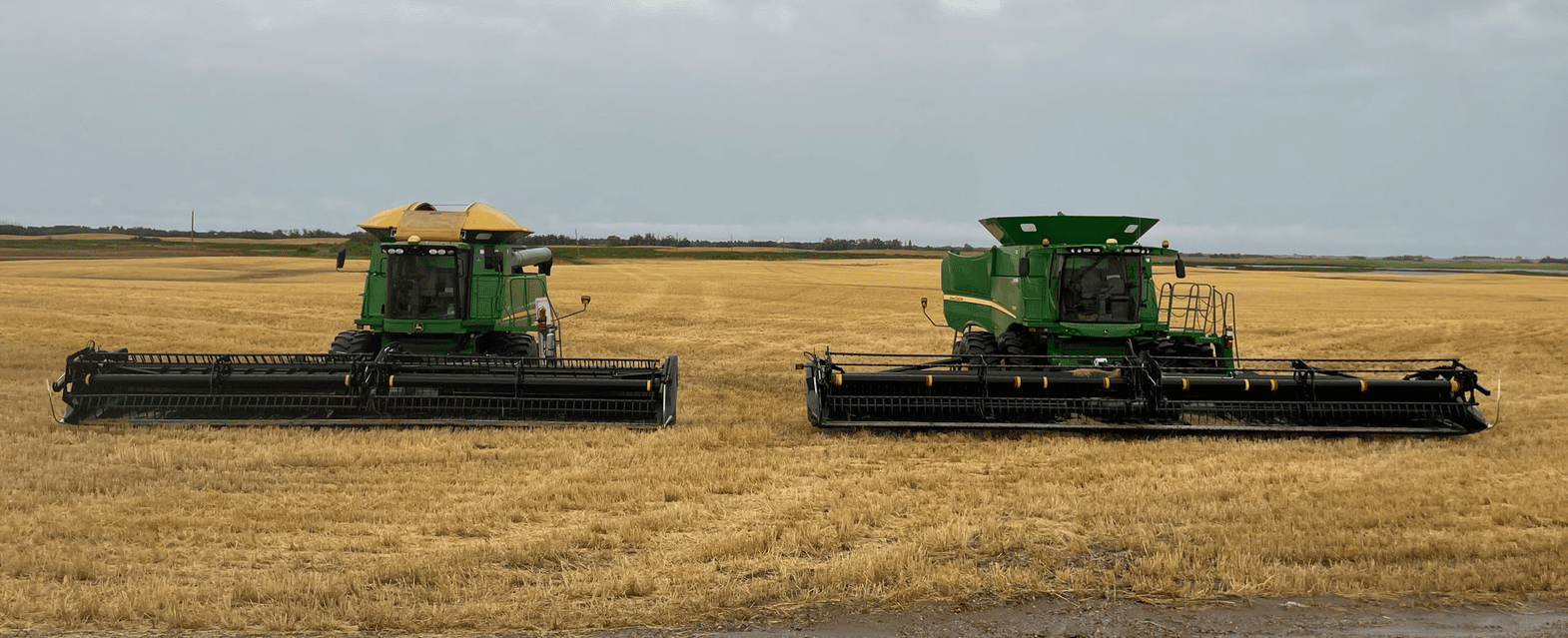
Close to 50mm of rain halted the barley harvest in Saskatchewan last week. Photo: Anna Grisnich
HEAVY rainfall across much of the Canadian Prairies over the past three weeks has transformed this season’s harvest into an epic battle against nature, with progress lagging long-term averages and farmers now bracing for widespread quality losses.
A downpour in the last week of August, which dropped 70-80mm through Saskatchewan and western Manitoba, was followed by another system on September 2. It delivered another 15-20mm across the same catchment, accompanied by wind gusts of up to 92km per hour.
Widespread storms over the Labour Day long weekend of September 5-7 then brought another 50-175mm of precipitation to a large proportion of Western Canada’s cropping regions. Isolated hail storms were also reported through parts of Saskatchewan and Alberta, adding to this season’s woes.
While severe thunderstorm events are common at this time of year, it is the intensity and volume of rainfall that is unusual. The weather quickly paused this season’s harvest, leaving headers idle for much of the past two weeks in many regions.
Challenges cascade
According to the latest provincial crop progress reports released last week, the 2026 campaign trailed the five and 10-year averages in all three Prairie provinces, exacerbated by the widespread rainfall over the Labour Day long weekend. Harvest has been slow to resume, and for those in the wettest areas, more reaping is likely to be accomplished in October than September.
Crop damage across the Prairies over the past few weeks is largely due to excess moisture, high winds and hail. Many crops are now lodged and waterlogged due to very wet fields, with isolated fields inundated. Producers are concerned about grain quality, bleaching and sprouting, while disease is also a mounting issue with humidity high and crops not drying out. Yield loss will also be an issue as kernel weights fall and the widespread lodging makes harvesting slow and difficult.
Growers and industry bodies agree that much of the barley still to be harvested in rain-affected regions will likely struggle to meet malting barley specifications, while passing falling-number requirements will be a significant challenge for milling wheat grading.
By province
In Alberta, the harvest was slow to commence and has been continually dogged by rain delays. Cool temperatures are adding to the challenge, keeping combines parked for days and decreasing the quality of the grain still in the paddock. Compared with last season’s hot and dry weather through late summer and autumn, this season’s conditions have slowed field progress considerably, particularly in the North East, North West and Peace regions.
In the week to September 8, harvest of the province’s major crops progressed by 7.5 percentage points to be 17.7 percent completed. This compares to 39.6pc at the same time last year, the five-year average of 40.2pc and the 10-year average of 30.4pc harvested at the same point in the season.
The winter wheat harvest was all but finished before the rain delays, but the spring wheat campaign sits at just 14.1pc complete against 48.8pc a year earlier. The barley harvest is further advanced at 33.6pc, compared to 52.9pc last year. While the canola harvest was 13.2pc complete at this time last year, the 2026 program had barely commenced in most regions, but a significant proportion has been windrowed and is ready to be reaped once moisture levels permit. The pulse harvest is relatively well advanced, with field peas and lentils reported at 73.7pc and 71.9pc done, respectively, versus 90.7pc and 91pc in 2025.
Moderate harvest progress was made across parts of Saskatchewan early in the week to September 7, before the widespread precipitation stalled field operations across much of the province. Paddocks are generally saturated in most districts, with growers hoping for a good run of warm, dry days to resume field activities.
As of September 7, 27pc of the province’s crop was in the bin, up from 18pc a week earlier. This is 14 percentage points behind last year, 34 percentage points behind 2024, and lags the five-year and 10-year harvest averages of 58pc and 50pc respectively.
Saskatchewan’s winter-wheat harvest was 87pc complete, against 96pc last year, with most reaped before the recent rainfall. Like Alberta, the barley program is relatively well advanced at 41pc, compared to 54pc a year earlier. However, the spring wheat harvest is only 13pc completed, just slightly ahead of canola at 9pc, both of which fall behind their respective long-term averages. The lentil harvest was 84pc complete and the field pea program 79pc done.
Unfavourable weather dominated the week to September 9 in Manitoba, with heavy rains and strong winds severely hampering field activities in most districts. That said, the province’s 2026 campaign is the most advanced of the three Prairie provinces.
Dated September 9, the most recent Manitoba crop-progress report had the winter cereal harvest nearing completion with average yields. The spring cereal program was at least 20pc complete across all regions, with pre-rain yield and quality reported to be average to above average. A significant proportion of canola area had been windrowed, and harvest had commenced in all regions.
The report put winter-wheat harvest progress at 95pc against 100pc last year; the spring wheat campaign at 54pc compared to 79pc last year; the barley program at 58pc versus 77pc at the same time in 2025; and canola progress 3 percentage points behind last year at 15pc complete.
Extra cost
While grain drying is a regular practice in Canada each season, it is expected to increase significantly this season. This means additional expenses for natural gas or propane in a season when planting and harvesting costs have increased substantially due to higher fuel prices.
The waiting game is the hardest, as the fields and unharvested crops slowly dry against a backdrop of shorter days and morning frosts, particularly in the northern growing regions. It all takes an emotional toll, but at least progress is being made once the headers roll and the battle recommences.
HAVE YOUR SAY