

Weather:
Heavy rain is forecast through parts of the US Midwest, with Iowa expected to receive around 100–200mm this week, likely shutting down corn and soybean harvest and creating some local flooding risk. US soybean harvest is currently 6 percent complete versus the 5-year average of 3pc, while corn is 8pc complete versus 6pc. In Canada, the slow Prairie harvest and approaching frost remain supportive for canola.
Markets
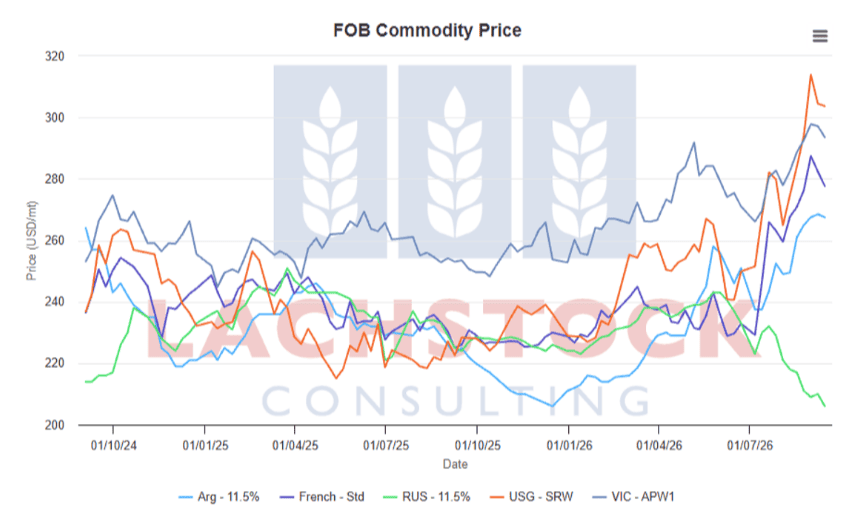
Wheat remains a battle between peace headlines and physical Black Sea disruption. US futures weakened after suggestions of a potential halt to infrastructure attacks, but the market quickly recovered part of the move when fresh Russian strikes were reported. With Russian and Ukrainian seaborne exports severely constrained and importers including Algeria returning, the physical wheat market still looks considerably tighter than headline global supply numbers suggest.
Canola and the broader oilseed complex continue to take their lead from energy. Fresh attacks on Saudi infrastructure pushed crude higher and dragged veg oils with it, while slow Canadian harvest progress adds another layer of support.
Day Ahead – Australia
Expect growers to remain increasingly engaged as the frost window begins to close and harvest gets closer. Canola should find the best support from offshore markets, while wheat remains a tug-of-war between stronger global replacement values and increasing new-crop selling pressure locally. Barley enquiry remains the softer part of the domestic complex, with China still the key demand watch.
Russian wheat keeps getting cheaper- it won’t be long before they are giving it away, although that doesn’t matter if you can’t move it. But if/when it can move, well.
Wheat: Wheat finished softer in the US with Chicago Dec down 3.25c, Kansas down 6c and Minneapolis down 8.75c, as markets remain extremely sensitive to Russia/Ukraine headlines.
A Trump post suggesting Russia and Ukraine had agreed to halt attacks on energy infrastructure initially knocked wheat around 18c lower, before prices recovered part of the move after reports of further Russian strikes around Odesa. There is still no confirmed Russian agreement.
The physical story remains supportive, with Russian and Ukrainian Black Sea seaborne grain exports heavily disrupted and alternative Danube/rail routes unable to replace lost capacity.
Russia’s seaborne grain exports fell 62% y/y in August to 2.0mmt, while Ukraine’s season-to-date grain exports are down 24% at 4.34mmt, including wheat down around 48% y/y to 2.1mmt.
APK-Inform lifted Ukraine’s crop forecast to 65.2mmt, but cut its export outlook to 33.9mmt from 39.4mmt, including wheat exports at just 10.5mmt vs 13.5mmt previously.
Importers are beginning to step back into the market. Algeria is tendering, Pakistan is active and Saudi Arabia may return, while Egypt has reportedly approached Russia directly. Algeria’s tender is particularly important if constrained Russian supply forces more demand toward European origins.
Other grains/oilseeds: Canola began the week firmer as the broader veg-oil complex followed crude higher, with soyoil, European rapeseed and Malaysian palm oil all stronger following fresh attacks on Saudi energy infrastructure.
Canadian harvest remains slow heading toward the first major frost risk. Alberta’s canola harvest is only just above 2% complete, with early yields around 37bu/ac.
Canadian production remains a key focus ahead of StatsCan on Wednesday. USDA remains at 22.5mmt, compared with Agriculture Canada at 21.6mmt, leaving plenty of room for volatility around the number.
Canadian canola exports improved to around 94kmt last week, lifting season-to-date shipments to 705kmt vs 530kmt last year, while a softer Canadian dollar also provided support.
Corn continues to look relatively constructive. USDA cut US production by 213m bu, with yield reduced 2.2bu/ac to 178.5bu/ac. The cut was smaller than the market wanted, but new-crop carryout was still lowered and the farm price lifted to US$4.80/bu.
Soybeans recovered some ground Monday after Friday’s WASDE-driven sell-off. USDA had lifted production by 16m bu and yield to 52.8bu/ac, but strong Chinese demand, US crop uncertainty and a still-tight window before South American supply arrives continue to underpin the market.
Macro: The Middle East remains the dominant macro story after Houthi attacks on Saudi Arabia and the postponement of planned Gulf–Iran talks increased the risk of the conflict spreading further.
Friday’s attack knocked out Saudi Arabia’s east–west pipeline, an important route allowing crude to bypass the Strait of Hormuz. A prolonged outage could materially tighten global oil availability.
Crude traded more than 4% higher intraday Monday before giving back some gains, with WTI still around US$102/bbl. The higher oil market remains a significant tailwind for vegetable oils and canola.
Higher energy prices are pushing inflation expectations back into focus, with the US 10-year Treasury yield briefly trading above 5% before easing to around 4.99%.
Markets are increasingly expecting tighter monetary policy, with ANZ expecting the Fed to raise rates 25bp this week and further hikes to follow as higher energy costs threaten renewed inflation pass-through.
Rising fuel costs are also working their way directly into agriculture. US rail fuel surcharges are up 153% y/y, now accounting for around 11% of corn and soybean rail freight costs and contributing to weaker grower basis .
Local: Canola bids started the week softer in the west, down $6 to $875 with GM at evens, while wheat was $381 and barley eased $2 to $327 FIS Albany.
Through the east, canola was $820 with GM around a $30 discount, wheat was $353 and barley $296 track Geelong.
Delivered wheat markets have softened through the south over the past week or so, with new-crop values easing around $5/mt while nearby markets have been steadier. Jan+ Hanwood is now bid $345, Geelong/Melbourne $360 and Murray Bridge $330.
The top end of this year’s Australian barley production estimate is generating plenty of discussion. There’s little doubt the crop is large — we currently have it pegged just shy of last year’s record at a little under 17mmt, although some estimates are now pushing towards 20mmt.
HAVE YOUR SAY