

Weather:
Australian conditions remain relatively benign in the immediate term. Offshore, weather remains more market-sensitive: persistent rain continues to delay the Canadian harvest and threaten quality, while heavy rain through the US central Plains and Iowa is expected to slow corn and soybean harvest activity.
Markets
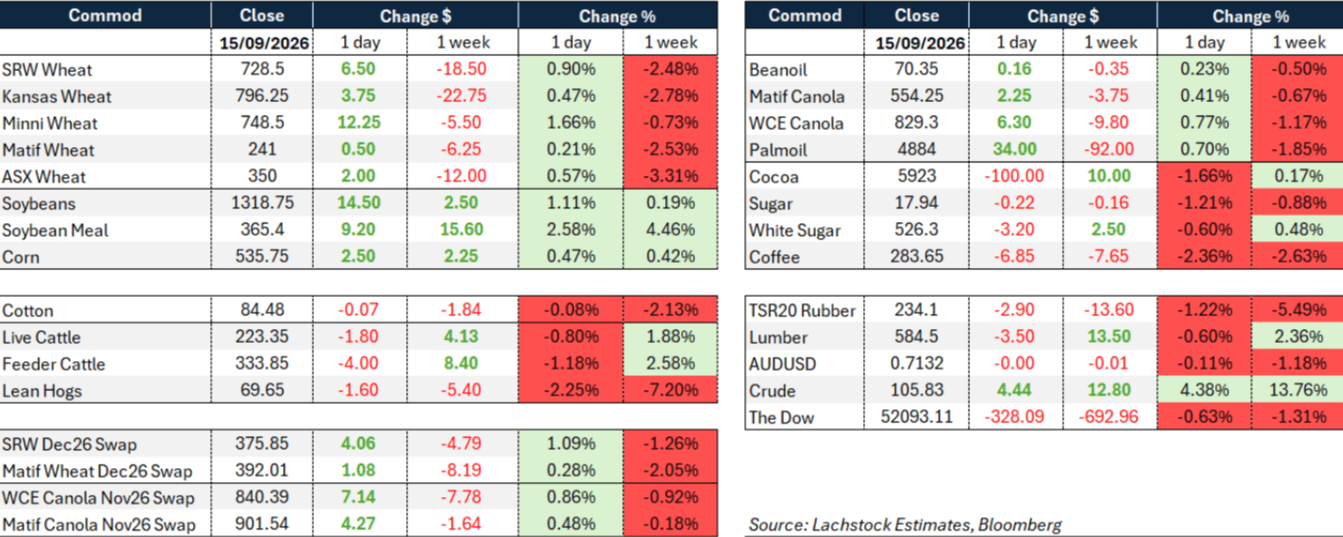
Wheat finally found some support overnight with Chicago +6.5c/bu, Kansas +3.75c and Minneapolis +12.25c, while Matif was slightly firmer. Physical demand is starting to show through with Algeria buying at least 510kt, while Morocco, Pakistan and Egypt remain in the market. Black Sea infrastructure attacks continue to keep risk premium in wheat, while Canada remains a concern with Saskatchewan harvest only 27 percent complete versus the 58pc five-year average, increasing the risk of quality downgrades if wet weather persists.
Oilseeds were the stronger part of the complex with soybeans +14.5c/bu and soybean meal +US$9.20/t, while canola and the wider veg-oil complex followed another sharp rally in crude. Brent finished at US$108.75/bbl and WTI US$105.83/bbl as Saudi export disruptions worsened, with Yanbu loadings suspended and some European cargoes cancelled. That energy move remains supportive for canola, but locally it also raises the risk of another leg higher in diesel and freight costs as harvest approaches.
Day Ahead – Australia
Canola should remain the clearest beneficiary locally from another large move in crude and the broader veg-oil complex. Wheat has also finally attracted some buying as physical import demand collides with ongoing Black Sea disruption, although the size of the Australian crop should continue to limit how much offshore strength translates directly into local bids, likely unchanged today.
The other developing local story is diesel heading into harvest. Wholesale prices are already above 250c/L in several capitals and the latest offshore move may still have more to feed through. If crude remains above US$100 and diesel cracks stay elevated, freight and harvest costs will rise quickly.
Source: StatsCan and Lachstock Estimates
Wheat: Wheat finally found some buying overnight with WZ +6.5c/bu, KWZ +3.75c and MWZ +12.25c, while Matif Dec added €0.50/t. Markets closed toward the highs as demand, Black Sea disruption and surging energy provided support.
Algeria reportedly bought at least 510kt of soft wheat at US$319–321/t for November shipment, with the business thought to be largely Baltic origin.
Import demand is starting to show up more broadly. Morocco opens for imports today after reportedly procuring only 655kt domestically versus an intended 1.5–2 million tonnes (Mt), while Pakistan and Egypt are also looking for supply.
Black Sea risk remains firmly in the market. Russia again attacked Odesa port infrastructure, Izmail, Chornomorsk and Pivdennyi, while Ukraine struck Russia’s Syzran refinery and other energy/military infrastructure.
EU soft-wheat exports have reached 5.6Mt to 13 September, down 2 percent y/y, with Saudi Arabia, Algeria and Nigeria among the leading destinations. EU barley exports are down a much larger 40pc to 1.7Mt.
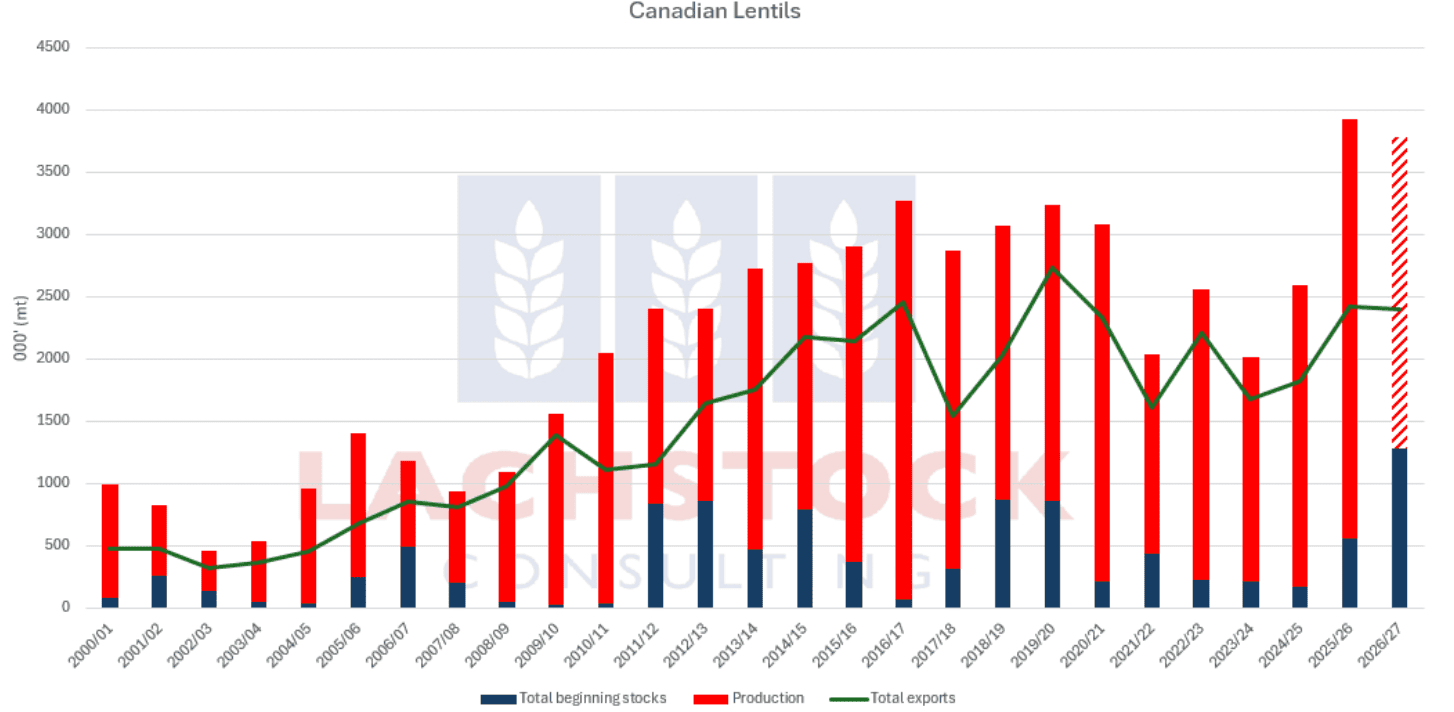
Canada remains a risk from both production and quality. Persistent rain is delaying harvest and increasing downgrading concerns, while StatsCan’s latest production estimates are due tonight Australian time.
Canadian harvest is running well behind normal in Saskatchewan, with just 27pc of crops combined as of 7 September, versus 58pc for the five-year average and 50pc for the 10-year average. That is also well behind 41pc at the same stage last year, reinforcing the concern that persistent rain is becoming both a harvest-delay and quality issue for cereals and canola.
Other grains/oilseeds: Oilseeds had another strong session with soybeans +14.5c/bu, soybean meal +US$9.20/t and soybean oil slightly firmer, while corn added 2.5c. Crude strength and concerns around harvest delays helped underpin the complex.
August NOPA soybean crush disappointed at 205.5m bu versus 212.2m expected, largely due to downtime. Soybean oil stocks were also tight at 1.20bn lb versus 1.276bn expected, helping support product markets.
Soybean meal remains particularly firm, with strong export demand and tighter global supply contributing to prices around two-year highs. Biofuel demand and US$100+ crude are simultaneously supporting soybean oil.
ICE canola pushed higher again as crude spilled into the veg-oil complex, with Chicago soyoil, European rapeseed and Malaysian palm oil also firmer. StatsCan’s crop report tonight will be the next major Canadian input.
China lifted its 2025/26 soybean import estimate to 108Mt, up 4.7Mt from last month on stronger imports and improved crush margins, while cutting corn imports to 5Mt.
Looking further ahead, EU rapeseed area is currently expected to fall around 5pc y/y for the 2027 crop as dry conditions disrupt sowing. Some area could shift into winter barley, with EU winter barley planting tentatively projected at 5.42m ha — near a 15-year high — although weaker barley pricing versus wheat may temper that switch.
Macro: Crude is the story again. Brent settled US$3.07 higher at US$108.75/bbl, while WTI surged US$4.44 to US$105.83, with both closing at their highest levels since May.
Saudi Arabia’s critical East-West pipeline remains offline following Houthi attacks, forcing a suspension of crude loadings at Yanbu and cancellations of some September cargoes to European refiners. The route had become particularly important as it allows Saudi crude to bypass the Strait of Hormuz.
The Saudi disruption could become more serious if repairs drag on. Industry reports suggest stored crude may only support normal export volumes for around 5–7 days, while repair estimates range from days to several weeks. The damaged route potentially affects around 4pc of global oil supply.
Libya is adding another layer of supply risk after three oilfields suspended operations, while continued attacks on Russian refining capacity are further tightening product markets. US diesel futures and diesel cracks have pushed to record levels.
The move is increasingly relevant locally heading into harvest. Adelaide diesel terminal-gate pricing was 252.2c/L on 15 September, up 6.7c/L in six days. With Australian diesel linked closely to Singapore gasoil, the latest offshore spike may not yet be fully reflected in farm fuel prices.
Every 10c/L rise adds around $1,000 to a 10,000L fuel bill, so sustained crude and diesel strength could quickly lift header, chaser-bin, contractor and freight costs through harvest.
The Fed remains the other major macro event, with a 25bp hike widely expected tomorrow morning Australian time. The US 10-year yield is around 5.00pc, while the DXY remained relatively rangebound ahead of the decision.
Local: In the west, canola was stronger yesterday, up A$5/t to $880, while wheat was $381 and barley $327 FIS Albany.
Through the east, canola improved to $817, while wheat was softer at $353 and barley $295 track Geelong.
Chickpeas remain well supported for prompt tonnes, currently bid around $840 delivered Brisbane, with a smaller crop this year and renewed export demand underpinning values.
Barley is proving difficult to place delivered end-user through SA and Victoria at the moment, with many buyers sitting back ahead of harvest on the view grain will be cheaper once grower storage and harvest logistics become stretched.
HAVE YOUR SAY