

Weather:
Canadian Prairies: a fresh storm system dumped 20-40mm (locally heavier) across Saskatchewan and Manitoba on 14-15 September, adding to 30-60mm from the Sept 4-7 weekend and pushing the 2026 harvest one to two weeks behind schedule, with growing risk of field sprouting, lodging and quality deterioration on canola and spring wheat still standing in the field.
Ukraine: soil drought now covers an estimated 50-60 percent of land intended for winter grain sowing, with meteorologists saying mass sowing in affected areas is inadvisable until rain arrives; only about 1pc of the planned 5.4 million hectares had been sown as of mid-September, and little rain is expected before Sept 25 in the east, central and southern regions.
US Midwest: dry weather is favouring a swift harvest pace across the Plains, Delta, southern and western Corn Belt per Maxar, with only minor delays expected in the northeastern Midwest from recent rain; soybean crop conditions have deteriorated to 63pc good-to-excellent, down 10 points over the past month on a dry August.
Australia: some sub zero temps through southern NSW overnight – doesn’t look widespread but reminds us we are in the frost hitting zone.
Markets
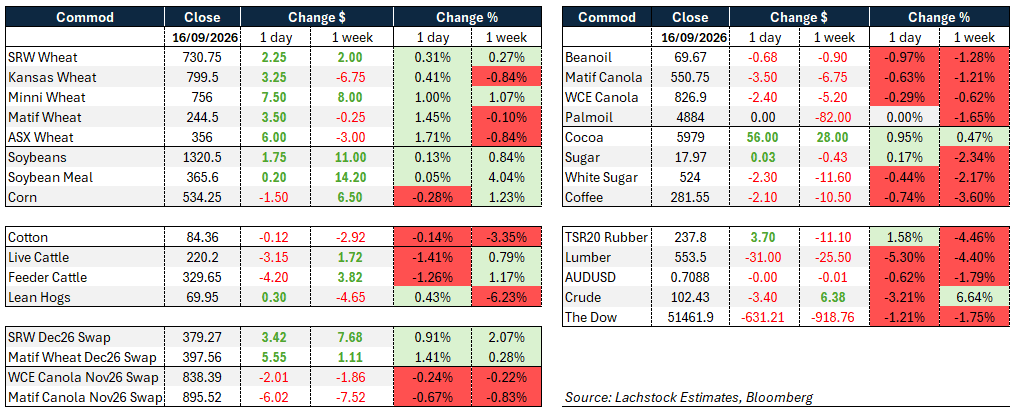
US wheat firmed across the board overnight in choppy, two-sided trade that turned decisively higher into the close as the Fed’s rate hike hit; Minneapolis wheat led on a supportive StatCan Canadian production number.
Corn stayed range-bound, caught between record managed-money length at harvest and a compelling demand story tied to lower yields and stalled Ukrainian exports.
Canola sold off hard on the StatCan release despite opening higher, as a record harvested area only partially offset an 8.3pc yield decline.
Equities and crude reversed sharply lower into the close after the Fed’s hawkish quarter-point hike, while the Dow’s weekly slide extended past 1.75pc.
Day Ahead – Australia
Fed hike and signals another increase this calendar year – AUD sub 0.7100 but we have an Australian hike in the wings so this AUD weakness feels short term.
So much noise around the China/US meeting – will it actually happen. Timing is everything – the fact the US Congress approved Donald to go coco bananas on tariffs on countries purchasing Russian oil – China at the front of that queue, makes the Xi meeting even more volatile.
Aussie crop is getting bigger but, the weight from increase supply is being met with support from the international market. The 2 current tenders suggest Aussie values are not inflated – it’s really about what the grower does and if there is enough export room to keep converging any continued export strength.
AUDUSD – Source: Bloomberg
Wheat: Wheat finished collectively higher in a sloppy, two-sided session consistent with the pattern since the September WASDE. Prices were down as much as 5c/bu with fifteen minutes left before charging into a broadly bid close across all ags, timed almost exactly with the Fed’s quarter-point hike — its first since July 2023.
Minneapolis wheat led the complex on a supportive StatCan figure showing Canadian production at 36.1 million tonnes (Mt) versus 38.3Mt expected, though that survey predates the torrential Prairie rain of the past two weeks that has since pushed harvest one to two weeks behind schedule and raised the risk the crop shrinks further along with quality.
On the demand side, Algeria bought roughly 500,000t milling wheat and Pakistan drew interest from eleven trading companies for its 750,000t tender, needing shipment by November 20.
The overarching driver remains the Black Sea, where continued drone activity keeps shipping restrained on both sides; SovEcon estimates combined Russian and Ukrainian wheat exports for July-September at around 8Mt, the lowest since 2010/11 and well below the 18.2Mt 5-year average, and argues the market is still underpricing the risk of a prolonged disruption.
Ukraine’s winter wheat sowing is also running well behind pace, with soil drought affecting 50-60pc of the intended area and only about 1pc of the planned 5.4 million hectares sown so far.
Congress has now given final approval to a bill allowing Trump to impose a 500pc blanket tariff on Russian goods and a further 100pc tariff on the top five buyers of Russian oil and gas — a group that includes China, India and Turkey — though broad White House waivers mean it is unclear whether the powers will actually be used.
With US crop insurance prices set well above last year’s levels, a large push into US wheat area looks likely even as the Black Sea struggles to get its winter crop in the ground.
Other grains/oilseeds: Corn remains stuck, unable to break either way as a compelling forward demand story runs up against a record managed-money net long heading into harvest.
Early yield checks have generally disappointed, adding to expectations the October yield estimate moves lower, while South America currently offers the best relative value to most of the world; if Ukraine fails to get export flows moving again, today’s already-lofty US demand projections could become reality.
Soybeans were also two-sided before rallying into the close on lower energy values, with meal making back its losses and bean oil supported by the same late-session bid that lifted the rest of the complex.
RCM’s Doug Bergman notes the bean uptrend is intact but the market is overbought again, with a record fund net long, the pending Trump-Xi meeting, and the ramping US harvest all injecting near-term uncertainty; further upside likely hinges on South American production prospects, currently priced for the smallest output increase in several years.
There was some confusion overnight about whether the Trump-Xi meeting was still on, tied to unconfirmed rumours about Xi’s health, but the Bessent pre-meeting with his Chinese counterpart appears to still be proceeding, suggesting the summit remains on track.
Canola gave back an early gain and sold off hard on the StatCan release, which put 2026-27 production at 22.1Mt, down 0.8pc year on year, on an 8.3pc yield decline that a record 23 million harvested acres only partly offset; one analyst called the production number “heavy” and flagged the chance of a further downward yield revision in StatCan’s December survey-based report.
Crude fell roughly 3pc on reports Saudi Arabia is offering additional cargoes via Oman, dragging Chicago soyoil and European rapeseed lower alongside canola, while Malaysian palm oil was closed for a holiday.
Indonesian palm output in Kalimantan is separately expected to fall 12-15pc in the fourth quarter on prolonged dry weather and widespread fires, and India’s cumulative monsoon rainfall sits 15pc below normal as of mid-September.
Macro: The dominant story overnight was the Fed’s unanimous quarter-point hike to a 3.75pc-4pc range, its first since July 2023, delivered just as the closing bell approached and catching markets somewhat off guard given how it was received.
Chair Kevin Warsh described the move as removing “a dose of accommodation” — language Fed watchers read as hawkish — and signalled one more hike is likely this year, with the median 2026 year-end rate projection lifting to 4.1pc from 3.8pc in June and the Fed’s 2pc-inflation timeline pushed out to 2029.
Two-year Treasury yields jumped over 12 basis points to 4.73pc and the 10-year moved back above 5pc during Warsh’s press conference. Trump called for rates at “1pc or lower” and labelled the Fed board “hostile, very political,” but stopped short of criticising Warsh directly and said he retains confidence in him.
Equities and crude both sold off sharply into the close — the Dow down over 1.2pc on the day and heading for a near-1.75pc weekly loss, crude off more than 3pc even as reports of a Saudi pipeline restart added supply relief.
Lumber was the session’s biggest mover, down over 5pc on the day and heading for a similarly steep weekly loss.
Separately, US agencies including the Coast Guard, FBI and DHS are tracking cyber threats against nearly 20 shipping vessels worldwide after intrusions on two inbound tankers in the Gulf of Mexico in late August — a fresh layer of risk for global freight and shipping markets alongside the ongoing Black Sea disruption, though there’s no evidence yet of a broader campaign targeting oil and gas tankers specifically.
Local: Through the west of the country, canola was stronger yesterday, up A$10/t to $885, wheat was $381 and barley improved to $330 FIS Albany.
In the east, canola was +$4 to $824, wheat was $350 and barley $294 track Geelong.
Malt spreads remain wide compared with recent years, currently around +$10 through the east coast and +$6 in the west. Spreads in Victoria have already narrowed from closer to +$15 a week ago. With malt selection expected to be strong this harvest, spreads are likely to continue tightening.
Some very low temperatures were recorded through southern NSW and the Riverina, with lows around -4°C. We are getting towards the back end of the frost window, but there is still potential for crop damage and the extent is unlikely to be clear for a couple of weeks. Further frost risk remains for parts of Victoria and South Australia tomorrow.
An interesting development in regional cattle markets, with Thailand targeting a new seaborne live cattle trade into China of up to 100,000 head/month, although protocols are still being finalised and no official shipments have started. Thai cattle are already becoming harder to source and more expensive, which could ultimately push Vietnamese and Malaysian buyers back towards Australian cattle if the trade does get established.
HAVE YOUR SAY