
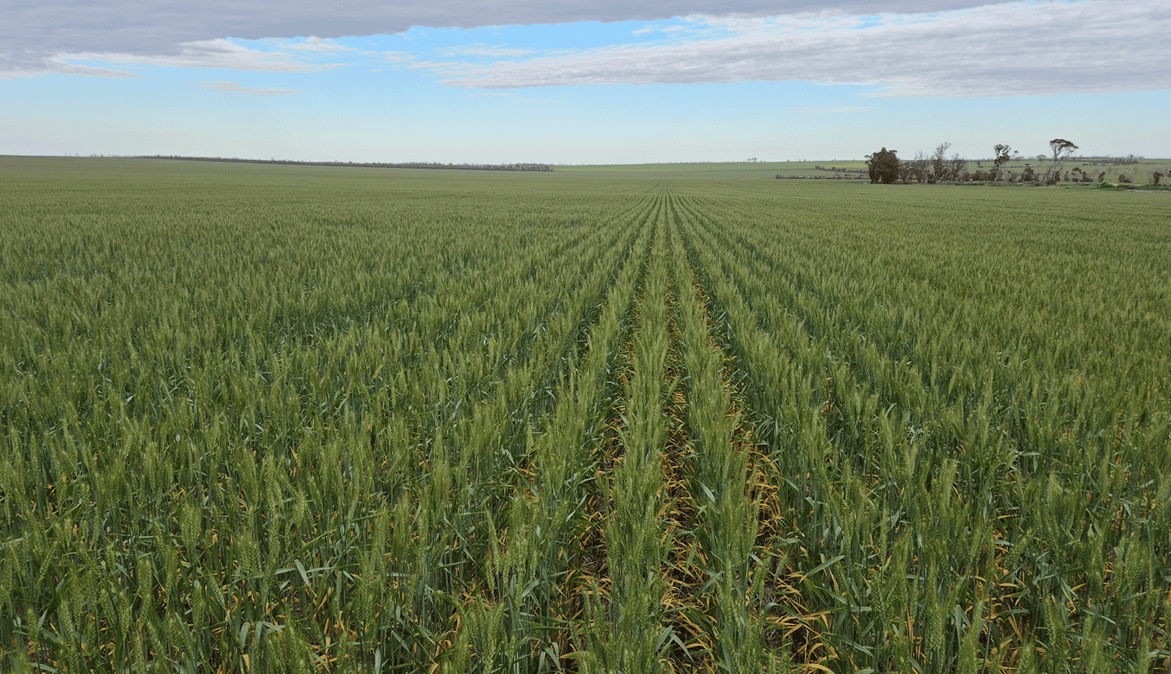
Wheat growing at the Corrigin Farm Improvement Group RiskWi$e nitrogen demonstration site. Photo: Ashley Jacobs
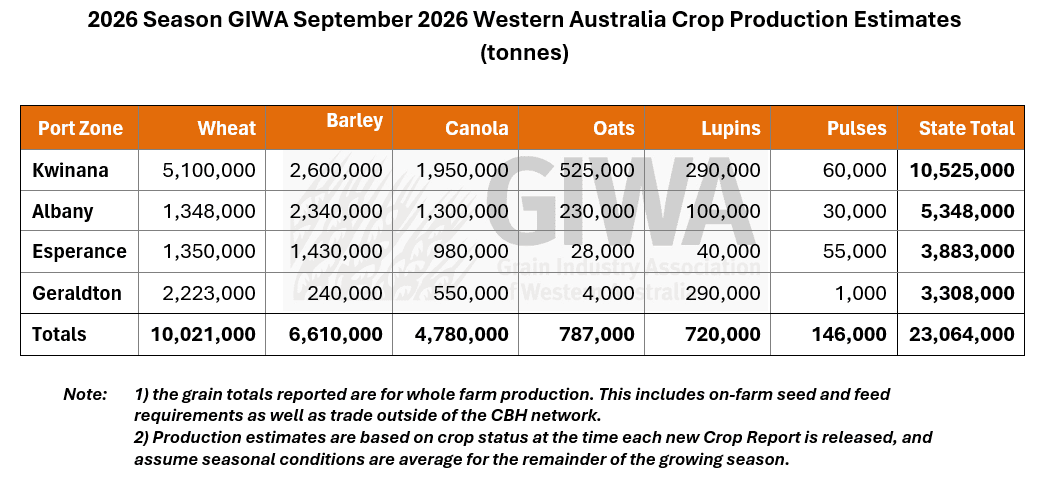
YIELD prospects for Western Australia’s winter crop have improved thanks to rain late last month, and the Grain Industry Association of WA now tips the weigh-in at 23.06 million tonnes (Mt), up from 21.01Mt expected mid-August.
In GIWA’s September crop report out today, author Michael Lamond said many WA crops were running out of subsoil moisture and grain yield potential was dropping by the day last month.
“This slide was halted in most areas in the last week of August with a non-traditional cut-off low-pressure system dropping buckets of water in the central regions of the state and useful falls in areas away from the epicentre of the low,” Mr Lamond said in the report.
“As a result of this rainfall event, crop-yield potential in the state over the last four weeks is now above what the crop was looking like when the last report came out in early August.”
Central Wheatbelt regions got the best of the rainfall, and the west Midlands and most of the Kwinana North zone also received some good rain from the system, while the western end of the Esperance Zone and west Albany picked up useful falls around the same time.
“The northern zones missed most of this, as did the corridor from south of Brookton through to Bremer Bay that has unfortunately been missing out all year.
“Crops that received upwards of 50mm in August are now likely to yield closer to what their potential was at the end of July, instead of the much lower potential they were showing in the middle of August just prior to the rain.”
Heat of concern
Heat has now taken over as the biggest limiting factor to grain yield, as easterly winds blow hot air across the grainbelt and little rain forecast to follow point to a “sharp finish” for the growing season.
“It looks as though the risk of frost has abated, as the next few weather systems coming through do not have a cold air mass behind them, which is more typically the case in spring.
“Frost has not been a significant factor anywhere this year and, due to the advanced stage of most crops, it is now unlikely to be as most crops are now outside the frost-risk window.”
Mr Lamond said this has contributed to the uptick in potential tonnage for the WA grain crop between GIWA’s August and September crop reports.
“Crops in the north of the state are too advanced for rain over the next few weeks to have any positive impact on yield; their yield potential will be determined more by the onset of heat.”
Mr Lamond said if the cold front forecast for this weekend follows this year’s pattern of slipping away without delivering much rain, it will be too late to add tonnes in most of the regions bar the south coast and west Albany zones.
“Grain quality is likely to be quite varied depending on the region.
“In areas such as Esperance, west Albany, the Midlands and the eastern and central Kwinana zones, grain yields are going to be limited by nitrogen.
“Yield will be left in the paddock and, even though grain size in cereals will be good, protein is expected to be down.
“In the northern zones and the drier areas of the Kwinana and Albany zones, yield will be limited more by rainfall than nitrogen, and protein should be good in the cereals.”
Mr Lamond said rain in late August saved WA from “a very ordinary year as far as production goes”.
“We are now going into harvest in many areas with reasonable grain-yield prospects more in line with what the crop was looking like at the end of winter.”
Mr Lamond said WA’s low-rainfall regions that typically grew “wall-to-wall wheat” this year highlight the trend of the past 10 years, with 47 percent of WA’s canola area this year growing in its the low to medium-rainfall cropping regions.
“This has been driven by profitability and consistency of yield.
“A good example of this is in the Yilgarn Shire, where there is 177,000ha of wheat, 64,000ha barley and 59,000ha canola this year.
“In Ravensthorpe Shire, there is 112,000ha of canola, 91,000ha of wheat, and 52,000ha of barley.
“In the higher-rainfall regions, it’s pretty well year-in-year-out cereal/canola.”
Mr Lamond said this increase in canola area and tonnage brings with it a lift in profitability for WA growers and opportunities for increased global market share due to consistent production levels.
“WA is now consistently producing 50 percent of Australia’s canola.
“It also brings with it greater production risk as the canola area increases and rotations become tighter.
“The challenge ahead is to balance all the agronomic and cultural practices available in a sustainable manner to keep WA’s most profitable crop profitable.”
Further detail on crop conditions in individual WA port zones can be found as part of the full report on the GIWA website.
Source: GIWA
HAVE YOUR SAY