

Weather:
Rain and cooler air spread across the Corn Belt on Monday, slowing early corn and soybean harvest while replenishing topsoil moisture for newly planted Plains winter wheat, with the NWS six-to-ten day outlook favouring near-to-above-normal temperatures for September 26-30.
SovEcon has lifted its 2026/27 Russian wheat crop view but continues to flag the smallest planted wheat area in 12 years after a slow, wet spring seeding campaign, with Black Sea port disruption reportedly pushing some farmers to trim winter wheat intentions for the following crop.
Argentina is forecast rain over September 25 to October 1 across key wheat regions, but severe dryness and frost through recent months have already curtailed the crop’s potential and could squeeze availability to regular African and Asian buyers.
Markets
China booked at least four cargoes, roughly 260,000 tonnes, of US soybeans for December-January loading out of the Pacific Northwest and Gulf, a fresh signal of progress toward Beijing’s farm-purchase pledge just days before the Trump-Xi summit.
Brazil’s Abiove trimmed its 2026 soybean export forecast by 400,000t to 115 million tonnes (Mt), its first monthly cut since March, even as processors lift crush estimates to a record 63.5Mt on the back of the same Chinese shift toward US supply.
Egypt is diversifying wheat sourcing toward France and other EU suppliers as Russian and Ukrainian shipments stay disrupted, while Ukraine’s own weekly grain exports fell 9 percent week-on-week to 270,200t as Black Sea deep-water ports remain largely out of service.
The National Sorghum Producers has asked Trump to secure an annual Chinese purchase commitment of 5 to 7Mt and the removal of retaliatory sorghum duties ahead of next week’s Xi meeting.
Day Ahead – Australia
Some frost through southern NSW and into the Vic Mallee will make things a little slow on the east coast. The fact that the drawing arch for dDarling Downs stretches into the area affected by the cold snap make assessing the market impact challenging.
No matter which way you look at it, diesel seems like it is undervalued. The impact of potential export bans from the US and the extension of Russia banning exports will take some time but only supports global values.
Russian winter crop planting pace is extremely slow – reports of excessive moisture pushing back planting will have a yield impact at some point and needs to be watched.
Slow day with growers sitting on hands and trade waiting to see harvest pressure.
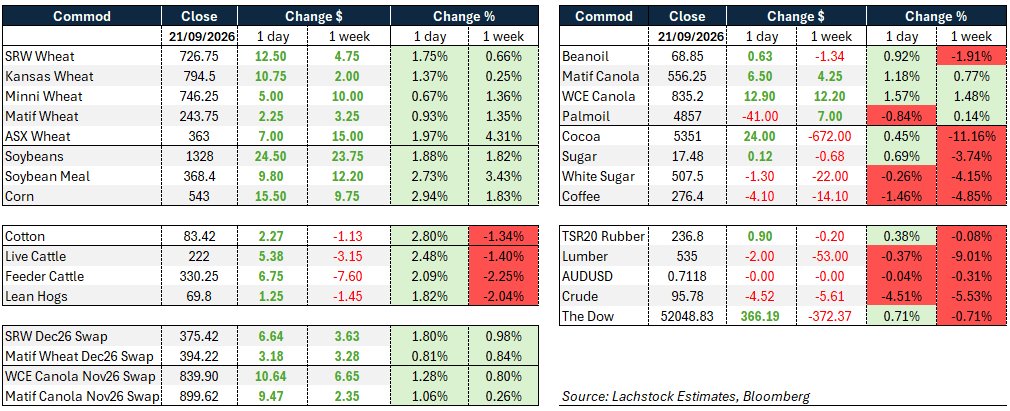
 Wheat: Chicago and Kansas wheat clawed back all of Friday’s losses as Trump-Xi II opened the week with Bessent and Lifeng having pre-staged a unified front over the weekend.
The market’s mental model from last May’s China visit was 25Mt of beans plus 17 billion dollars of annual ag purchases; the beans leg is tracking, but the 17 billion had been largely dismissed until Monday, and traders are now pricing the chance that lower tariffs and some form of bilateral trade board bring US wheat back into China’s basket, however uneconomic that remains against world FOBs.
Black Sea tension added its own bid: Ukraine struck deep into Russia around Moscow during the parliamentary election that returned Putin’s United Russia party on 57.83pc of the vote, while Turkey continues shuttling between the two sides and Zelensky has signalled openness to meeting Trump at the UN this week, where Trump addresses the assembly Tuesday.
Putin, notably, has chosen APEC in China over the G20 leaders’ gathering.
On tenders, Pakistan covered only 365,000 of 750,000t sought at US$348.83 c&f, with gluten specs and internal politics cited for the shortfall, and reopened for a further 185,000t closing September 28; most of what was bought likely ships from Bulgaria or Romania.
US wheat inspections of 335,000t matched expectations but sat 32pc behind year-ago pace, and winter wheat planting reached 17pc versus 16pc expected, against a five-year average of 21pc.
Other grains/oilseeds: Corn had a rare session, spiking 15.5c on speculation China involvement lay behind the move, whether via futures ahead of a physical purchase or reserve-directed state buying timed awkwardly close to China’s own harvest; the EU’s looming need for Ukrainian corn as that country ramps shipments adds another support leg.
Corn inspections of 1.939Mt beat every estimate and lifted the marketing-year pace 16pc, while crop conditions held at 57pc and harvest reached 13pc, both roughly in line with expectations.
Soybeans rode the same 17 billion dollar narrative, which could translate to an extra 5Mt of US demand; meal surged as western-belt wetness persists, with the December crush up 4 to 239.75.
Bean inspections of 759,000t beat forecasts, conditions held at 58pc and harvest reached 12pc, but the crop remains too wet, with more rain forecast for the beleaguered central and western areas.
In Winnipeg, canola tracked strength in Chicago soy and European rapeseed even as Malaysian palm slipped; the November contract cleared its major moving averages on a slow Prairie harvest, particularly in Alberta, though a run of 20-plus-°C-rain-free days ahead should help. The Canadian dollar eased to 71.24 US cents from Friday’s 71.42.
Macro: Crude sold off hard, with the move read largely as long liquidation, even as diesel politics intensified in Washington. Agriculture Secretary Brooke Rollins said Trump called her Monday to discuss diesel prices, which touched a record $6.51 a gallon, and signalled an announcement was likely soon; farm-state Republicans including Grassley, Hinson and Louisiana’s Landry are pushing for an export ban, while Energy Secretary Chris Wright and API’s Mike Sommers warn that curbing exports would raise gasoline and jet fuel costs instead of easing them.
Bloomberg separately reported Moscow will extend its own diesel export ban beyond September as Ukrainian strikes keep refining rates depressed, with diesel’s premium over crude near $84 a barrel in Europe versus about $28 in February.
On rates, ANZ now expects the RBA to hike 25bp in September on top of a previously flagged November move, taking the cash rate to 4.85pc, the highest since 2008, while also adding hikes to its RBNZ (to a 3.50pc OCR peak) and Bank of England (to 4.25pc by February 2027) forecasts, with the RBA still expected to ease from November 2027 .
Local: Through the west of the country bids started the week firmer for canola bid A$880/t with no discount to GM, wheat was $386 and barley $327 FIS Albany. In the east canola was steady around $815, wheat $356 and barley $297 track Geelong.
New crop oat prices in the west of the country have rallied nearly $100 from August lows to be bid $372 FIS Kwinana. GIWA is forecasting production near 800kt, but current demand for oats is strong however it can quickly come under pressure once harvest selling starts in earnest.
New crop hay values have softened in the Darling Downs, currently bid $450 delivered back from $475 last week. Plenty of hay hitting the ground now through more southern regions where cereal hay is worth $200-220/t ex farm and vetch $280-300.
Chickpeas remain well bid in the north with delivered Darling Downs currently bid around $835.
HAVE YOUR SAY