

Weather:
Northeast Iowa is dealing with severe flooding after 3.5 to 5 inches fell across most of the region in a week and up to 8 inches locally, with harvest days away until soils improve and ear and stalk rots a growing concern, while BAM Weather expects western harvest delays against increasingly favourable windows in the eastern Corn Belt.
Plains rain shifted west and lightened over the wheat areas, with eastern Kansas and southeastern Nebraska now looking to about 0.75 to 1.5 inches around 28–30 September, and CPC flagging a slight risk of heavy precipitation across the southern Plains from 30 September to 4 October.
In Australia eastern Pacific waters are now well above the El Niño threshold, with NINO3.4 at +2.35°C, and global models lean drier and warmer for Victoria through November, while models suggest a positive IOD could develop this spring. Advanced crops across southern growing regions carry heightened frost risk, though above-average soil moisture should blunt some of it.
In Brazil Inmet forecast above-average September rainfall across the Central-West, including north-central and southeastern Mato Grosso, but DTN still sees Mato Grosso and the northeast at higher risk of prolonged dryness through the El Niño season.
Markets
The trade is risk-off into Trump/Xi, the truce extended to 10 January but expectations for ag deals low, leaving heavy fund length and a firmer dollar the bigger near-term risk.
Wheat headlines keep promising Black Sea diplomacy while strikes continue, and nothing works until Matif Dec shows a pulse, with French supply in commercial hands, funds long 158k and buyers turning to India and the Baltic.
Oilseeds are balanced between an unsolved meal market with Iowa underwater and diesel export curb chatter adding bean oil volatility, while India’s duty cuts support veg oil demand even as palm sits at seven-week lows.
Locally ASX wheat held A$360 with Matif swaps about A$20 over SRW, while canola swaps firmed on a 76-point AUD drop and China’s second private purchase of new-crop Australian canola underpins Lachstock’s record 6.75mt export view
Day Ahead – Australia
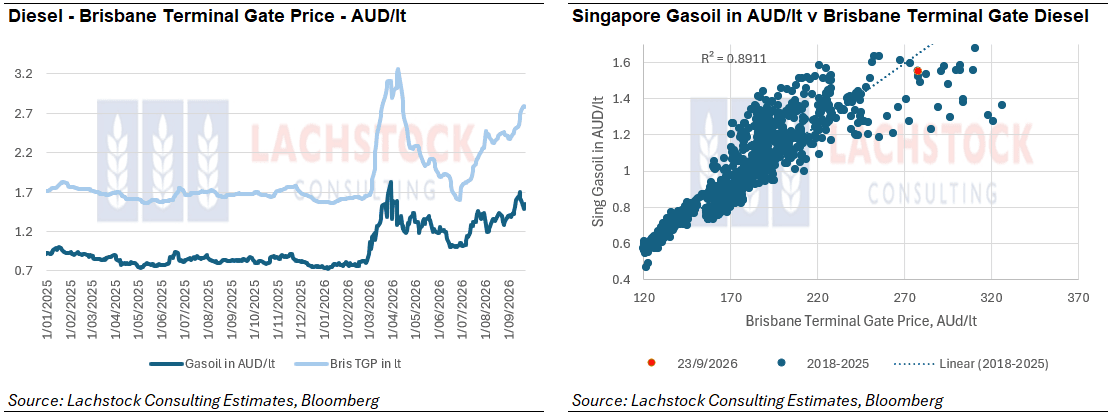
Going home yesterday, news wires were suggesting the US had officially banned diesel exports. This morning its clear this was a little per-emptive but there are those that want to see this happen. The impact of this would be widespread – Europe is a big buyer of US diesel and, with around 15% of French servos out of diesel already, this would be massively destabilizing.
If the current trajectory of diesel prices continue the Aussie market will be faced with the choice – who pays – does ex farm values drop or do delivered values rally – probably a little of both.
Warm temps through the southern belt, offshore noise, export margins – so much to deal with.
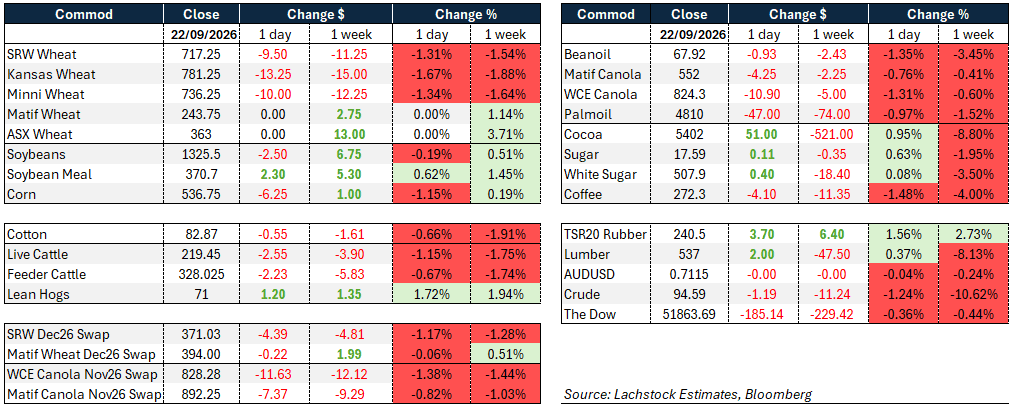
 Wheat: Wheat stayed under pressure, WZ dropping 8.75c, KWZ 9.5c and MWZ 7.5c.
Chicago touched its lowest since August on hopes of easing in the Black Sea, with a Russian spokesperson flagging talks with Turkey on ending strikes on grain vessels. The UNGA diplomacy again ran into battlefield reality.
Lavrov told the Security Council Moscow would not pause its special military operation and cast the EU’s ceasefire push as a bid to rearm Ukraine.
Overnight Russia struck port, civilian and food storage infrastructure in Odesa and hit an Antigua and Barbuda-flagged cargo vessel, killing its captain. Ukraine is working around the blockade. Authorities will clear Danube-bound vessels for the Sulina Canal while they are still at sea, to erase a two-week queue.
Heavy rain across Ukraine for at least the next week will slow the late grain and oilseed harvest.
Matif Dec lost €3.25 to €240.50 and March €2.50, with Russian cash up $3 to $213.
French wheat is the missing link. It is available and the logical answer to EU feed deficits and a BSEA substitute, yet Dec/March shows no life, with the crop in commercial hands and money managers reportedly long 158k.
Coceral trimmed EU and UK soft wheat to 137.5mt from 140.8mt. Buyers are making other plans.
Bangladesh has booked more than 200kt of Indian wheat since New Delhi lifted its export ban in late August, the first significant sales since 2022.
Baltic and EU origins are having a run, and Tunisia bought 125kt for Nov/Dec at $311.72–314.23. U
S wheat remains well above the world market, with export sales tipped at 475kt Thursday.
Further out, SovEcon puts Russian winter grain plantings at 6.1m ha versus 7.1m a year ago, the slowest since 2013, on financial strain from disrupted exports.
BAGE cut Argentina’s 2026/27 wheat to 23.4mt from 27.8mt last year.
Locally ASX eased A$3 to A$360 but held A$4 up on the week. The SRW Dec26 swap slipped A$0.77 to A$370.26 and the Matif Dec26 swap fell A$3.19 to A$390.81, narrowing Matif’s premium to about A$20.55. The weaker AUD cushioned both.
Other grains/oilseeds: Corn met another offer, CZ down 7.75c and all but erasing Monday’s surge, as harvest, cheaper South American supply and an overly long market outweighed a constructive forward story.
Argus pointed to the stronger dollar and Treasury yields capping grains and warned prices are backing into technical levels that could invite further declines.
Demand is holding up, with 100kt sold to Mexico and export sales tipped at 1.1mt. Coceral slashed EU and UK corn to 48.6mt from 52.7mt in July after heat and dryness, deepening the EU feed deficit. Ethanol output slid to 1.028m b/d against 1.057m expected, the lowest since early May, and stocks drew to 24.683m bbl versus 25.08m expected.
BAGE sees Argentina’s corn rising to 66mt from 64mt and soybeans to 53.6mt from 50.1mt, pointing to a record grain crop.
Paraná soybean planting jumped to 15% as El Niño rain arrived, the second-fastest pace behind 2023. Beans fell as crush surged. SX lost 7.5c, SMV gained $1.40, SMZ slipped $0.10 to 370.60 and BOZ fell 11 points to 67.81, lifting Dec crush 6c to 243.25.
Meal remains unsolved. Processors are short beans even after August downtime, with Iowa too wet to harvest.
Yield questions, the summit and selective El Niño-year selling in South America add further support.
The diesel export debate is feeding bean oil volatility. Wright hinted at a voluntary cap rather than a ban, and Ag Bull’s Jim Wiesemeyer warned an outright ban could cut refinery throughput and actually raise farm diesel costs.
The market, though, is solving for a biofuel mandate rather than diesel demand, and one study projects global biofuel output up nearly 70% by 2030 as blending mandates rise.
Export sales are tipped at 1.75mt beans, 300kt meal and 3kt oil.
India cut the basic duty on crude palm and soy oil to 5% from 10% and on refined to 27.5% from 32.5%, and scrapped the crude sunflower oil duty, all effective 24 September.
The monsoon has delivered 713.3mm against 837.7mm normal.
Palm still fell 42 to 4768, its lowest since early August, on swelling Malaysian stocks.
ICE canola recovered from early losses to close fractionally higher on 59,825 contracts, Nov up C$0.80 to 825.10, as crude turned around intraday.
Resilient Capital’s Jerry Klassen sees canola heading lower into October. Harvest is accelerating and deliveries are picking up, StatCan’s 22.05mt estimate has taken out risk premium, and exporters are well covered nearby.
A private Chinese crusher bought 68kt of new-crop Australian canola for March shipment, the second private cargo and the first such trade since 2020.
Klassen flagged it as a growing threat to Canadian sales into China.
AAFC has Canadian exports at 8mt, down 1.1mt, while Lachstock projects record Australian exports of 6.75mt, 2.2mt of it to China.
Manitoba’s harvest reached 43% with quality below average to average, and the loonie eased to 70.93 US cents.
Macro: Crude fell US$2.43 to US$92.16, down 10% on the week, even as Iran’s Pezeshkian told the UNGA there would be no freedom of navigation through Hormuz while sanctions and the US blockade remain.
Diesel is now the policy flashpoint, with retail prices at a record US$6.52/gal per AAA ahead of the November midterms.
Wright warned refiners to brace for possible export curbs, then publicly pivoted to a voluntary, cooperative effort and ruled out a blanket ban.
The White House called Politico’s report of a 90-day ban fake news.
The cabinet is split, Rollins supportive and Bessent cool, while Grassley urged the White House to ignore Big Oil and industry warned curbs would backfire within days and risk a European recession.
Bessent extended the US-China trade truce by two months to a 10 January deadline as Xi landed at Joint Base Andrews to a tarmac welcome from Trump, with the state arrival ceremony Thursday morning. Bessent was noncommittal on a bigger deal, Xi arrives without a business delegation, and Trump is pushing for ag and aircraft purchases.
US 10-year yields above 5% weighed on risk. The Dow shed 352 points and the Aussie dropped 76 points to 0.7039 on the stronger US dollar.
Trump said the US would keep buying Canadian potash despite Belarus offering lower prices .
Local: Canola was softer yesterday, back A$12/t to $875, while wheat eased $3 to $382, and barley was $325 FIS Albany.
Through the east, canola was also softer at $815, with GM at a $26 discount. Wheat was $356 and barley $295 track Geelong.
Rainfall is building through southern WA, with 25–50mm forecast across much of the Albany and Esperance zones and 10–25mm further north through the production zones. There is some debate around how much benefit this will provide at this stage of the season. Wheat should benefit the most, while some later southern canola crops may still add yield. Harvest has already started through Geraldton, so the rainfall is unlikely to have a meaningful impact there.
Barley markets remain lifeless as you move away from northern markets, with Chinese export demand for new crop slow to virtually non-existent. Domestic buyers are either waiting for harvest pressure to build or are already well covered with new crop. There has been a little more engagement on old crop from China ahead of Golden Week at the start of next month, as buyers prepare for the holiday shutdown, although enquiry is still coming from a very low base .
HAVE YOUR SAY