
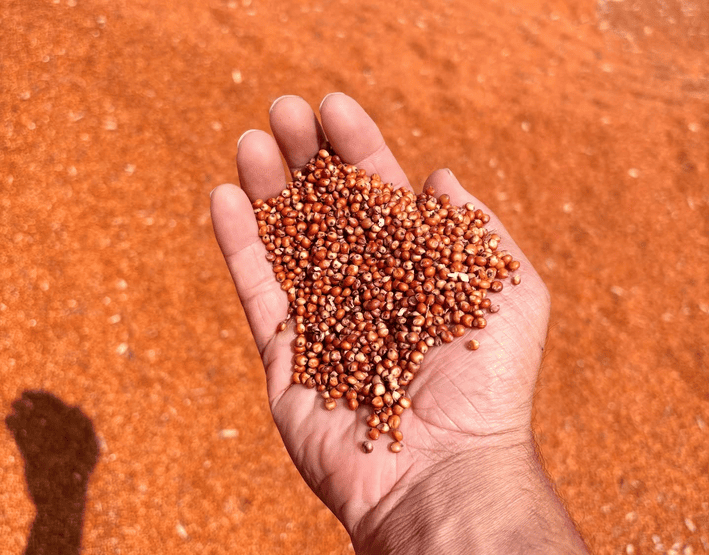
Sorghum is Qld’s biggest summer crop. File photo: GrainCorp
RESEARCH from Queensland’s Department of Primary Industries has found opportunities to market sorghum and other millet-based foods to Australian consumers, with health benefits and gluten-free status offering potential advantages in the marketplace.
The research found some products required further refinement, with bitterness and aftertaste potentially deterring some consumers.
There are currently few products marketed in Australia as containing sorghum, with most foods featuring sorghum or other millets as part of a multigrain offering.
One example is Weet-Bix’s gluten-free range, which is marketed as containing Australian-grown sorghum.
Overseas, sorghum is more widely used in food and alcoholic drinks, including Chinese baijiu, as well as being milled into flour for flatbreads such as roti and for porridge.

Ishita Pramanik
QDPI consumer and sensory scientist Ishita Pramanik and QDPI food technologist Philippa Harmon discussed the findings of the project during a recent QAAFI Science Seminar event.
The research featured a combination of food trials and consumer surveys and feedback.
It tested a variety of sorghum and millet-based chips, sweet and savoury porridge and beer.
Ms Pramanik said the results showed consumers viewed sorghum and millet products positively when they were marketed and formulated appropriately.
“After tasting all the products, about 84 percent of participants indicated that they would definitely purchase millet products again,” Ms Pramanik said.
“Consumers also highlighted brand communications, online platforms and cooking shows as their preferred channels for learning about the health benefits.
“The opportunities here is clear; the market is ready when we pair the right sensory profiles with transparent health messaging.”
During the validation phase, the team recruited 101 consumers to taste and evaluate the foods individually, alongside 52 beer drinkers who benchmarked the millet ale against other gluten-free options.
The food products were assessed on appearance, colour, aroma, flavour, texture and overall appeal, while the beers were evaluated specifically for body and carbonation.
“Looking at the big picture, overall consumer feedback was positive, but success in each category came down to a few key areas.
“The success in chips required nailing the crisp texture, over 74pc of participants felt that the chips met and exceeded expectations, with majority willing to pay the standard retail corn chip prices.”
Ms Pramanik said two-thirds of the participants viewed the chips as a “strong commercial alternative across the age groups” and a “great option for catering to dietary needs”.
With the porridge, she said it depended on “hitting the perfect sweetness and flavour intensities”.
“Across both formulations, 64-74pc of consumers reported that they met and or exceeded expectations with strong purchase-intent at current retail oat prices.
“In fact, nearly a third were willing to pay a premium of retail for the top formulation.”
She said the savoury versions showed “surprising versatility” with some consumers preferring them as a “convenient flavour-forward everyday lunch solution”.
Ms Pramanik said, in the beer taste-testing, the sorghum-based Indian pale ale matched an English brown ale for “flavour and overall liking”.
“Most importantly, it stood out for its fuller mouthfeel, which is a major technical win in the gluten-free brewing.”

Sorghum chip development
The research also involved developing a sorghum chip product, which was taste-tested alongside commercially available corn chips.
Ms Harmon said the team opted to create a baked and fried chip with formulas using several different sorghum flours commercially available.
She said the “biggest technical hurdle” was moisture retention, with moisture levels in the sorghum chips ranging from about 3.5-5pc, compared with a benchmark of 2pc.
She said this factor was “important for achieving that characteristic crunch and contributing to a long shelf life”.
Three sorghum chip formulations were taste-tested by consumers against benchmark products, including commercially available corn chips and corn chips produced by the research team.
As part of the experiment, Ms Harmon said the team was “focused on bitterness and bitterness aftertaste”, which had been identified as key issues for sorghum-based foods.
“These were the two key challenges when we’re trying to understand millet-based products and by measuring these attributes separately, we can identify which materials and formulations have the greatest potential for other developments,” Ms Harmon said.
She noted that Woods Group sorghum had the lowest bitterness score comparable to the corn benchmark, followed by the Outback Harvest sorghum.
She said both were red sorghum varieties, with the Woods sample also having free fatty acid and seed fattiness levels closest to the cornflour.
“We’ve demonstrated that sorghum can be successfully produced in a chip using relatively simple equipment, although moisture management may need to be optimised at scale.
“From a sensory perspective, the biggest challenge we’ve identified is what we’re calling the bitterness barrier.
“We found that different sorghum flours behave differently and as our results suggest that flour quality and lipid stability may play an important role in that bitterness.”
The project was funded by Grains Research and Development Corporation and the Department of Foreign Affairs and Trade.
HAVE YOUR SAY