

Weather:
The director of USDA’s Midwest Climate Hub expects little or no harvest progress through the central Corn Belt after repeated rain, with the second week of October shaping as the driest window, and Iowa had just 1.7 days suitable for fieldwork against 4.9 at the same point last year.
Eastern Kansas and southeastern Nebraska are forecast to get roughly 0.75–1.5 inches around Sept 28–30, and CPC flags a slight heavy-rain risk across parts of the southern Plains for Sept 30–Oct 4, arriving with winter wheat 17% planted nationally against a 21% average and Oklahoma at 4% versus 14%.
Southern Europe, the Black Sea and Argentina are expected to stay warm and dry, with the chance of a very strong El Niño put above 90% and the event potentially lasting into early 2027, while the Rhine sits at another record low.
Markets
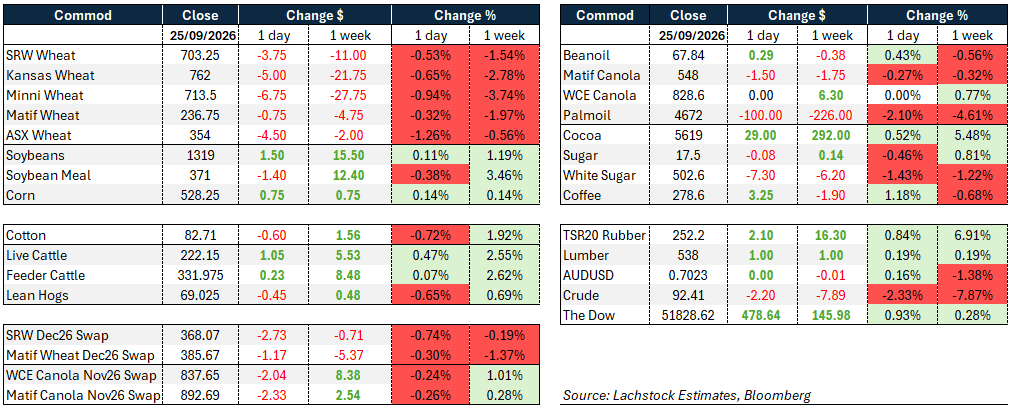
Wheat rebounded from a 23.5c intraday loss as ceasefire talk collided with continued strikes on shipping and ports; Russian September exports near 2.3 mil t against a 5 mil norm keep the supply case alive, but 158k Matif MM longs and no nearby pull are capping Paris.
Corn’s low held on the estimated 515 average MM long, and Wednesday’s stocks report, softer anecdotal yields and the seasonal turn toward Ukrainian corn leave the market exposed to swings both ways.
Beans recovered 21.5c off the low on Monday’s promised Trump/Xi detail and western harvest delays that have crushers paying up, but the market needs Chinese buying beyond the 25 mil t already priced. – Diesel is the macro swing factor, with a US export ban under serious consideration while crude lost nearly 8% and palm 4.6% on the week, keeping vegoils heavy even as Canadian crush sets a record.
Day Ahead – Australia
More of the same offshore – markets have been looking hard for some sort of way forward in both conflicts. Russia/Ukraine hope of a cease fire was basically crushed with more attacks from both sides. Donald even encouraged Zelenskyy to sit down with Vlad – Zelenskyy replied, saying the only way he would go to Moscow is on a missile.
Meanwhile, the talk around Don banning diesel exports from the US continues to move markets. Globally, refining margins tell the story – the world is hungry for diesel and capactiy has been impacted
Rain for southern NSW will certainly help. Sideways to kick off the week.
.
 Wheat: Wheat limited the damage after an overnight rout. WZ was 23.5c lower early in the day session before settling down 3.75c, with KWZ off 5c and MWZ 6.75c.
The selling came from a stream of headlines about a BSEA reopening and a possible ceasefire, and from the lack of any Chinese purchase announcement after day one of the Trump/Xi summit. The market turned once USTR Greer said substantive announcements were coming Monday and Trump said US farmers would be happy. That risk was enough to flip order flow into the weekend.
On the water, nothing changed. Russia claimed strikes on five dry-cargo ships at Odesa and in the Black Sea, plus berthing and storage at Reni. Ukraine hit two Russian refineries. Peskov said no substantive Black Sea security negotiations are underway, even as Zelenskiy named India, Turkey and Egypt in unblocking talks and said the US has proposed a technical-level trilateral in the UAE.
Rusagrotrans puts Russian September exports at 2.3 mil t against a typical 5 mil, with July to September at 6.6 mil. Russian cash held at $213.
Egypt bought Baltic cargoes, with Russian wheat offered at $277 FOB Riga and $270 FOB Vysotsk, and also bought Ukrainian coasters at $300-304 for 11.5% protein.
Paris remains the problem. Matif Dec slipped €0.75 and March €1.25, nearby shows no pull on supplies, the crop is in commercial hands, and 158k MM longs are waiting to get paid.
Chicago MM is short 13.1k after selling 7.7k, while KC is long 41.8k and Minneapolis long 21.4k. The SRW Dec26 swap fell 2.73 to 368.07 and is off just 0.71 on the week. The Matif Dec26 swap eased 1.17 to 385.67, down 5.37 weekly. ASX underperformed, down 1.26%.
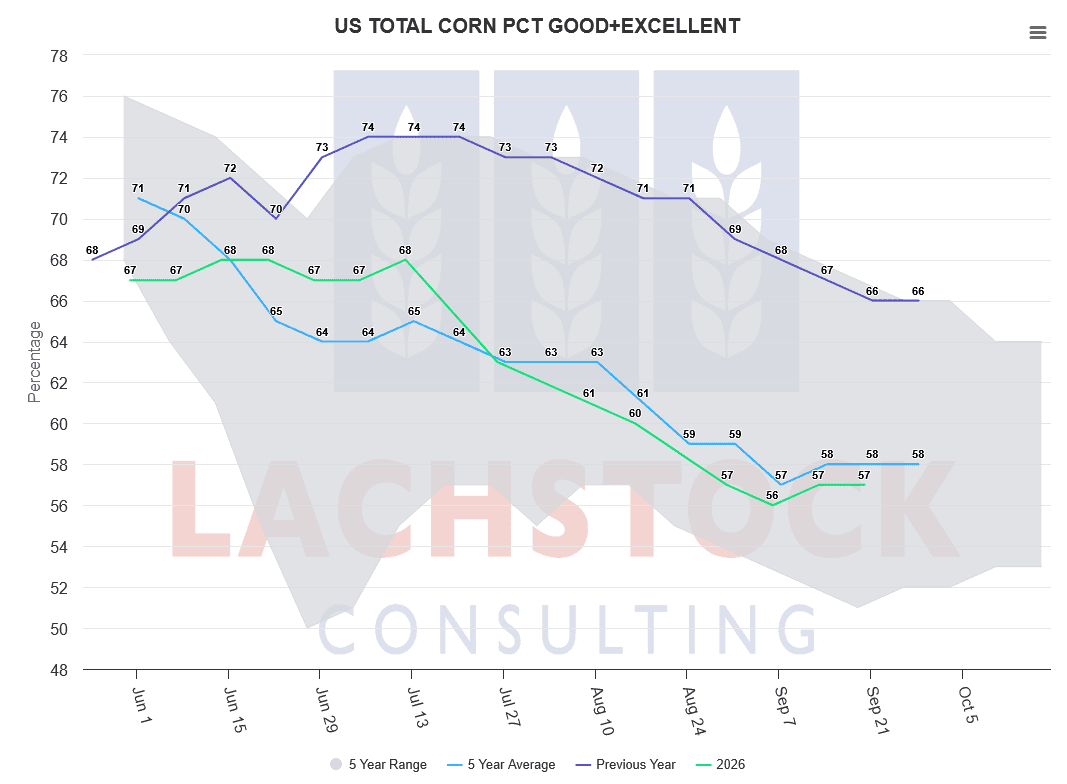
Other grains/oilseeds: Corn mirrored wheat but recovered fully. CZ closed up 0.75c after trading 13.5c lower, and the selling stopped about an hour into the day session once forced exits were done. The low of 514.75 sat almost exactly on the estimated 515 average MM long entry.
AgResource read the drop as momentum-driven rather than fundamental. The risks now run both ways: anecdotal yields point lower, quarterly stocks are due Wednesday, and Ukrainian corn demand normally builds from here.
South American corn is still cheapest, but US demand is visibly coming.
FranceAgriMer held French maize at 23% good/excellent and 49% poor/very poor, with harvest at 45% against 13% a year ago and an 11% five-year average.
Soybeans traded 20c lower before closing up 1.5c. Support came from the Greer headline and a sloppy western Midwest forecast, which has western crushers paying hefty premiums for nearby beans and some plants scaling back.
Products reversed: SMV fell $2.20 and SMZ $1.40, BOZ gained 29 pts, and Dec crush slipped 1.25c to 243.5. The open question is whether Xi takes more than the 25 mil t already expected.
StoneX’s Matt Zeller noted the September stocks report has produced bearish bean moves in each of the last five years.
Patria AgroNegocios sees Brazil’s 2026/27 crop at 173.75 mil t, down 3.3%.
ICE canola finished steady to firmer after early losses, with Nov settling unchanged. Chicago’s turnaround helped, while sharply lower crude capped vegoils.
Statistics Canada reported a record August crush of about 1.24 mil t. CGC exports recovered to 43,300 t in the week to Sept 20, taking YTD to 752,900 t against 627,400 last year.
The WCE Nov26 swap eased 2.04 to 837.65 but is up 8.38 on the week.
Palm fell more than 2% on higher output and weak exports, although El Niño dryness is expected to cut Indonesian and Malaysian production in 2027.
Romanian and Bulgarian sunflower seed hit one-year lows on bigger supplies and expectations of renewed Black Sea corridor flows.
Macro: AUDUSD 0.7023, unchanged, up 0.16% on the day, down 0.01 or 1.38% weekly; Crude 92.41, down 2.20 or 2.33%, down 7.89 or 7.87% weekly; The Dow 51828.62, up 478.64 or 0.93%, up 145.98 or 0.28% weekly.
Crude fell another 2.33%, taking the weekly loss to nearly 8%, despite fresh Middle East risk. Houthi missiles targeted Yanbu and Taif, and Saudi, Turkish and Pakistani military chiefs are meeting to discuss support under their defence pact.
Diesel is the bigger ag story. Trump said Sunday he is looking very seriously at a US export ban, and Hassett, Bessent and Greer have spent the week analysing a short-term halt.
US retail diesel hit a record near $6.50/gal last week, and exports ran near a record 2 mil bpd last month. A ban would likely drop domestic prices in the short run but leave Brazil and the UK scrambling for fuel. The oil industry is pushing a suspension of the federal excise tax instead, and Energy Secretary Wright is working with refiners on voluntary curbs.
Peskov separately said lifting Russia’s export ban alone wouldn’t boost diesel supply without sanctions relief and safe Black Sea shipping.
Capital Economics sees US-China relations still stuck on core disagreements despite the truce, with detail due Monday.
The Rhine fell to another record low, hampering transport, and India’s cumulative monsoon rain was 13% below normal as of Sept 25.
The Dow gained 0.93%. AUDUSD held at 0.7023 but gave up 1.38% on the week.
Local: Bids in the west were softer to end the week, with canola back A$10/t to $880, wheat off $2 to $384 and barley at $325 FIS Albany.
In the east, canola was back $5 to $829, wheat was $371 and barley $304 track Port Kembla.
Some good falls across WA over the weekend, with southern Kwinana, Albany and Esperance recording between 20-100mm. Welcome through these areas and, while it may not add a lot of yield for most, it should certainly help stop the rot.
Interesting to read that strong grain and feeder cattle prices are squeezing Darling Downs lotfeeding margins, with $540/t rations and 520c/kg feeders leaving a typical 100-day program showing a loss of around $170/head against an 875c/kg forward grainfed cattle price. Better-performing cattle at 2.2kg/day ADG narrow the loss to around $72/head.
HAVE YOUR SAY