
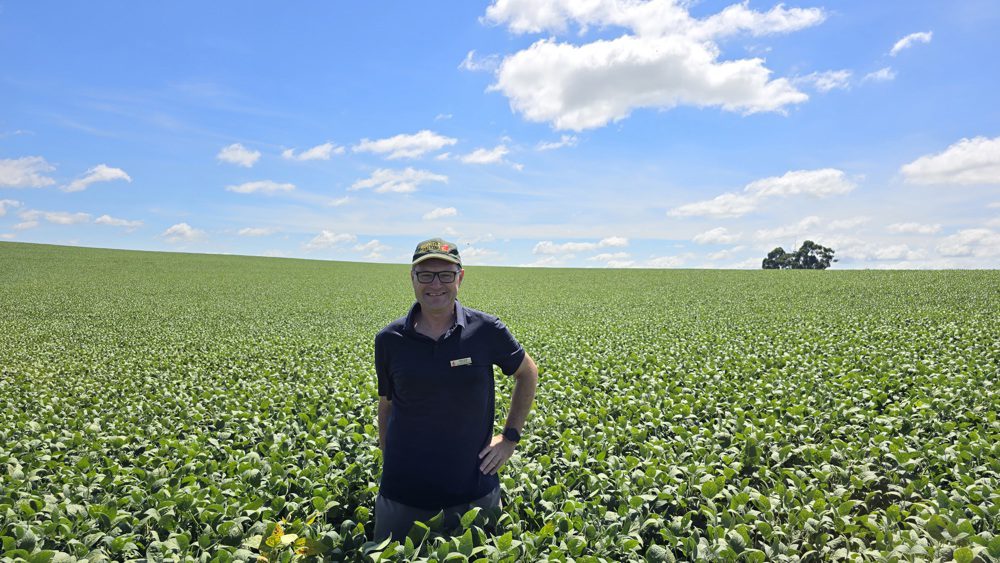
WA grower Ashley Wiese was a Nuffield Scholar in 2024.
BREAKFAST choices are not between Australian and Canadian oats but between oats, toast, congee and eggs, the reframe at the heart of a new Nuffield Australia report by 2024 scholar Ashley Wiese, who argues the Australian grains industry has been selling the wrong thing: grain rather than food.
Mr Wiese, a 2024 Nuffield Scholar, farms sheep, grain and hay with his wife Jo at Narrogin in Western Australia’s Great Southern.
His Nuffield study was supported by CBH Group, and saw him visit close to 100 businesses across Brazil, New Zealand, Canada, the United States, Kenya and the United Kingdom to find out how other industries have broken away from commodity pricing and created real value for producers.
“As a farmer I had always focused on selling our grain,” Mr Wiese said.
“Now I was thinking about solving someone’s problem.”
His report argues consumers do not connect to agricultural commodities, but connect to food, and industries that create real value tell food stories, not farming stories.
Examples include certified Angus Beef building a global brand by talking about steak dinners instead of carcase traits, and Bord Bia lifting the value of Irish dairy and beef exports by packaging sustainability data and provenance stories for supermarket use without taking title to the product.
Mr Wiese knows the model works because he has built it himself through Three Farmers quinoa and Red Tractor wheat-free oats.
Grown on the same WA property, they have replaced imported products on Coles and Woolworths shelves, with the oats now the best-selling product in Woolworths’ health food aisle two years running.
Where’s the marketing?
Mr Wiese’s report recommends the grain industry funds a dedicated, pre-competitive body to collect data and tell consumer-facing food stories, filling the gap left since the Australian Wheat Board’s single desk was dismantled in 2008.
Mr Wiese argues that this body could work within current industry structures to establish and resource its functions and pursue structural reform to create or reshape institutions so this function is embedded and sustainably funded.
He said that Grains Australia could be one solution to “deliver this pathway within its current market insights and market-delivery pillars”.
“The objective is to shift selected grains from commodity positioning to problem-solving food ingredients, increasing demand elasticity and resilience against global commodity pricing,” the report said.
Mr Wiese’s other suggestion was to create a new Australian grains marketing body.
This could be done using GRDC resources, but would require legislative change, or would require other funding options to be explored.
“Governance options could include a new statutory marketing corporation or an industry-owned commercial partnership model sitting alongside RD&E.
“The structure must remain industry-controlled, operate on a pre-competitive basis, and avoid distorting exporter competition.
“Funding options may include allocating a portion of the existing levy, securing government co-investment, introducing a voluntary levy across processors and bulk handlers, or adopting a blended model.”
Mr Wiese said the organisation – either new or within an existing body – should create an “industry-owned platform” focused on food rather than grain.
It would undertake a range of functions, such as:
- Develop validated consumer-facing stories backed by facts in order to connect at a consumer level;
- Invest in the development of a consumer-facing logo that is consistent across all storytelling in the Australian grain industry;
- Link Australian grain qualities to food outcomes;
- Provide market-ready assets to exporters and manufacturers;
- Align with existing sustainability frameworks;
- Operate on a pre-competitive basis;
- Deliver measurable farm-gate return;
- Avoid distorting exporter competition;
- Focus on premium capture, not volume promotion; and,
- Be independently evaluated.
He said the organisation should also establish a centrally governed digital repository which is discoverable on digital platforms containing consumer-facing stories, and featuring resources that are factual, relevant and fit within a framework established by industry.
Mr Wiese’s full report is available on the Nuffield Australia website.
He presented his findings at the 2025 Nuffield National Conference in Adelaide.
Source: Nuffield Australia
HAVE YOUR SAY