
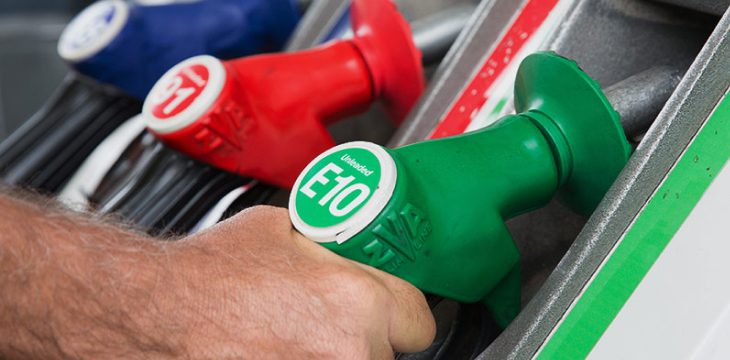
QUEENSLAND MP Shane Knuth is seeking to overhaul the state’s ethanol laws, with changes aimed at increasing demand through mandating a minimum level, strengthening compliance and closing loopholes.
The Member for Hill, an electorate located in the Atherton Tableland, introduced the Liquid Fuel Supply (Ethanol and Other Biofuels Mandate) Amendment Bill 2026 into the Queensland Parliament in May, and a committee is currently undertaking an inquiry into the potential impacts of the proposal.
If passed, the bill would amend the Liquid Fuel Supply Act 1984 to require fuel retailers:
- take all reasonable and practical steps to ensure that the bio-based petrol blended fuels marketed as E10 contain a minimum of 9 percent ethanol, all other bio-based petrol blended fuels contain a minimum of 1pc ethanol, and diesel fuels contain at least 2pc biodiesel; and,
- display the octane rating for fuels marketed as E10.
The bill would also increase penalties for non-compliance, introduce new operational requirements governing the sale and composition of blended fuels, and replace existing subjective compliance defences with a stricter, evidence-based due-diligence framework.
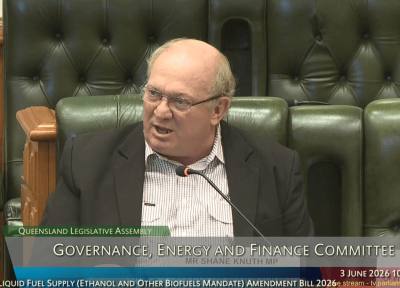
Shane Knuth
Under the proposed defence provisions, the burden of proof would be reversed, requiring fuel sellers to demonstrate they have active compliance systems and have exercised due diligence.
Primarily designed to support demand for sugar cane-derived ethanol, the bill has also garnered support from the Manildra Group, a New South Wales-based ethanol and gluten producer and flour miller, and Australia’s largest wheat buyer.
Submissions to the inquiry also highlighted the failed Dalby Bio-Refinery and the impact of weak ethanol demand on its long-term viability.
The plant, which closed in 2020, was a major market for Darling Downs sorghum, consuming up to 200,000 tonnes a year at full capacity.
Speaking at a public hearing in June, Mr Knuth said the bill was about more than securing demand for ethanol, arguing it was also about “long-term fuel security, state and national resilience, regional jobs, agricultural diversification and ensuring Queensland is not left behind while the rest of the world moves on”.
“The current fuel crisis, instability in the Middle East, global shipping disruptions and fertiliser shortages have exposed just how vulnerable Australia has become,” Mr Knuth said.
“The National Farmers’ Federation, GrainGrowers, Australian Sugar Manufacturers and Canegrowers have jointly warned that Australia’s dependence on imported fuel represents a strategic vulnerability and have collectively called for an immediate national ethanol and biodiesel mandate.
“All of these groups support the bill before the committee, so this is not the KAP’s position alone.
“This is now the position of Australia’s major agricultural and manufacturing bodies representing more than 150,000 farming business businesses nationwide.”
Mr Knuth said a key part of the bill was ensuring E10 comprised the level of ethanol it was marketed as containing.
“When Queensland motorists purchase E10, they reasonably expect they are receiving a fuel containing approximately 10pc ethanol.
“However, under current arrangements, E10 can legally contain significantly less, with the average ethanol content rarely exceeding 3pc.”
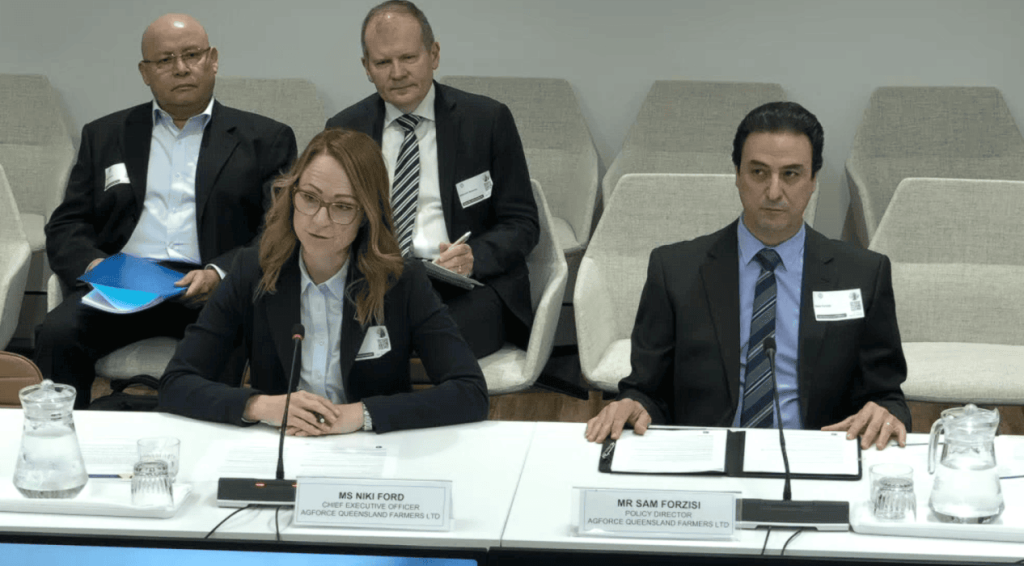
AgForce CEO Niki Ford and policy director Sam Forzisi at the table at a public inquiry last month.
AgForce, Manildra supportive
Although not major beneficiaries of the proposal, Manildra sent in a submission in support of the bill and urged for its passage.
“The proposed reforms provide a practical and proportionate response to the underperformance of the existing Queensland renewable fuel mandate,” the submission said.
“They will improve the integrity, transparency and enforceability of the framework, while preserving suitable flexibility for fuel suppliers and recognising legitimate supply constraints.”
Manildra’s submission said the current mandate had not “produced the level of renewable-fuel uptake necessary to realise its intended benefits”.
“Actual ethanol sales and blending outcomes have remained materially below the applicable target.
“This is not evidence that ethanol is unavailable, unsuitable or unwanted by motorists; rather, it demonstrates that the existing framework has not sufficiently aligned commercial incentives, compliance obligations, public reporting and enforcement consequences.”
AgForce chief executive Niki Ford told a hearing on 10 September that farmers needed an ethanol mandate that supported domestic feedstock production, which she said Qld was well placed to supply.
“AgForce’s primary interest is in the outcome and that the mandate actually works,” Ms Ford said.
“It needs to be credible, enforceable, and capable of supporting investment while maintaining competitive fuel prices for agriculture, regional businesses and consumers.”
Ms Ford said Qld had an opportunity to lead the nation and drive growth in Australia’s biofuels industry.
“We need to turn Queensland’s feedstock advantage and production scale into domestic biofuels as soon as possible and ensure that producers in regional communities participate in that value creation.”
AgForce policy director Sam Forzisi said the bill should also be accompanied by an education campaign informing consumers about the facts around ethanol-blended fuels.
“We feel that in the past there has been a bit of a fear campaign around putting ethanol into petrol tanks and the consequences that may have on engines,” Mr Forzisi said.
“We have come a long way in the development of motor vehicle manufacturing.
“It has been very well shown overseas that ethanol in fuel tanks does not harm vehicles, so that kind of education and reassurance could ensure ethanol could be part of the broader fuel production system in Queensland.”
Petrol industry push-back
Representative body the Australian Institute of Petroleum (AIP), argued against the bill, with its submission saying a minimum ethanol level for E10 was “unnecessary” and further biofuel mandates would lead to an increase in fuel prices.
AIP’s submission said national data demonstrated average ethanol content in E10 was almost 9pc, close to the floor proposed by the bill.
AIP chief executive officer Malcolm Roberts said he was not aware of any case where the amount of ethanol fell substantially short of the expected 10pc, as contended by Mr Knuth.
He said there was no evidence that the Bill would be beneficial to Queenslanders.

AIP CEO Malcolm Robert with industry expert Willy Castro.
“The bill is not supported by evidence that the regulatory changes being proposed will deliver economic or environmental benefits for Queensland,” Dr Roberts said.
“There is no consideration of the cost to be imposed on customers and fuel suppliers.”
Dr Roberts argued that the additional cost of the mandates would be passed on to consumers.
“Mandating ethanol and biodiesel blending for all petrol and diesel grades will have an impact on prices.
“Ethanol and biodiesel are not cheap feedstocks.”
He also argued there was not a strong natural preference for E10 in the marketplace with “most customers buying petrol prefer[ring] other grades”.
“We believe that E10 is a distinct niche in the Queensland market appealing to price-conscious customers who can use it in their vehicles.
“We competitively price fuel to serve that niche, but it is a niche.”
Submissions to the inquiry closed in August with 13 received.
The Queensland Governance, Energy and Finance Committee is due to table its report into the proposed Bill by November 16.
Grain Central: Get our free news straight to your inbox – Click here
HAVE YOUR SAY