
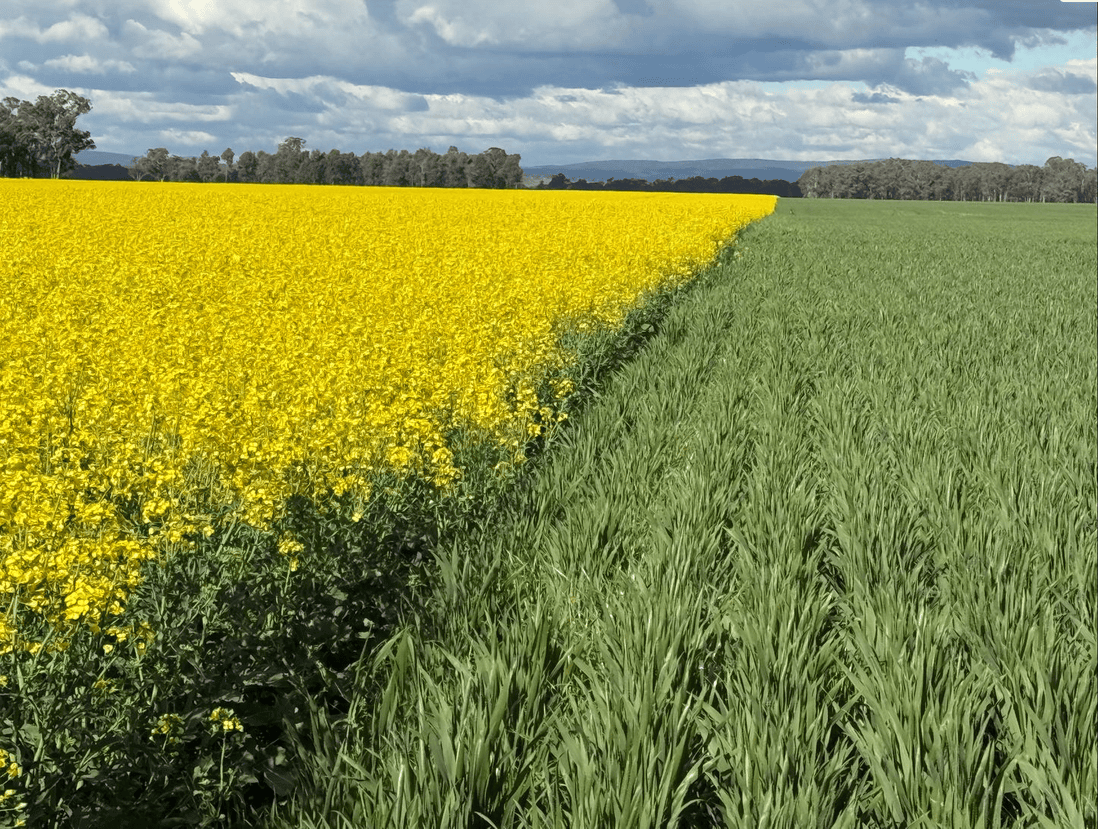
Alllengrove covers 2931ha between Parkes and Forbes, and has sold locally. Photo: Nutrien Harcourts
THREE local farming families have expanded their foothold in central New South Wales as separate purchases of the Allengrove Aggregation, Merrigal, and Peep-O-Day.
Allengrove Aggregation
A local family has paid around $23 million for the Allengrove Aggregation in the Central West.
The 2931ha dryland cropping opportunity is 12km from Parkes and 20km from Forbes.
It comprises three non-contiguous properties located within a 10km radius.
Nutrien Harcourts agent Ainslee Toole was unable to disclose the buyer or the price paid, however during the marketing campaign the three properties were listed as follows:
- 1153ha Allengrove for $8895/ha;
- 1202ha Oaklands for $7415ha; and;
- 576ha Heatherleigh for $8900/ha.
Allengrove was purchased by the Deniliquin-based Dye family in 2012 and expanded with nearby properties, Oaklands and Heatherleigh.
Around 2656ha, or 91 percent, is arable and grows wheat, canola, chickpeas, barley and faba beans on open and level land featuring red-brown earths and alluviums that come with an extensive liming history.
In the past, canola has yielded up to 3.5t/ha and averaged 2t/ha, while wheat has yielded up to 5.5t/ha or 4t/ha on average.
Situated in a 550mm rainfall area, water is provided by bores and a town water scheme.
Infrastructure includes a four-bedroom home on Allengrove and additional accommodation on Heatherleigh, grain silos with 1000-tonnes of capacity and numerous sheds.
Merrigal
Two local farming families have paid more $20 million for a highly regarded and historic cropping and livestock enterprise in the Collie district of central western NSW.
The 5075ha Merrigal is 11km north of Collie, midway between Warren and Gilgandra, and 90km north of Dubbo.
It was sold by the Lean family after 19 years of ownership.
During the marketing campaign, Peter Milling & Company agent Peter Dwyer fielded strong interest from corporates and large family farming operators.
In the end, two established local farmers purchased the property, including one who is believed to be a neighbour.
Originally settled by Alexander McGregor in 1845, Merrigal has transitioned from a traditional wool-growing enterprise into a mixed farming operation combining cropping (cereals and pulses) with a self-replacing Merino flock.
It is equally suited to sheep, cattle or a combination of both.
Continually improved under the stewardship of the Lean family, around 3242ha of fertile soft grey self-mulching soils through to red loams is typically sown to dryland cropping.
The remaining 1833ha provides quality grazing and finishing country along the creek systems.
In addition, lucerne has been grown on some of the cropping country, providing a valuable grazing and finishing platform.
Situated in a temperate inland climate with hot summers, cool winters and moderate annual rainfall averaging between 480mm and 500mm, water is supplied by five equipped bores, 13 dams and frontage to the Merrigal and Wemabung Creeks.
Infrastructure includes three three-bedroom residences, a five-stand shearing shed, two steel sheep yards, two steel cattle yards, numerous sheds, and 2270 tonnes of grain and fertiliser storage across 14 silos.
A historic 12-stand shearing shed, one of the first in New South Wales to be powered by electricity, is used for sheep shedding and storage.
Peep-O-Day
A local family has paid around the asking price for a blue-ribbon mixed farm in Central Western NSW.
The 3812ha Peep-O-Day is 25km north of Tottenham and 165km north-west of Dubbo and was sold by Dr Colin Andrews, a retired neurologist from Canberra who grew up in Tottenham, after 30 years of family ownership.
Forbes Livestock & Agency Co agent Sam Mackay was unable to disclose the buyer or the price paid, however a guide of between $12.8 million and $13.2 million was offered during the marketing campaign.
Mr Mackay described Peep-O-Day as one of the most prestigious cropping portfolios in the Lachlan and Bogan Shires.
“A model of sustainable farming, it strikes a careful balance between soil health, crop rotation and infrastructure investment to drive long-term productivity and success.”
The soils range from grey self-mulching clays to soft red clay loams suitable for both cropping and lucerne pastures.
Around 97 percent of Peep-O-Day is arable and divided into 12 paddocks designated for rotational cropping, including cereals, lupins and canola, delivering an average wheat yield of 2.85 tonnes per hectare.
Seasonal oats are strategically planted to enhance cattle feed supply.
Mr Mackay said the property also excels in water use efficiency (WUE), with an average of 17kg/mm of growing-season rainfall over the past decade – well above the regional average of 14kg/mm for wheat in the area.
“Peep-O-Day places a strong emphasis on soil fertility with balanced nutrient levels maintained through the consistent application of 70kg/ha of MAP equivalent phosphorus.
“Regular soil testing ensures the careful management of potassium and sulphur levels.”
Break crops such as monola and lupins are grown to enhance nitrogen levels, improve soil structure and support long term soil health.
Peep-O-Day is watered by 16 dams and three 30,000-litre water tanks.
Infrastructure includes two homes, a worker’s quarters, 16 silos with a combined 1900t of grain storage, cattle and sheep yards, a five-stand shearing shed and numerous sheds.
Grain Central: Get our free news straight to your inbox – Click here
HAVE YOUR SAY