

Weather:
The US Corn Belt is turning dry from the northwest from 1 October, which should open the harvest window after last week’s rain delays.
NOAA’s weekly ENSO update, issued 28 September, still has El Niño continuing through the northern winter, keeping southern hemisphere planting and crop finish weather as the market’s main focus.
Brazil’s soybean belt is split. Northern and central areas face a brief planting opportunity before another dry interval, while southern Brazil and Paraguay contend with excessive moisture, with northern Brazil turning dry and hitting 100°F+ from 7 to 15 October. Argentina gets near- to above-normal precipitation and notably cool temperatures through week two.
The BoM’s spring outlook keeps drier-than-average conditions for southeastern Australia and southwest Western Australia through crop finish.
India’s monsoon ended at 759 mm against the normal 868.6 mm, a shortfall of 12.6 per cent, the weakest since 2015, and the IMD expects below-normal rainfall during the October-December period. The central government has declared a drought in five states, and large areas of India have inadequate soil moisture for winter crops, a risk to rabi wheat and oilseed sowing.
Markets
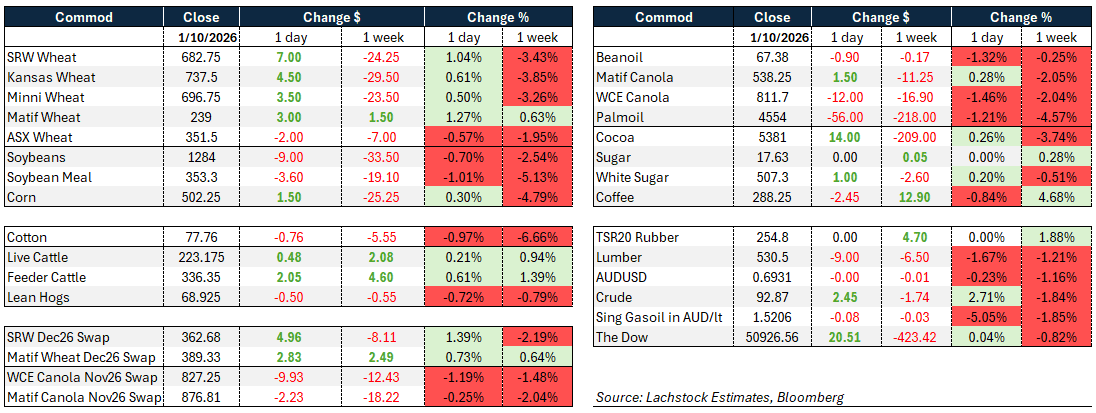
Wheat is trading Black Sea supply risk. SovEcon’s 36.7 million tonnes (Mt) Russian export forecast and Kpler data showing alternative ports replacing only about a tenth of Black Sea capacity both point to a structural loss of Russian volume and higher delivered costs into North Africa and the Middle East. Matif is the clear beneficiary, up on the week while US contracts and ASX are still down.
The soybean complex is under pressure from Chinese demand. Reports of large Chinese stocks and negative crush margins have cooled hopes of post-summit US buying, sending meal down 5.13 percent for the week, while weak palm and bean oil are dragging WCE canola and the Nov26 swap lower.
Fund positioning is amplifying the moves. Higher margin requirements are forcing managed money to cut net longs built over recent months, which explains much of the weekly losses in US wheat and corn. Corn is down 4.79pc for the week after a bearish USDA stocks surprise, so Friday’s COT report will be watched closely.
Strong US data is keeping Fed hike risk alive even after October odds fell to 28pc. That is supporting the US dollar and holding the AUD near 0.69, which helps Australian grain prices in local currency terms.
Day Ahead – Australia
Despite the fact half the day is done – sorry about that, a few technical issues my side.
As always, so many moving parts – lots of reports at the start of the month about the performance of the Black Sea export path – yet, in general, Asian/sub continent CNF values have eased over the last few weeks. Demand has done an amazing job of not panicking – especially as the Russia/Ukraine conflict shows absolutely no sign of finding a resolution.
The Aussie market is reflecting good export pull on wheat and canola but, for SA and Vic at least, crops are getting bigger.
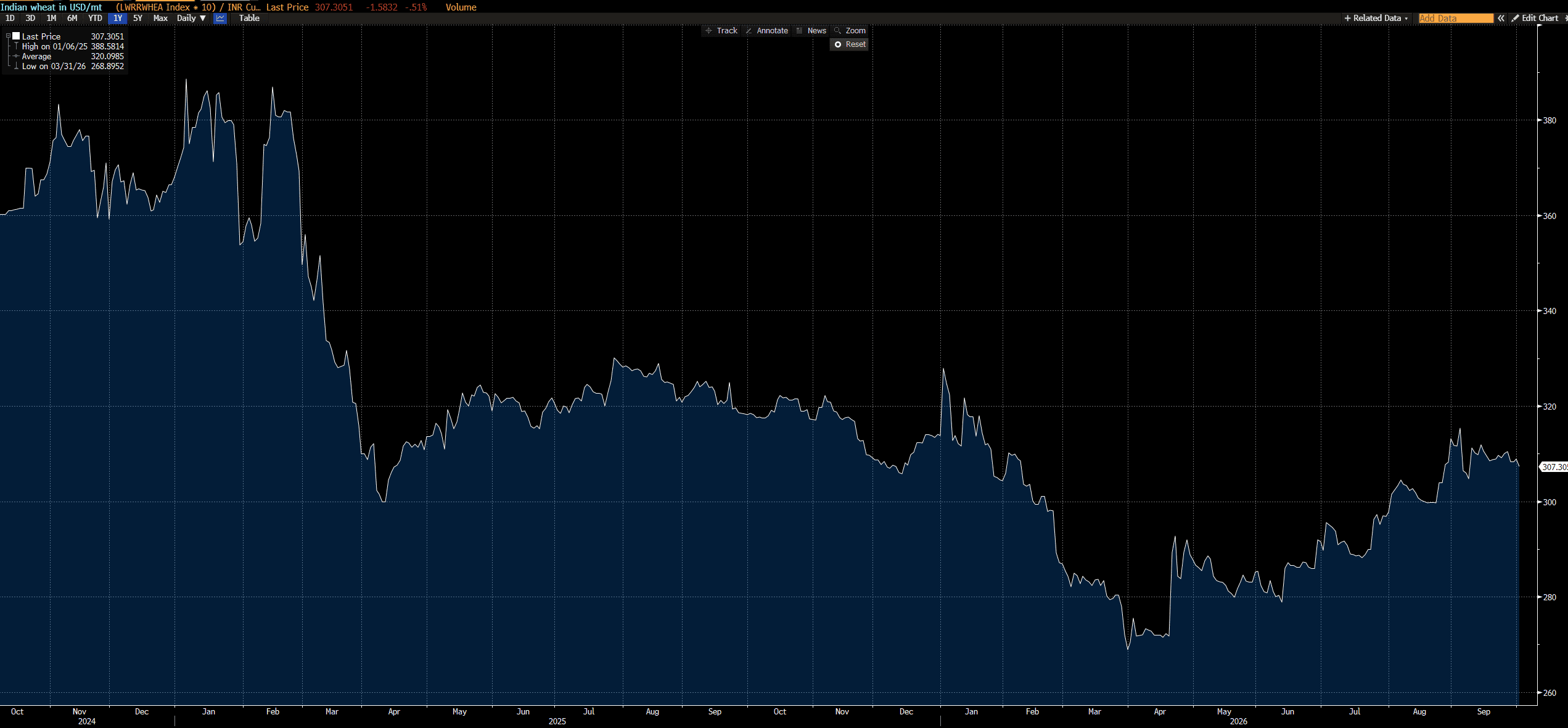
Indian domestic wheat in USD/mt. Source: Bloomberg, Lachstock Consulting Estimates
Wheat: Wheat recovered some ground overnight. The support came from Black Sea supply, after SovEcon cut its 2026/27 Russian export forecast by 4.7Mt to 36.7Mt.
That is 20pc below last year and the lowest since 2021/22. SovEcon now assumes the war runs until some point after 2027, so it expects no normalisation of trade. The physical data supports that view. Kpler shows Russia’s alternative ports in the Baltic, Caspian and Far East shipped about 1.3Mt over the July to September peak season, against roughly 12Mt Black Sea capacity. September volumes through those ports reached nearly 800,000 tonnes, about eight times July levels, but the economics are poor. Baltic cargoes to Egypt cost an estimated 30 to 35pc more per tonne than pre-escalation Black Sea shipments, and Moscow has suspended export duties on wheat, corn and barley and subsidised rail to the north to keep grain moving.
Matif led the move and is the only wheat contract up for the week, with the Dec26 swap up 2.83 (+0.73pc) to 389.33. The SRW Dec26 swap rose 4.96 (+1.39pc) to 362.68 but is still down 8.11 (-2.19pc) for the week. US contracts are carrying heavy weekly losses from fund liquidation.
On demand, Saudi Arabia is tendering for 535,000 tonnes, while French exports from Rouen fell 39pc in the week to 30 September. ASX slipped 2.00 to 351.50 against the offshore bounce .
Other grains/oilseeds: Soybeans turned lower on reports that Chinese crushers are holding large stocks while crush margins deteriorate.
That is the market’s explanation for why China has bought little US soybean volume since the Trump-Xi summit in Washington last week.
Meal led the complex lower and is now down more than 5pc for the week. Funds trimmed net length in grains to open October, with Midwest Market Solutions pointing to margin-call selling as higher exchange margin requirements force position cuts.
Corn bounced modestly after Wednesday’s sell-off. The USDA quarterly stocks report found considerably more old crop corn than expected, and Total Farm Marketing called the report bearish but the selling overdone.
StoneX has since trimmed its US corn yield estimate and raised its soybean outlook. In Brazil, soybean and first-crop corn planting is running under a strengthening Super El Niño that is leaving some regions in drought and others too wet, and WeatherWealth stresses that timing will matter heavily for the 2027 crop.
Vegetable oils were weak across the board. WCE canola fell 12.00, the Nov26 swap dropped 9.93 (-1.19pc) to 827.25, and the Matif canola Nov26 swap eased 2.23 (-0.25pc) to 876.81. Palm oil is down 4.57pc for the week.
Macro: The Fed’s internal debate sharpened. Dallas Fed President Lorie Logan, a voter this year, said rates need to rise a further 50 basis points or more, following September’s 25 basis point hike, the first increase in three years. She also noted that rising term premiums could slow the economy and reduce how much tightening is required. Thirty-year yields are up 64 basis points since June.
Vice Chair Jefferson, New York Fed President Williams and Vice Chair for Supervision Bowman all signalled patience.
That cut the market-implied odds of a hike at the 27-28 October meeting to 28pc, from 70pc earlier in the week. The data argues against patience. ISM manufacturing held at 54.5, with new orders up 1.6 points to 55.3 and inventories down 2.0 points to 48.6, both pointing to stronger production ahead.
The prices index jumped 6.8 points to 77.9 on energy costs. Initial claims fell to 197k, taking the four-week average to 200k, near post-pandemic lows.
Construction spending rose 0.9pc m/m, the largest gain since November 2023, as data centre construction surged 7.5pc m/m and 73pc y/y.
Together these suggest the neutral rate is rising and policy may not be as restrictive as the Fed assumes. The AUD eased to 0.6931 and is down 1.16pc for the week. Crude rose 2.71pc to 92.87, although Singapore gasoil in AUD terms fell 5.05pc.
The Bloomberg Agriculture Spot Index gained 13pc in the third quarter, its largest quarterly rise since March 2022.
HAVE YOUR SAY