

Weather:
Tropical Storm Isaias is forecast to strengthen to a Category 3 or 4 hurricane, make landfall in Mississippi and Alabama early Saturday and track into Illinois and Indiana by Sunday, where AgResource warns strong winds could lodge unharvested corn and soybeans already weakened by stalk disease, while Gulf export logistics and Louisiana renewable diesel capacity face disruption.
El Niño continues to strengthen, and September rainfall across Australian cropping regions was generally very much below average; cropping regions in Victoria, South Australia and central and southern NSW were forecast to get 10 to 50 mm in the week to 8 October, while WA, northern NSW and Queensland were forecast only 1 to 10 mm, and Oil World expects El Niño’s lagged effect to cut Indonesian and Malaysian palm output through 2027 and 2028.
El Niño is splitting South America, with brighter prospects in Argentina, where the Rosario Board of Trade sees the 2026/27 wheat crop reaching about 20 million tonnes (Mt), which would be the third-largest on record, while early dryness in northern Brazil is raising concern over soybean planting timing and the safrinha corn crop that follows it.
Southern Russia, which grows a large share of the country’s winter grain, faces low soil moisture for a second straight year as autumn sowing proceeds, adding risk to the 2027 crop on top of SovEcon’s cut to 87.5Mt for this season, while the Canadian Prairies have had a dry harvest window that lifted Manitoba canola to 74 percent harvested.
Markets
Record Treasury yields and a stronger US dollar drove broad selling across commodities, with wheat hit hardest as Chicago and Kansas lost 17.75c, crude fell 1.3pc and the Dow dropped 341 points. This was macro-driven selling, not a change in grain fundamentals, so it says little about supply.
Wheat still finished higher on the week across all exchanges despite Wednesday’s fall, and ASX Jan rose A$4/t to $359. The Black Sea closure is keeping Russian wheat on costlier northern and overland routes that will become less reliable as winter sets in, which leaves the supply premium in place.
The vegetable oil complex was liquidated. Soyoil fell 3.2pc, Matif rapeseed 3.2pc and the Matif canola Nov26 swap lost 7.05pc on the week, which pressures Australian canola values right as harvest begins. Meal rose 3.1pc and Dec crush firmed.
Corn and soybeans are positioning ahead of Friday’s WASDE, with large spec longs capping rallies. A bigger-than-expected corn yield cut, as in 2010, combined with hurricane damage to unharvested Eastern Corn Belt crops, is the main upside risk into the weekend.
Day Ahead – Australia
Weaker offshore markets and rain on the way – feels heavy to start the day. However, signs of demand kicking will certainly add some confidence to those with shipping slots as we approach harvest.
RBA is painted into a corner and will still hike if this inflation sticks around. From an Australian producer perspective, the US yield rally should have put more pressure on the AUD – but the RBA has been clear about the strategy.
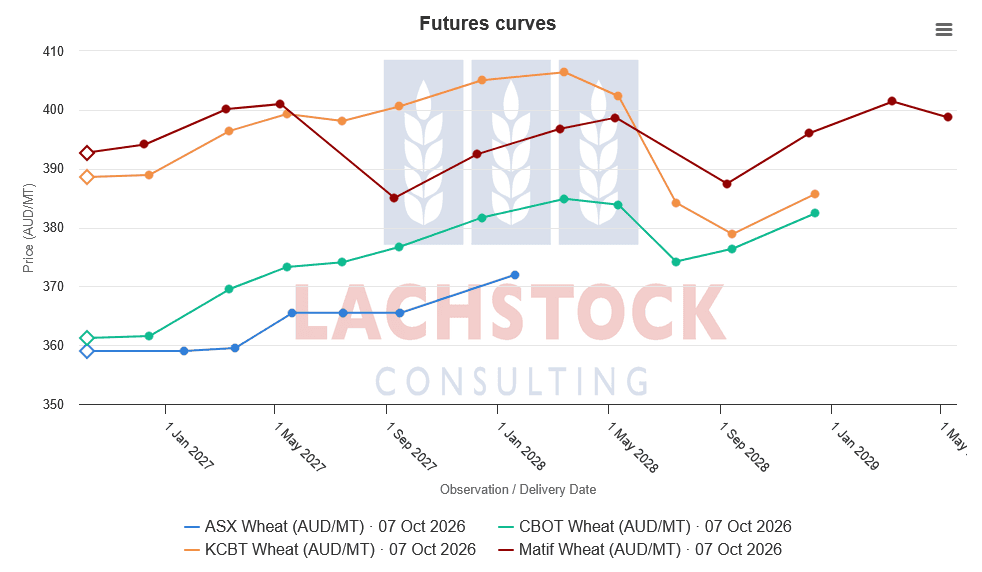 Wheat: Wheat took the brunt of Wednesday’s macro selling. Record Treasury yields lifted the US dollar and pulled most commodities lower, and Chicago and Kansas both lost 17.75c.
That ended a four-session run of higher lows that had seen Chicago close against its 50-day moving average on Tuesday.
The SRW Dec26 swap dropped 8.31 to A$362.50 and the Matif Dec26 swap fell 6.31 to A$394.20. Matif Dec lost €3.25/t, while Russian cash held at US$204/t fob.
The supply story is unchanged. The Black Sea remains off limits to shipping, but Russian wheat is still getting out through northern ports and by rail. IKAR estimates September exports at about 2.5Mt, including a record 1.4Mt through the Baltic, with October seen near 3Mt and Baltic volumes near 1.8Mt. SovEcon trimmed its Russian crop estimate 0.8pc to 87.5Mt. EU soft wheat exports are running 1pc above last year to 4 October.
Demand showed up in tenders. Jordan is seeking 120,000t milling wheat, with offers due 13 October. The Philippines wants 377,000t feed wheat, Thailand at least 60,000t feed wheat, and Morocco has extended its import bonus at a higher rate. US export sales are expected at about 350,000t. The bullish case stands as long as there is no diplomatic opening in the Black Sea and winter erodes the alternative export routes.
It also expects corn and Friday’s WASDE to set where wheat finishes the week.
ASX Jan was the exception, gaining $4 to $359 as harvest begins under fuel costs more than 50pc higher than last year.
Other grains/oilseeds: Corn gave back part of Tuesday’s rally as traders positioned for Friday’s WASDE.
The WSJ survey has the yield cut 0.9 bu/ac from 178.5, despite falling crop conditions and lower-than-expected anecdotal yields. There remains the risk of a 2010-style October cut, given the similarity in summer weather.
Large spec longs are expected to limit any rallies before the report.
Export sales are forecast between 1.15Mt and as much as 1.7Mt, against 536,000t the prior week.
Ethanol output rose 46,000 b/d to 1.053m b/d, and stocks fell to 23.73m bbl. South Korea’s NOFI is tendering for 207,000t and the Philippines for 110,000t of corn.
Ukraine’s ability to ship 3 to 5Mt a month over the coming months is becoming the key question for end users.
In soy, meal was the only gainer. It rose $11.00 on firm Brazilian premiums and as processors catch up after downtime and heavy rain in Iowa and Nebraska.
Soyoil lost 223 points because it is priced too high against competing feedstocks, more imports are arriving, and the hurricane could knock renewable diesel plants near New Orleans offline.
Dec crush rose 5.25c to 251.75. Beans are expected to hold near the September yield, with surveys at 52.9 bu/ac.
China returns from holiday late this week.
EU soybean imports are down 9pc at 3.06Mt, and Anec sees Brazil’s October exports at 6.18Mt against 6.4Mt a year ago.
Weaker vegetable oils dragged on canola. ICE Nov traded between C$805 and C$830 for the week. RBC’s Phil Speiss blamed fund liquidation and the soyoil sell-off. He puts support at C$800 for Nov and C$820 for Jan and expects funds to roll their longs rather than exit. Manitoba’s harvest jumped 21 points to 74pc. The WCE Nov26 swap fell 16.10 to A$819.56. Matif rapeseed was hit harder, with the Nov26 swap down 29.28 (-3.46pc) to A$817.04 and down 7.05pc on the week.
Oil World expects global palm oil production to fall 2Mt next year, with El Niño’s lagged effect expected to hit hardest in 2027 and 2028.
Macro: Treasury yields hit new record highs, and the stronger dollar weighed on commodities across the board.
Minutes from the Fed’s September meeting showed unanimous support for the rate hike, but less urgency for another quarter-point move in October.
Equities fell from all-time highs on inflation concerns.
Energy remains volatile. Global diesel prices have surged because of disruption in the Strait of Hormuz from the US-Iran war, where Iran has stepped up attacks on shipping, and because of Ukrainian strikes on Russian refineries.
Singapore gasoil in AUD rose 6pc on the day but is still down 6.3pc on the week.
Shipping risk in the Black Sea was underlined when a vessel sank after a drone strike about 70 nautical miles off Bulgaria.
In Brazil, an unexpected first-round presidential result has raised the prospect of a Flávio Bolsonaro government that would lean closer to Washington on trade, and the BRL gave back some of its recent gains.
Sugar is the standout in softs, up 11.9pc on the week.
Local: Bids were firmer through the west of the country yesterday, with canola +A$7/t to $877, wheat at $383 and barley $326 FIS Albany.
Through the east, canola was +$8 to $816, with GM at a $25 discount, wheat was $357 and barley $285 track Geelong.
Delivered wheat markets through the south remain soft, with ASW bid at $335 delivered Bendigo, $350 Hanwood and $330 Murray Bridge Jan+.
Interesting to read about the growing pressure on wheat profitability in Ukraine, with Agrohub estimating that a 10pc rise in production costs and a 10pc fall in prices would leave wheat needing to yield 5.98t/ha just to break even, against actual yields of 6.1t/ha. Rapeseed remains far more profitable, requiring just 2.5t/ha against current yields of 3.4t/ha. A further 10pc fall in prices would push wheat into loss-making territory, while rapeseed would retain a healthy margin. A similar story is playing out closer to home, as we have seen this year with Australian growers shifting area away from wheat in favour of canola and barley, highlighting how relative profitability continues to drive planting decisions.
HAVE YOUR SAY