
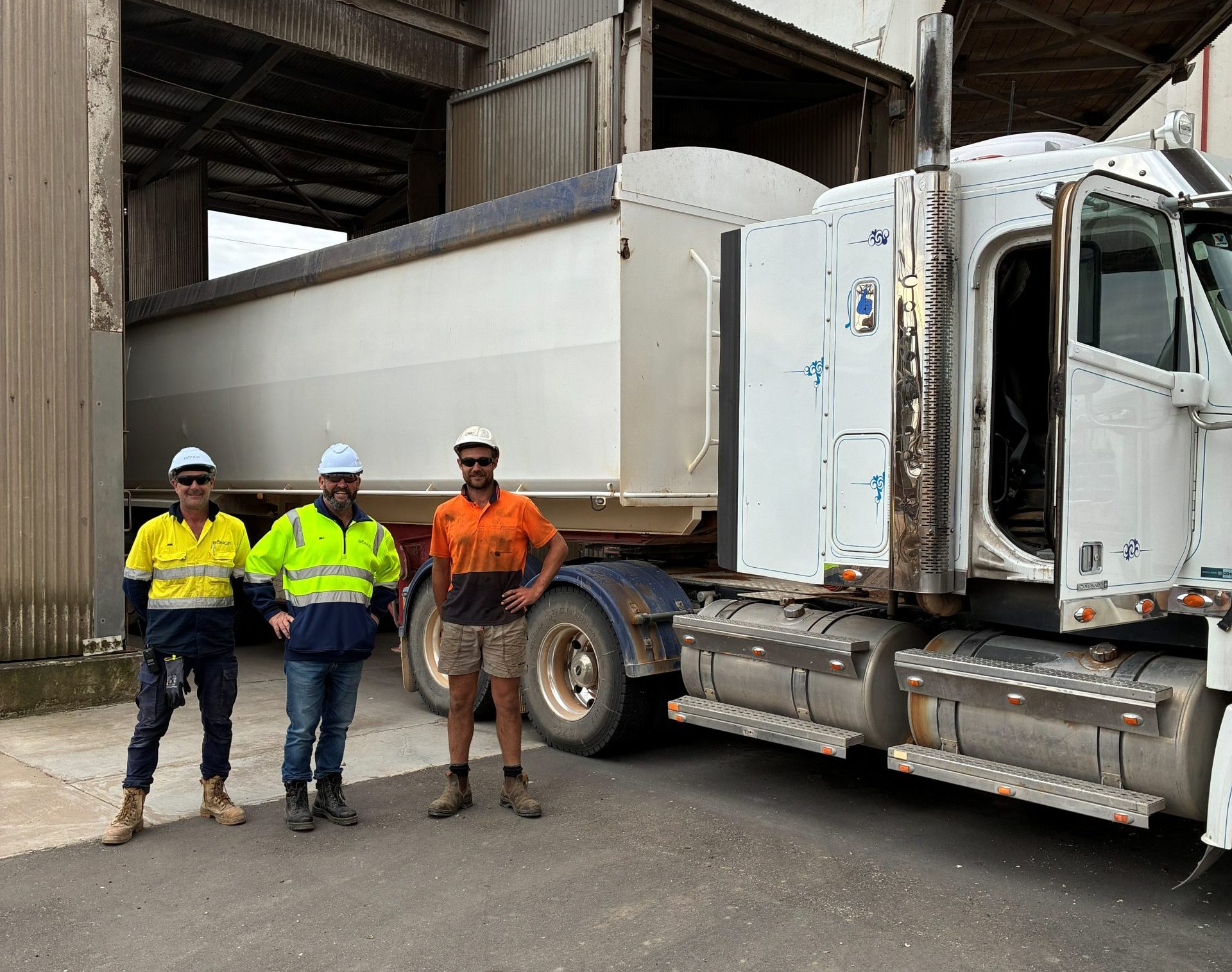
Major SA bulk handler Bunge received its first load for harvest on September 25, barley into Bunge’s Thevenard terminal, from grower Jesse Chandler (right), pictured with Bunge Thevenard operator Jamie Davies (left) and operations co-ordinator Mike Bulmer. With a bumper harvest now gathering pace, those across SA’s grain supply chain are relieved the lowered phosphine limits will not be introduced in its midst. Photo: Bunge
THE SOUTH Australian Government will delay the introduction of new workplace exposure limits (WEL) for phosphine until July 2028.
The decision has been welcomed by grain-industry groups, which had warned the regulations posed a risk to Australia’s grain biosecurity and trade.
WELs are fixed at a national level through Safe Work Australia (SWA), with implementation left to individual state and territory jurisdiction regulators.
The new WEL for phosphine was due to commence on December 1 as one of more than 600 revised airborne contaminant exposure limits set by SWA for state governments to enforce.
Although the SWA mass review of contaminants has been taking place for several years, the vast scope of changed contaminant limits has seen the Australian grains sector scramble to establish what the changes will be and how they can be managed.
The SA Government moratorium means the current and following winter-crop harvests will not be affected by the new phosphine limit, giving time for detailed discussion and consultation between industry, SafeWork SA, and other authorities about the impact of the proposed WEL.
This follows Victoria’s decision earlier this year to defer commencement of the phosphine WEL based on similar industry concerns.

SA Minister for Industrial Relations Kyam Maher.
SafeWork SA will also work in collaboration with the grain industry to deliver specific guidance, education and support on other WELs including grain dust.
Response to lobbying
SA Minister for Industrial Relations Kyam Maher said this decision was made after consultation with industry, led by Grain Producers SA, which raised concerns about measurability of the new limit, potential impacts on biosecurity and export controls, and challenges with the limit starting midway through an expected record harvest season.
“Industry has raised a number of practical concerns about the implementation of the new exposure limit and the impact it could have on the coming harvest season,” Mr Maher said.
“The matters industry has raised require detailed consideration, and this extension will ensure those issues can be properly considered by regulatory authorities.”
GPSA chief executive officer Brad Perry welcomed the announcement and thanked the government for listening to the grains sector’s concerns and acting on them.
“GPSA has worked closely with the State Government to explain the serious consequences of introducing the new phosphine exposure limit in the middle of a potentially record harvest,” Mr Perry said.
“We welcome the government listening to those concerns and acting to give growers and the grain supply chain certainty.
“Phosphine is critical to protecting stored grain from insect infestation, from on-farm silos through to bulk storage and export facilities.
“With the 1 December deadline looming and practical questions about compliance unresolved, the industry faced the prospect of major disruption to grain storage at the very time we need that capacity most.
“While the deferral is shorter than Victoria’s three years, 18 months gives us valuable time to work with government, regulators and technical experts on reliable monitoring, practical controls and a clear path to compliance.
“This is an important outcome for South Australian grain producers.
“The extension protects the coming two harvests and creates the opportunity to work through the practicalities of these changes, while maintaining our focus on worker safety.”
Positive step forward: GTA
Grain Trade Australia has welcomed the announcement, but holds that a three-year deferral, consistent with that proposed in Victoria, is needed to properly validate practical measurement methods and develop workable controls.
GTA CEO Pat O’Shannassy said worker safety is the priority for all parties involved in the grain supply chain and recognised the SA decision was the result of genuine dialogue between government and industry.
“We thank the Deputy Premier, the Hon Kyam Maher MLC, and SafeWork SA for the way they have engaged with industry,” Mr O’Shannassy said.
“They took the time to listen, to understand how phosphine is used across the grain value chain, and to give appropriate weight to the practical concerns industry has raised.
“The revised WEL cannot presently be measured reliably in a timely manner in practical workplace conditions; its introduction midway through harvest would cause significant operational disruption.”
Mr O’Shannassy said there was no equivalent, registered, commercially-viable alternative to phosphine available at the scale the industry requires.
“Introducing a limit of this kind in the middle of what is expected to be a record harvest in South Australia would have put grain storage, biosecurity, and export programs at risk at precisely the time that capacity is needed most.
“This extension gives growers, storage operators, and exporters certainty across at least the next two harvests.”
GPA, Opposition welcome decision
Grain Producers Australia also welcomed the delay, saying it would give industry more time to consider the workplace changes.
“GPA are deeply committed to safe workplace standards, but this new phosphine exposure limit would have seen a real risk to Australia’s biosecurity and trade,” GPA chair Matthew Madden said.
“The new standard would make Australia’s phosphine exposure standard out of touch with the rest world, including the EU, UK, USA, Canada and Argentina.
“There isn’t really a viable alternative for grain growers to fumigate stored grain against pests, and support our biosecurity and trade, so this looming change has been deeply concerning to our growers.
“The Australian grain sector has been facing monumental challenges recently, including fuel and fertiliser supply and price challenges caused by the Iran war, we don’t need any further undue burdens.”
The view was echoed by the SA Shadow Minister for Primary Industries and Regional Development Nicola Centofanti, who thanked GPA and GPSA for their advocacy to government on the issue.
“The South Australian Government has listened to the concerns being raised by our grain industry and delayed the proposed reduction to workplace exposure limits for phosphine by at least 18 months,” Ms Centofanti said in a statement.
“Phosphine is critical to protecting stored grain, maintaining grain quality and biosecurity and ensuring our growers can get their product through the supply chain and into export markets.
“With another strong harvest approaching, imposing these changes without a practical alternative in place risked creating serious problems for growers and grain handlers.
“Thank you to Grain Producers Australia, GPSA and everyone across the industry who spoke up and helped make the case for common sense.”
“Farmers have had enough of unnecessary regulation that makes it harder to do what they do best – producing the food and grain our state and nation rely on; let farmers farm.”
Source: SA Government, GPSA, GPA, GTA, Liberal Party SA
HAVE YOUR SAY