

Weather:
NOAA’s Climate Prediction Center says El Niño is strengthening and now likely to persist as a stronger-than-usual event into January to March 2027, with equatorial Pacific waters up to 4°C warmer, widening the window for severe weather; Mielke expects it to cut palm oil output for two years, while weeks of Indonesian wildfires are choking Malaysia in smog.
Brazil’s planting is lagging slightly, with AgRural reporting 7.3 percent of the 2026/27 soybean area sown, up from 3.4pc a week earlier but behind 9pc a year ago, and first-crop corn in the centre-south at 38pc against 40pc last year, keeping October rainfall a key watch point.
Europe is still carrying the legacy of a record hot, dry summer, with low Rhine and Danube levels restricting barge freight to crushers and prompting Switzerland to release strategic protein feed reserves, while the UK and Nordics turn wet and windy next week.
Markets
The WASDE is shaping as a corn yield event, with the trade at 177.7 bpa and risk skewed to a larger cut, but heavy fund length in corn leaves the market vulnerable to liquidation if stocks or production surprise higher.
Soybeans are trading China’s absence, with export sales, meal sales and flash announcements all underwhelming after the summit, and attention will turn to South American planting weather once the report is through.
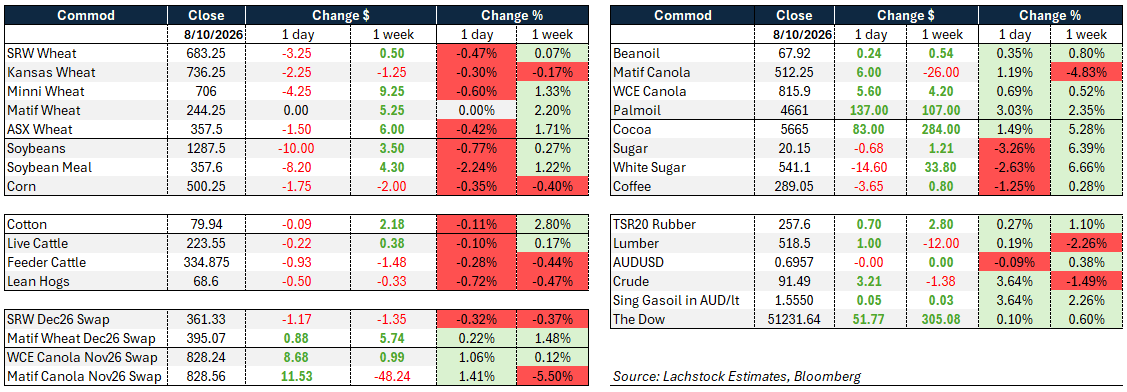
Middle East escalation pushed Brent above $105 and gasoil up $88.25, lifting the vegoil complex through biofuel demand, with palm up 3pc, Euronext rapeseed at a one-month high and both AUD canola swaps firmer.
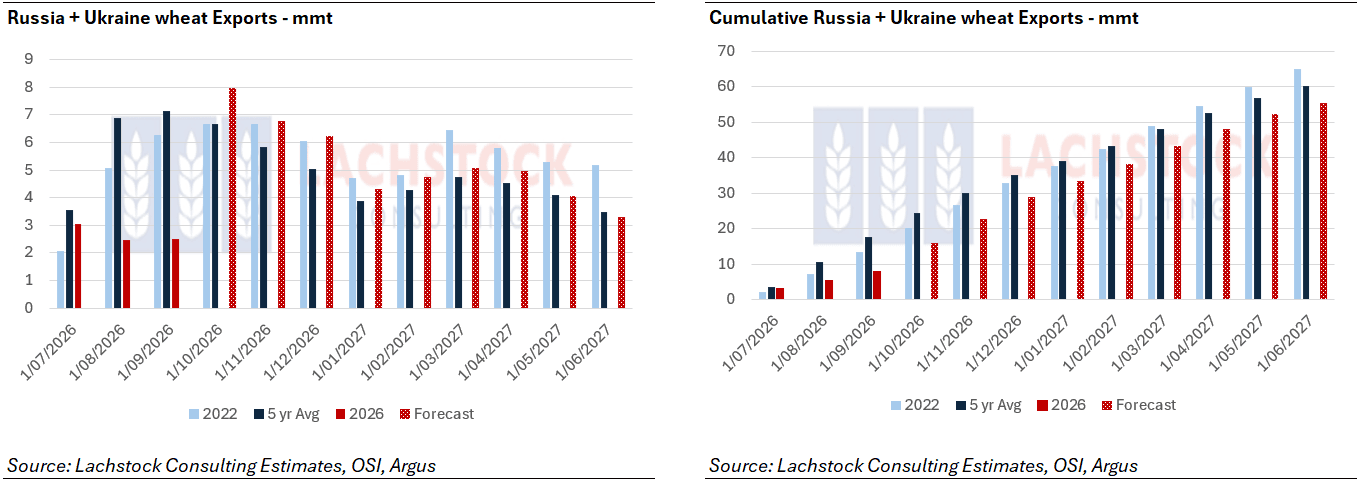
Black Sea disruption continues to reshape wheat flows, with Russian exports down sharply, Ukrainian ports blocked and Asian millers buying hand to mouth, while modest US and French export gains highlight shifting demand to alternative origins.
Day Ahead – Australia
When it rains, it… well, we will see i guess. Cynoptec on X is talking up some significant falls for Qld and into NNSW, the first significant storm of the season. This will certainly help the prospects of sorghum and cotton and may encourage increased planted area.
Markets are bracing for the USDA report tonight which, given the potential for significant volatility, probably keeps the market somewhat defensive today.
Some interesting price action in the global diesel markets – the G7 decision to release strategic reserves is proving to be a sugar hit – crack margins, or the revenue made by refining crude to diesel tells us we are very far from out of the woods.
 Wheat: Wheat drifted modestly lower in a tight, two-sided session ahead of tonight’s WASDE, with WZ implied vol easing to 26.25pc from 26.63pc.
US export sales of 451.6kt beat the 350kt expected, led by South Korea and the Philippines with HRS (187.6kt) and white wheat (143.7kt) the strongest classes, and Taiwan’s millers booked an estimated 105.8kt of US milling wheat.
The report is not a wheat event, with US ending stocks expected at 721m bu against 717m in September.
The Black Sea remains the driver. Russian July to September exports of around 7 million tonnes (Mt) compare with 11.3Mt a year ago as freight costs soar and grain moves through less efficient channels that may struggle over winter, and SovEcon has cut its Russian crop to 87.5Mt.
Ukrainian rail shipments for export rose 19pc in October but remain under half last year’s pace with seaports blocked since late July, and Lithuania is pushing for an EU ban on Russian grain transit.
Reports that some Asian millers in Southeast and South Asia are covering only through December rather than the usual six months forward, leaving them exposed to further volatility.
French business is picking up, with Rouen loading 297kt for the week including 232kt of soft wheat to Morocco, while Russian cash was flat at US$204/t fob.
England’s harvest is provisionally 10.8Mt, up 0.8pc on a 2.7pc yield gain to 7.2t/ha, and France is offering up to €2bn in zero-interest loans after record summer heat and drought.
In AUD terms the SRW Dec26 swap slipped 1.17 to 361.33 while the Matif Dec26 swap firmed 0.88 to 395.07.
Other grains/oilseeds: Soybeans led the complex lower as meal corrected and fresh Chinese buying failed to show after the summit. Bean sales of 549.4kt missed the 850kt expected, and new-crop meal sales stripped of rolls were just 186kt against 400kt ideas, while bean oil held up on crude, leaving Dec crush 5.5c lower at 246.25.
The trade sees the bean yield unchanged at 52.8 bpa with anecdotal results pulling consensus higher, and focus shifts to China and South American weather after the report.
Corn eased into the numbers with the trade at 177.7 bpa against 178.5 in September and ending stocks at 1.670bn bu. Risk is skewed to a larger cut of perhaps 2 to 3 bpa given weather parallels with 2010, though AgMarket.net notes large fund net longs leave room for liquidation on a bearish surprise.
US corn sales of 769.5kt fell short of 1.15Mt expected, with Mexico and Colombia the top buyers, while South Korean feed buyers were active with NOFI taking 134kt, Incheon 55 to 66kt privately and MFG tendering for 140kt.
BAGE put Argentina’s 2025/26 corn crop at 64Mt, 6Mt above its original forecast and above USDA’s 63Mt, and SLC expects Brazilian planted area up 2.2pc with soybeans up 2.9pc.
Euronext rapeseed touched €562.25 intraday, a one-month high, as Brent above $105 lifted biofuel demand and low Rhine levels raised transport costs to crushers, with StoneX noting the rebound follows funds unwinding large longs earlier in the week.
Palm jumped over 3pc on Indian demand despite rising stocks, while Mielke warns a severe El Niño will hit output for two years, and Russia is undercutting Ukraine in core sunflower oil markets.
The WCE canola Nov26 swap rose 8.68 to 828.24 and the Matif canola Nov26 swap gained 11.53 to 828.56, though it is still down 48.24 on the week.
Macro: Brent surged past $105 as Iran escalated tanker attacks, with UKMTO reporting nine in Hormuz so far in October and transits at a two-month low, while the Houthis killed three in strikes on Saudi airports.
Trump said the US would not attack Iran before the midterms, citing productive talks, but kept the naval blockade in place, and reports suggest a three-day campaign has been discussed for after the vote, backed by an extra carrier and 10,000 personnel in the Gulf.
European gas eased on the comments, and Gulf producers are now fighting to recapture lost market share as flows recover.
Distillates were the standout, with October ICE gasoil up $88.25 to $1,509.25/t, even as France releases 10m bbl of strategic diesel over three months under the G7 deal and Russian product exports hit a three-month high.
Ukraine struck the Salavat complex and Russia’s largest refinery, and Russian defence spending is heading for a record near 17tn rubles.
The dollar neared a high for the year on haven demand alongside elevated Treasury yields, weighing on grains early before turning lower in the afternoon.
The euro is down 1pc this month on French political risk, and Insight Investment is positioning to fund carry trades short euro against the AUD and NZD.
India’s urea tender drew offers nearly 10pc below August, offering some relief on input costs.
Local: Canola was off A$10/t yesterday to $870, wheat was steady at $380 and barley softened to $324 FIS Albany.
In the east, canola took a bath, falling $15 to $800, with GM at $775, while wheat was $353 and barley $288 track Geelong.
Freight is becoming an increasing talking point as diesel prices remain elevated and harvest draws closer. Current rates are around 20c/km for medium to long hauls, with the potential for further increases as harvest ramps up if diesel prices remain elevated.
Barley prices remain under pressure, with a record crop expected and Chinese demand notably quieter than this time last year. Australian new-crop barley sales to China are estimated at just 1–1.2Mt, compared with 1.5–2Mt at the same point last year. Saudi Arabia had also purchased around 200kt by this stage last season, compared with no reported new-crop commitments this year. Existing Chinese commitments are spread more evenly across October–February, rather than being heavily concentrated at the front end as they were last year.
HAVE YOUR SAY