
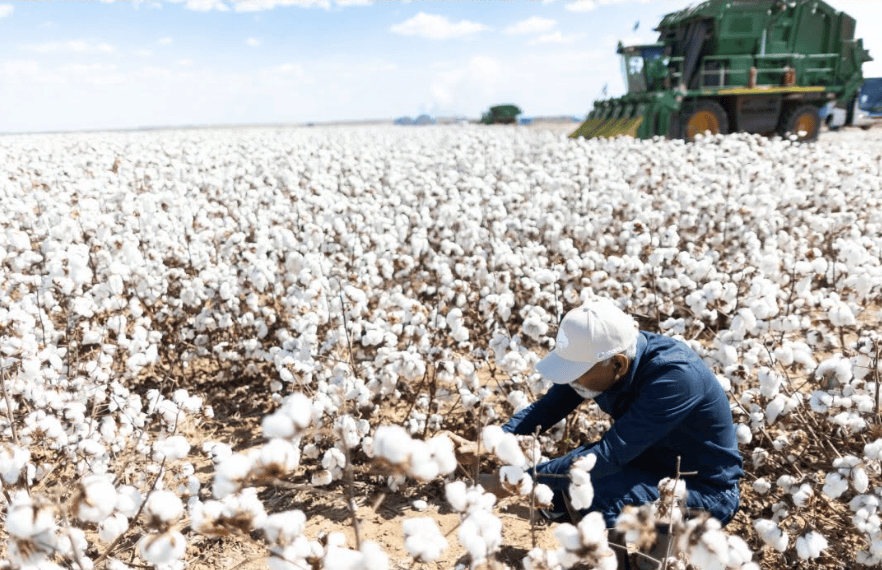
A Brazilian rise in production has driven a jump in the global cotton figures for October. Photo: Cotton Brazil
GLOBAL cotton production is forecast to reach 118 million bales for 2026-27, according to the World Agricultural Supply and Demand Estimates released on Friday by the United States Department of Agriculture
This is 600,000 bales more than the September report as larger crops in Brazil and the United States more than offset a smaller crop in Argentina.
Argentina production is lowered more than 100,000 bales to 1.3 million on smaller area harvested.
Brazil’s production estimate was raised by 500,000 bales, while the US jumped 241,000 bales.
WASDE has Australian production stable at 3Mb, mirroring earlier estimates from the Australian Cotton Shippers Association, and about 1.5Mb down from last season.
Australia would rank as the world’s seventh-largest cotton producer, behind China at 33.5Mb, India at 24Mb, Brazil at 19Mb, the US at 13.44Mb, Pakistan at 5Mb and Uzbekistan at 3.4Mb.
Global trade is projected up nearly 500,000 bales to 44.7Mb.
Brazil exports are forecast up 500,000 bales to 16Mb on higher production.
If realised, this will be a record level of Brazil cotton exports for the fourth consecutive year.
Brazil is the world’s largest cotton exporter, followed by the US, which is forecast to export 12.3Mb in 2026-27.
WASDE has Australia third at 4.5Mb, stable on the September numbers.
The report forecast higher import demand at 44.72Mb, up 482,000 bales on the last publication, driven by increases for India and Vietnam.
India imports are raised 300,000 bales to 3.3Mb as buyers continue to take advantage of the previously announced temporary suspension of duties on all cotton imports during the first quarter of the 2026-27 marketing year starting August 2026.
Vietnam imports are also up 100,000 bales to 8.3Mb.
Global consumption is forecast up nearly 200,000 bales to 123.1Mb on higher consumption in Guatemala, Malaysia, and Vietnam.
Global ending stocks are forecast up over 800,000 bales to 70.7Mb on increases in India, the United States, and Uzbekistan.
Australia’s ending stocks are estimated at 2.47Mb, the lowest in several years.
The U.S. season-average farm price for 2026-27 is lowered 1 cent to 77 cents per pound.
Since the last WASDE report, cotton futures on the Intercontinental Exchange (ICE) have fallen 8 cents to around 80 cents per pound.
Turkiye turns to Brazil
The October WASDE report highlighted Turkiye’s cotton imports and its growing reliance on Brazilian supplies.
Turkiye’s cotton imports are forecast at 5Mb in marketing year to July 2027, making it the fifth-largest global importer.
Shipments are expected to continue rebounding to offset lower domestic output.
Import growth has been supported by rising purchases from Brazil, which surpassed the US as Turkiye’s leading supplier in 2024-25.
Persistent macroeconomic volatility, including high inflation and elevated energy costs, have increased operating expenses for textile and apparel manufacturers.
To remain competitive, mills have increasingly sourced lower-priced cotton from Brazil and nearby Azerbaijan.
The move may help explain the decline in Australian cotton imports in recent years.
Australia exported almost 43,000 bales of cotton to Turkiye in 2025-26, down sharply from 139,442 bales in 2024-25 and 116,808 bales in 2023-24, according to the USDA’s 2 September Cotton and Products Update.
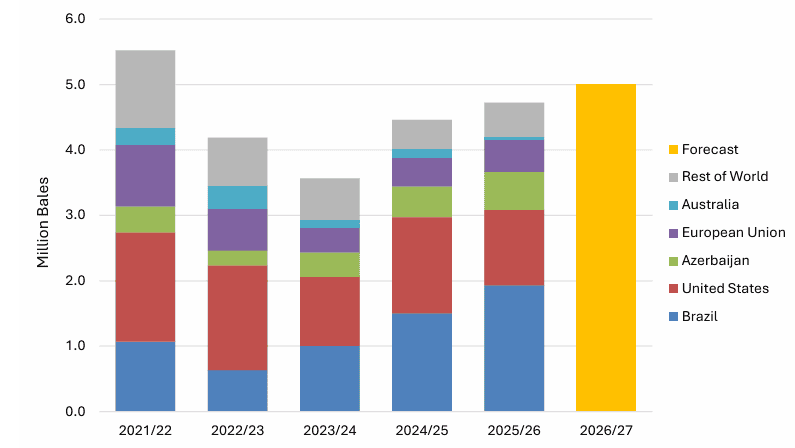
Turkiye’s cotton imports for 2021-22 to forecasted 2026-27. Source Trade Data Monitor, LLC via USDA
Turkiye cotton exports in 2026-27 are forecast to decline nearly 50 percent from the previous year to 600,000 bales due to reduced supplies.
Top markets include the European Union, Bangladesh, and India.
Turkiye is expected to be the sixth largest cotton consumer in 2026-27 at 6.8Mb, unchanged from the previous year but 21pc below the record level 5 years earlier.
Lower domestic purchasing power is reducing domestic demand for cotton products, especially garments.
Nearly half of Turkiye’s production of cotton products are consumed by the domestic market while the other half are exported.
Export demand has also weakened amid lower orders from the EU and rising competition from China, Pakistan, Bangladesh, and Vietnam.
Regional instability, including conflicts in the Middle East and Ukraine, has further reduced demand in markets where Turkiye has traditionally been a major supplier.
Mills report falling capacity utilization, with some facilities closing or shifting to lower cost locations.
Turkiye’s cotton products industry is expected to face continued pressure from weaker demand and elevated production costs, limiting prospects for recovery.
Source: USDA
HAVE YOUR SAY