

Weather: El Niño continues to strengthen. The US Climate Prediction Center puts the odds of a very strong event over the northern autumn and winter above 90 percent, with a 75pc chance in October–December that it exceeds every event since 1950. Trade commentary notes no adverse crop impact yet, but the risk window is now opening.
Brazil soybean planting is at a record pace, but DTN warns El Niño typically brings patchier rain and longer dry gaps to central and northern Brazil, raising drought risk. Southern Brazil is expected to benefit from El Niño rainfall, with soil moisture already well built.
DTN flags enhanced dryness in Malaysia and Indonesia as unfavourable for oil palm. In the Northern Hemisphere, conditions are benign: the Canadian Prairies turn dry and warmer after early showers, Europe’s rapeseed regions see isolated showers with near to above-normal temperatures, and central China’s winter canola establishment is favourable but would benefit from more rain.
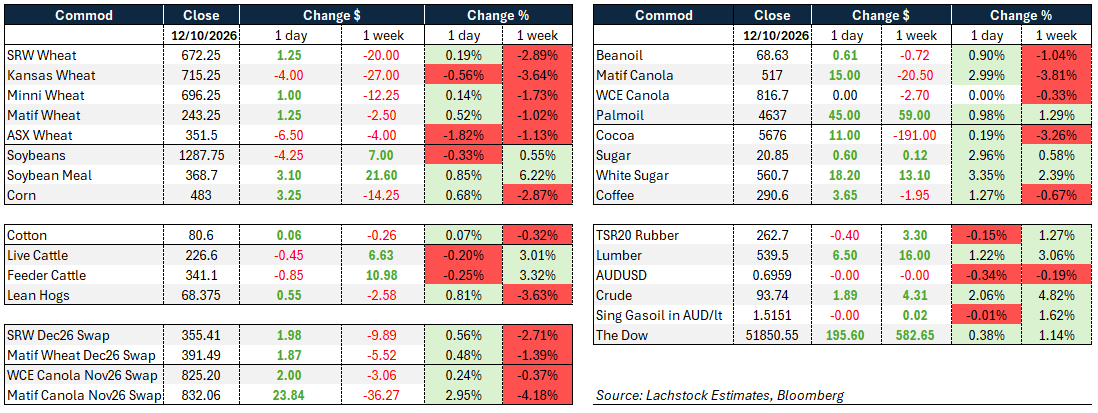
Markets: Wheat finished mixed. Geopolitics and shrinking Black Sea export estimates, with Russian consultancy IKAR putting wheat exports at 42 million tonnes (Mt), and Ukraine grain exports at 31.7Mt. This was offset by buyers waiting on the Southern Hemisphere harvest. ASX fell 1.82pc to $351.50/t while the SRW and MATIF swaps firmed about A$2.
Corn retraced part of its post-WASDE loss on a run of Asian tenders and farmer holding, but is still down 2.87pc on the week as the market questions USDA’s large supply addition.
Oilseed products led. Meal is up 6.22pc on the week, the December crush rose to 278.25, and MATIF canola rebounded 2.99pc with crude and palm, while beans were capped by negative Chinese crush margins and Brazil’s record planting pace.
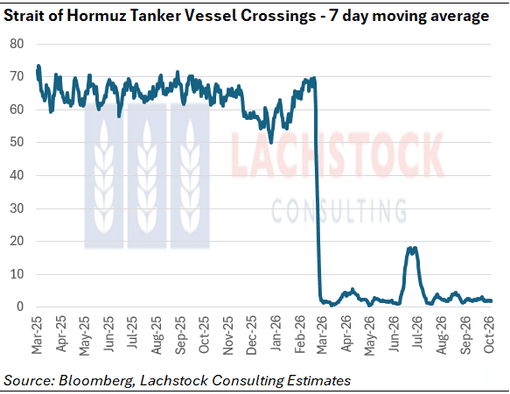
Crude oil rose 2.06pc, up 4.82pc on the week, on the Russia-Ukraine energy dispute, the Hormuz standoff and Houthi attacks, feeding inflation fears ahead of US CPI.
Day ahead – Australia: C and f wheat values have been sliding slightly; baffling, given the background but probably shows the lack of panic by Asian buyers. Aussie still works and will fill up the export path. Rain in Queensland is increasing and stretching into NSW now.
Wheat: With Columbus Day in the US, wheat had a mixed holiday-thinned Monday. Chicago and Minneapolis spreads were firm, the KC curve was soft, and WZ implied volatility eased to 23.43pc from 24.68pc. MATIF December and March both gained €1.25/t and Russian cash held near $204/t. US banks and USDA were closed for the holiday, and Canada was on Thanksgiving, so there was no crop progress, inspections or daily sales reports, making Tuesday the first full session after Friday’s WASDE.
Politics did most of the work. Trump’s suspension of sanctions on Russian diesel, his unconfirmed “energy ceasefire” and Russia’s continued strikes on Ukrainian energy infrastructure kept supply-chain risk in the market. AgResource said the war will further constrain refinery capacity into winter and stoke inflation fears. FSU states also renewed efforts to block Russian grain moving through to Baltic ports. Black Sea supply estimates continue to slip. IKAR cut Russia’s grain crop by 1Mt to 137Mt and wheat 500,000t to 88Mt. It cut wheat export potential to 42Mt from 43.5Mt, and Rylko warned total grain exports could fall to around 35Mt under a stress scenario, with part of the crop likely harvested in spring.
APK-Inform lifted Ukraine’s wheat crop to 25.5Mt from 25Mt but cut grain exports 6.5pc to 31.7Mt. Oil World data show Ukrainian wheat exports down 1Mt year on year in September and 1.3Mt in August, with the largest losses to Egypt, Indonesia, Vietnam and Thailand.
On demand, Algeria’s tender closes today, nominally calling for 50,000t, offers valid to Wednesday, and a Philippine group took about 140,000t of feed wheat, likely Australian.
With the Southern Hemisphere harvest imminent, buyers have been rewarded for waiting.
ASX fell $6.50/t to $351.50 even as the SRW Dec26 swap firmed $1.98 to $355.41, down $9.89 on the week, and the MATIF Dec26 swap rose $1.87 to A$391.49.
Corn: December corn traded both sides before closing 3.25 cents per bushel higher, partly reversing Friday’s post-WASDE slide. StoneX noted a cluster of tenders after the break. South Korea’s FLC is seeking up to 69,000t, Taiwan’s MFIG up to 65,000t, and The Philippines bought about 110,000t of South American corn.
Scepticism remains over USDA adding as much as it did to the US corn balance sheet, and growers are holding grain off the market. The lower board has made the PNW competitive with Argentina and cheaper than Brazil in some cases.
With CZ 65-70c off its highs, Ukrainian corn still trapped and an El Niño year in South America, some see value if weakness extends. On supply, IKAR cut Russian corn to 16.2Mt and APK-Inform cut Ukraine’s crop 1.5pc to 31.8Mt.
On demand, China lowered 2026-27 corn consumption to 306.85Mt from 311.65Mt on greater use of substitute grains.
Oilseeds: Products led the soy complex. SX fell 4.25c, SMZ rallied $3.10 and BOZ gained 61 points, lifting December crush 17.75c to 278.25. Meal remains the tighter leg: South American premiums are bid, the US is oversold, and processors are scrambling to cover commitments.
China’s crush is negative $20/t and expected to slow sharply over the next three weeks, Marex said, which is capping beans, and China cut its own soybean crop 590,000t to 20.36Mt.
Brazil planting is at a record 19.77pc, against 12.86pc last year and an 11.55pc average. In oil, OMB finished reviewing the EPA’s SRE reallocation plan on October 9, so an announcement may be close. Oil World put US soyoil use at 4.96Mt for May-August on biofuel demand.
Malaysian palm rose more than 1pc on firmer Dalian olein, despite September stocks reaching a record 3.51Mt on all-time-high output.
Early October exports were up 33.51pc month on month, and USDA sees Indonesian exports at a 14-year low in 2026-27.
MATIF canola rebounded €15/t alongside crude and palm, but remains 3.81pc lower on the week.
Ukraine shipped 431,000t of rapeseed in September, 420,000t of it to the EU, plus record rapeseed oil of 157,000t and meal at 140,000t exported.
The MATIF canola Nov26 swap jumped A$23.84 to $832.06 and the WCE Nov26 swap rose $2 to $825.20.
Local: The week started softer in the west, with canola bids back $6/t to $865, wheat steady at $381 and barley at $324 FIS Albany. In the east, canola fell $7 to $804, with GM at a $30 discount. Wheat was $352 and barley $285 track Geelong. The upward revision to US corn production adds pressure to feed grains. The increase surprised the market and has been met with scepticism, but combined with softer domestic corn prices in China, it offers little support for barley in the short term.
Rain is forecast for Qld and northern NSW over the next few days. Further out, another decent rain event looks possible across the east coast and into SA, awkward timing for those preparing to harvest.
HAVE YOUR SAY