
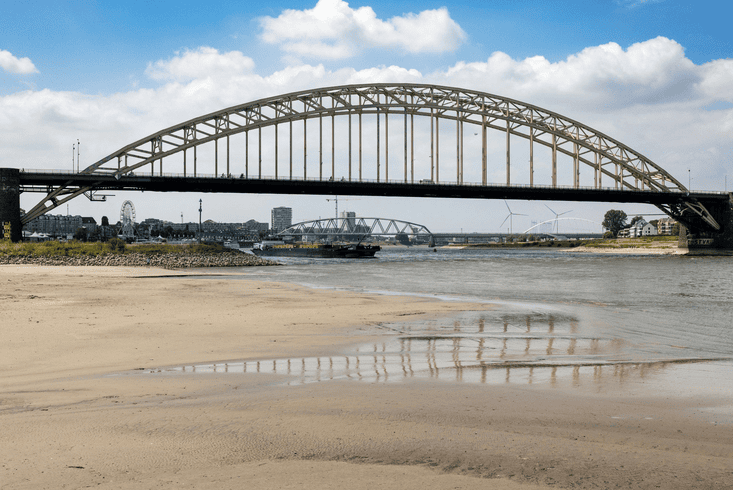
Netherlands’ Waalbrug over the Waal River, a distributary branch of the Rhine, shows low water levels which are limiting western Europe’s river traffic. Photo: Rinse Fokkema via Rijkswaterstaat
SEVERE drought and extreme heat, which have beset much of Europe for months, are severely hampering navigation on the Rhine River. One of the continent’s most important commercial waterways, the Rhine plays a critical role in transporting grain, minerals, ores, coal and petroleum products.
Benchmark water levels continue to drop along the length of the river, reaching record lows yet again last week, grounding several vessels in the process and preventing critical fuel tanker deliveries from making their way inland. Multiple record lows and near-record lows have been recorded throughout this past summer and into autumn at various monitoring stations along the Rhine River.
One of the world’s busiest inland shipping routes, the Rhine stretches 1230km from the Swiss Alps, initially meandering westward before heading north to Rotterdam in the Netherlands, where it enters the North Sea. It is navigable for over 870km from Rheinfelden, around 20km upstream from the Swiss capital Basel, through France and Germany to the Netherlands. A large share of western Europe’s heavy industry, chemical plants, steel mills, and automotive hubs line its banks, relying on the river for transport, cooling, and process water.
The river normally carries 285-300 million tonnes (Mt) of freight annually to and from the port of Rotterdam, the largest in Europe, making up around 30 percent of that trade hub’s total cargo turnover each year, and 70pc of Europe’s annual inland waterway freight task.
Agricultural produce, including grain, accounts for around 10 per cent of the annual volume. A traditional grain-transit corridor runs from north-eastern France via the Mosel River, a major tributary, into the Rhine. The Port of Metz on the banks of the Mosel has significantly reduced its activity as a result of the situation. France transports more than 2Mt of wheat from there each year to Germany, the Netherlands, Belgium and Luxembourg. But this year, the port’s grain storage facilities are full, yet the accumulated quantity cannot be shipped.
Swiss draw on reserves
Switzerland has reportedly begun drawdown of mandatory reserves of protein feed for livestock, such as soybean meal, rapeseed meal and sunflower meal. Since the beginning of September, the landlocked nation has already used 9.5pc of its reserves, with further releases expected if the supply chain constraints continue.
Mandatory protein feed reserves are designed to cover around two months of consumption in the event of a complete halt in imports. Switzerland is almost entirely dependent on imports of soybean meal, making the livestock sector particularly vulnerable to logistics disruptions.
The latest European inland navigation report noted that while coal transport shrank significantly in 2024, demand for bulk agricultural commodities and food transport was extremely resilient, with volume across the Rhine basin up 6.8pc from the previous year.
Official readings from the German water authority on October 1 showed water levels at Kaub, the Rhine’s shallowest point, had dropped 6cm below its 113cm benchmark level, surpassing the previous all-time low of -2cm against the baseline threshold recorded on September 29.
Falling water levels at the Kaub chokepoint follow reports of record low water levels in parts of the lower Rhine, downstream from the German city of Bonn. Reported readings at Cologne in Germany and the Dutch village of Lobith are currently hovering just above record lows set late in September.
The inability to move large volumes of containers and bulk goods between major North Sea ports and inland centres is creating huge operational headaches and cost pressures for businesses and their logistics partners.
Barge movements restricted
Near-term forecasts show little rain to ease the logistical nightmare. The low water levels mean barges are held up at port or carry smaller payloads to reduce their draft, reducing capacity and driving up freight rates. This is forcing shippers to divert loads to other, less efficient transport modes and routes, such as road and rail, that lack the capacity to make up the difference. Only very small vessels, or those partially loaded to just 15-20pc of capacity, can transit the upper and middle Rhine pinch points, while large barges can’t operate at all.
In addition to higher transportation and container-repositioning costs to reroute products by rail or road, shippers face demurrage and detention storage fees amid mounting backlogs at ocean and inland terminals geared to barge freight that lack the space or systems to quickly move containers onto road and rail alternatives.
Container-shipping giant Maersk has announced low-water surcharges on the Rhine River due to unexpectedly low water levels affecting its inland logistics network. Water levels less than 81cm above the Kaub benchmark, or 181cm at Duisburg-Ruhrort, eliminate loading guarantees. Surcharges apply to full containers, ranging from €20 to €1670, depending on container size and water levels at the time of transit.
With water levels at some points the lowest in records stretching back to the 1880s, companies are confronting the possibility that reliable access to the Rhine can no longer be taken for granted. Earlier this year, a study released by the Nature and Biodiversity Union in Germany described the lowering water levels as an”environmental catastrophe”, estimating the river had lost 60 billion cubic metres of water over the past 20 years, and warned constant shutdowns of the river would cost over a trillion dollars in lost trade by 2050.
However, the disruption has shown how industries can adapt. After a severe drought brought shipping to a near standstill in 2018, some companies invested in barges designed specifically to navigate a shallower Rhine, as well as alternative rail and road transport links. Those prudent investments are allowing them to keep goods moving this year, even as conventional barges struggle.
HAVE YOUR SAY