
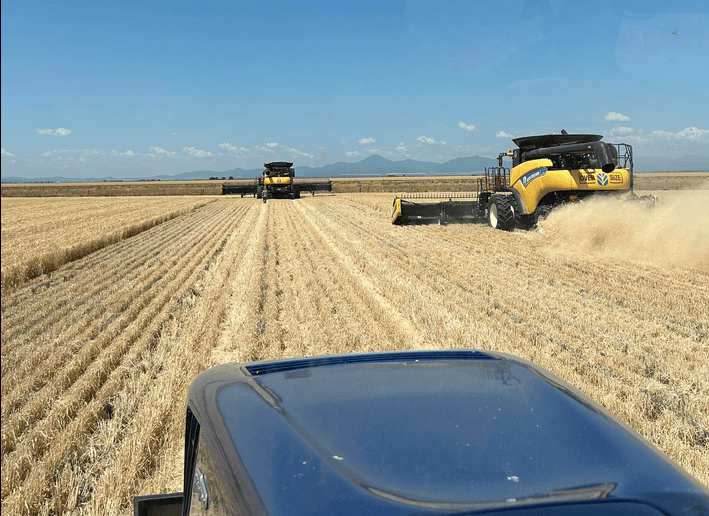
Harvesting barley this week south-east of Moree. Photo: The Jackson Brothers
NEARBY values have firmed in the north as growers limit new-crop grain being meted out to a hungry domestic market, and southern markets have eased in response to a tail-off in barley demand.
The impact of expensive diesel on road freight has stemmed the movement of Mallee and Riverina barley to southern Queensland feedlots, and bids to local growers have crept up as a result.
Another week of patchy rain has slowed the northern harvest in places, but further consolidated yield prospects in the south.
| Oct 8 prompt | Today prompt | Oct 8 for Jan | Today for Jan | |
| Downs barley | $400 | $408 | $410 | $408 |
| Downs SFW | $425 | $433 | $435 | $433 |
| Downs sorghum | $380 | $380 | $380 | $380 |
| Mel barley | $310 | $300 | $300 | $300 |
| Mel ASW | $385 | $360 | $360 | $360 |
Table 1: Indicative prices in Australian dollars per tonne for prompt and January 2027 delivery.
North
In the northern market, chickpeas remain the hot harvest sell, and are currently bid at around $950/t delivered site in Central Qld, $1000/t delivered Downs, and $1020/t delivered Brisbane.
The CQ harvest is just about over, and is believed to have produced more chickpeas than wheat because of the small area planted, and limited in-crop rain.
In southern Qld, many growers on the Western Downs are harvesting barley and wheat, and holding barley in the hope of a price rally.
“Feedlots are looking for barley, but growers are only selling the stuff they can’t store,” one trader said.
“If you want to buy it, you’ve got to have a truck ‘combat ready’ to put under the auger as soon as it’s been harvested.”
Barley as well as corn has been calculating into Downs feedlots, barley at around $400/t and corn at roughly $600, with corn sourced from the Murray and Murrumbidgee valleys.
However, the high cost of diesel has priced it out of the market, and feedlots are bidding up to attract barley from farms close to home.
Cottonseed is trading at around $540/t ex gin in the Gwydir Valley and on the Downs.
Old-crop wheat is available locally, but growers are in the main holding that in the hope that prices rally, particularly as weather agencies point to a strengthening El Niño.
Storms and showers have brought significant rain to some paddocks in recent days.
In the week to 9am this morning, top registrations in Qld’s growing regions include: Emerald 20mm; Roma 14mm; Springsure 13mm, and Surat 16mm.
A limited number of Qld growers have had enough rain to open their sorghum-planting programs, but most need 25-50mm more to get them going.
In northern NSW, double-digit totals include: Moree 38mm; Mungindi 17mm; Pallamallawa 19mm.
The falls have interrupted the opening week for many of the NSW harvest, but the rain is welcome as a boost for sorghum.
South shapes up as harvest nears
More welcome rain has fallen across parts of south-eastern Australia this week.
In southern NSW, registrations for the week include Cootamundra with 14mm, and Temora with 20mm.
In Victoria, pockets of the Wimmera had around 10mm, and most gauges in SA growing districts west of the Murray Mallee recorded 5-20mm.
Horsham-based Mygrain broker Andy Brown said growers were “trying to clear out silos” ahead of harvest.
“For wheat, there’s a bit of demand, but barley demand is hard to find,” Mr Brown said.
Multigrade contracts based on APW at around $375/t are being written, and new-crop export sales are staving off supply side pressure from Vic’s bumper crop expected to start hitting the bins before the month is out.
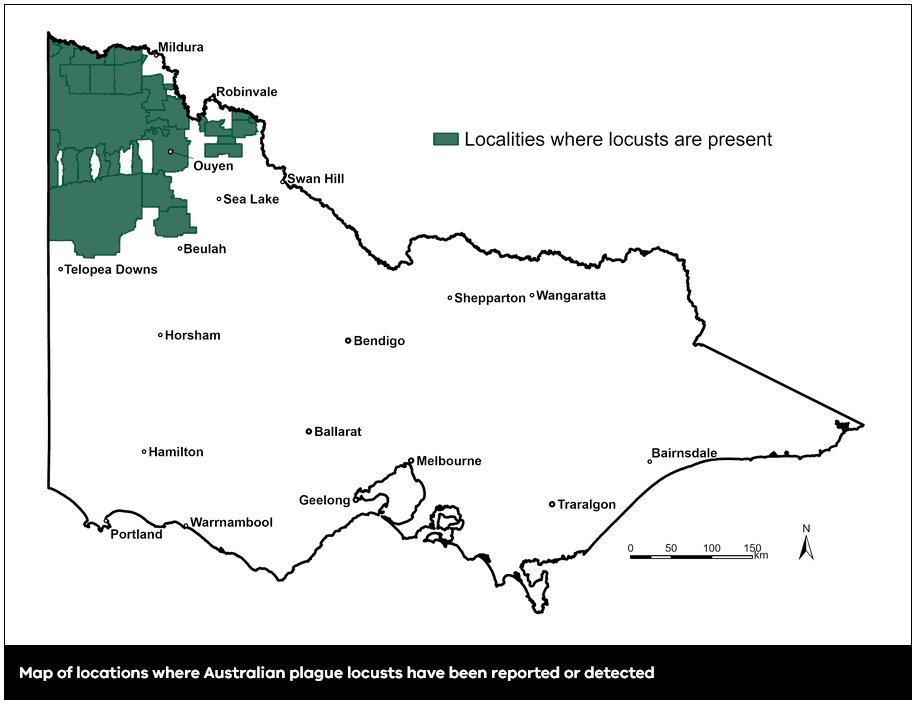
Source: Agriculture Victoria
In Victoria, Australian plague locusts have been reported or detected in much of the state’s north-west.
The insect can cause significant damage to crops and pastures if populations are not controlled at the optimum time.
Surveillance of the priority local government areas has found locusts hatchings in the following north-west Vic locations:
Northern Mallee: Cullulleraine, Hattah, Lindsay Point, Meringur, Merrinee, Murray Sunset, Neds Corner, Werrimull and Wargan
Central Mallee: Panitya, Murrayville, Cowangie, Boinka, Linga, Annuello, Bolton, and Manangatang
Southern Mallee: Patchewollock and Hopetoun.
Agriculture Victoria advises a lack of detection in other townships within its priority LGAs does not mean locusts are absent.
“Under Victoria’s shared responsibility arrangements, private landholders and public land managers are responsible for monitoring their land and undertaking any necessary control,” Agriculture Victoria said in a statement.
Locusts have been observed as a mix of developmental stages in some locations. This may have occurred because in some areas, eggs were laid during different periods of the year.
An extended hatching time is now expected.
Grain Central: Get our free news straight to your inbox – Click here
HAVE YOUR SAY