
 Weather: El Niño is heading towards historic strength, and the World Meteorological Organization expects central and eastern Pacific sea temperatures to reach record levels over October–December, peaking in December. South-east Asian dryness is now hitting vegetable oil and sugar supply.Palm yield losses typically lag 12 to 24 months, and Thai millers see sugar output falling below 10 million tonnes (Mt) in 2026-27 from 12Mt.
Northern Hemisphere conditions are mixed; a drier US week allowed harvest and wheat planting to catch up, though both still trail average, and Hurricane Isaias did less damage than feared, while cool, wet weather threatens late Prairie canola fields. Drought that persisted into September has left France with its smallest maize crop in decades at 7.3Mt.
Southern Hemisphere crops are holding up better than the El Niño headline suggests. Central Brazil rainfall has been better than expected, while Paraná is dealing with cold, hail, and excess moisture.
Rabobank still sees Australia’s winter crop above average at 63 mt despite El Niño, but regional outcomes are diverging sharply, from deficits to records.
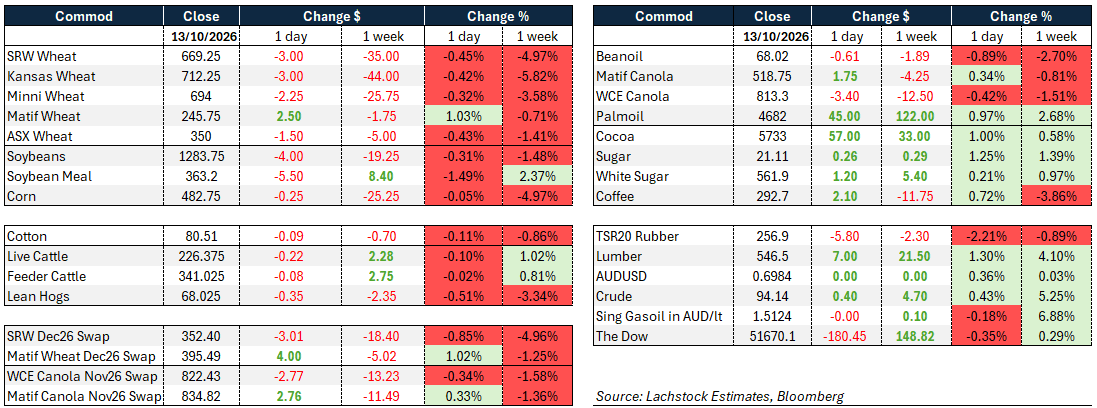
Markets: Wheat shed almost 5 percent in Chicago and close to 6pc in Kansas City on the week. Black Sea escalation and Algerian demand failed to hold a risk premium. MATIF’s relative strength has lifted the MATIF Dec26 swap about A$43/t over SRW, while ASX at $350 has been far better insulated than US futures.
European feedgrain is the tightest spot in the complex. MATIF maize jumped €12/t on the French crop cut, with EU users exposed to any disruption of Ukrainian corn from November. CBOT corn lost 5pc on the week as delayed harvest and a long fund position cap rallies.
The soy complex is trading policy headlines rather than fundamentals. Thin Chinese buying and a sell-the-fact reaction to the EPA SRE reallocation dragged bean oil down 2.7pc on the week and capped it at 70c per bushel again. Canola tracked Chicago lower on both MATIF and WCE, and palm’s inverted-forward curve shows the market pricing a 2027 deficit.
Energy is the key input cost risk. Crude rose 5.25pc and Singapore gasoil 6.9pc in A$ terms over the week, lifting harvest and freight costs for Australian growers just as harvest starts. The AUD steady near 0.698 US cents offers no offset, and the contested Russian diesel deal and IMF growth concentration leave the macro backdrop volatile.
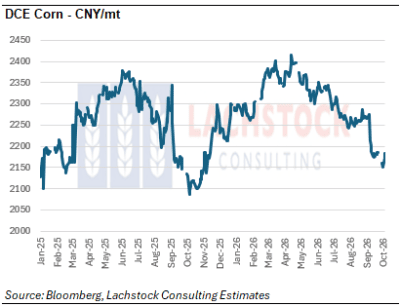 Day ahead – Australia: Wheat exports continue to show strength from Australia. Fun fact: This month is the first time in a long time wheat will dominate barley from Australia to China. Barley is the more difficult one to predict given big local production, a relatively full supply chain and a very quiet China. Not a great correlation, but it’s worth noting that China corn futures are also getting pounded.
A mixed night on canola offshore might keep things relatively flat today.
Wheat: US wheat gave up an early Black Sea and Algeria rally to close modestly lower. WZ and KWZ each lost 3c and MWZ 2.25c, spreads were flat to weaker, and WZ implied vol eased to 22.31pc from 23.43pc.
MATIF went the other way, with Dec up €2.50 and March up €2.25. That widened the SRW Dec26 swap (A$352.40, -3.01) to Matif Dec26 swap (A$395.49, +4.00) gap to about A$43.
The Black Sea escalated again. Two more cargo ships were hit by drones off Bulgaria overnight, and one sunk with 11 sailors missing. That makes four Bulgarian-linked vessels hit in a week. Sofia summoned Russia’s ambassador, and NATO’s Rutte said the alliance’s eastern-flank posture would be adjusted as needed. A Mykolaiv cargo terminal was also damaged. Condemnation was broad but there are no consequences in sight. Combined with Hormuz, buyers are being pushed toward longer-term supply alternatives.
IKAR cut Russia’s wheat export potential by 1.5Mt to 42Mt and total grain exports by 2.2Mt to 52.8Mt. It flagged a stress scenario of only around 35Mt of grain exports.
IKAR quotes 12.5pc FOB at $268, up $2 on the week. The wider market $204 Russian cash quote shows the disparity in values quoted out of the region.
Algeria is understood to have bought around 600,000t, with no details yet.
US inspections were 305,000t, leaving the year-on-year deficit at 35pc, and winter-wheat planting reached 51pc against 50pc expected and a 58pc five-year average.
Rabobank puts Australia’s winter crop at 63Mt, 2.6pc above the five-year average but 7.9pc below last year. Its wheat forecast is 31Mt, down 13.3pc, with sharply divergent regional outcomes.
Corn and oilseeds: CCZ traded 5c either side before settling down 0.25c. Some buyers see value on breaks, while others expect harvest pressure against a managed money long. Harvest lagged at 33pc against 37pc expected and a 39pc average, but conditions rose 2 points to 56pc against 54pc expected. Inspections of 1.302Mt matched estimates and keep the pace up 5pc.
Cordonnier is at 180 bushels per acre for corn and 53.1 bushels for soybeans, questioning a WASDE that raised yields while ratings fell.
COFCO was talking the market down. Part of the fund long is likely positioned for Ukrainian flow risk and El Niño-affected South American output.
Europe is the pressure point. France cut its grain maize crop to 7.3Mt from 8.1Mt, the lowest in decades after drought ran into September. MATIF maize jumped €12 to €289.25, and the EU corn user is the obvious short if Ukraine’s November flows stay constrained.
South Korea’s NOFI and FLC each took about 130,000t of corn.
On soybeans, SX was up 10c early before settling down 4c. China asked for US offers but bought only one or two cargoes. AgResource estimates China has bought about 15Mt since the Busan agreement, leaving roughly 10Mt still to secure by December 31.
Bean oil was up 100+ points on the EPA plan to reallocate 2025 SREs (1.76bn gallons across 29 refineries in 2025) into 2026 and 2027. It then sold the fact to finish down 61 points, failing at 70c for a fourth time.
Meal lost $5.50 on liquidation as crush runs flat out, and the Dec crush fell 14.75c to 263.50.
Bean inspections of 1.097Mt missed estimates, with the pace at 27pc of last year. Harvest reached 46pc against 43pc expected and a 50pc average, and conditions held at 57pc.
Brazil’s soy planting is 15pc done against 7pc a week earlier and 14pc last year (AgRural).
Canola followed Chicago lower from a C$824.70/t high. Prairie harvest pressure and a Canadian dollar weighed, though cool, wet weather may delay late fields. Nov/Jan traded $13 to $13.70 under.
The WCE Nov26 swap sits at A$822.43 (-2.77) and the MATIF canola Nov26 swap at A$834.82 (+2.76).
Palm’s Jan contract sits about 420 ringgit under July, from near parity two months ago. Record Malaysian stocks weigh on the front, while El Niño yield losses, Indonesia’s B50 mandate and USDA’s forecast of 14-year-low Indonesian exports support the back. Mistry sees 2026-27 global supply down 2.5Mt.
Local: In the west, canola eased $3 yesterday to $861, while wheat was steady at $382 and barley at $324 FIS Albany. In the east, canola was $801, wheat $352 and barley $288 track Geelong. Russian wheat is very cheap, but its influence remains limited while export flows are constrained. If shipments regain momentum, that cheap supply could quickly weigh on global prices — a key reason many will look to market wheat early this season. Demand remains firm for early lentil tonnes, but packing capacity is becoming a bottleneck, with most slots now fully booked. The market felt a little softer late yesterday.
HAVE YOUR SAY