
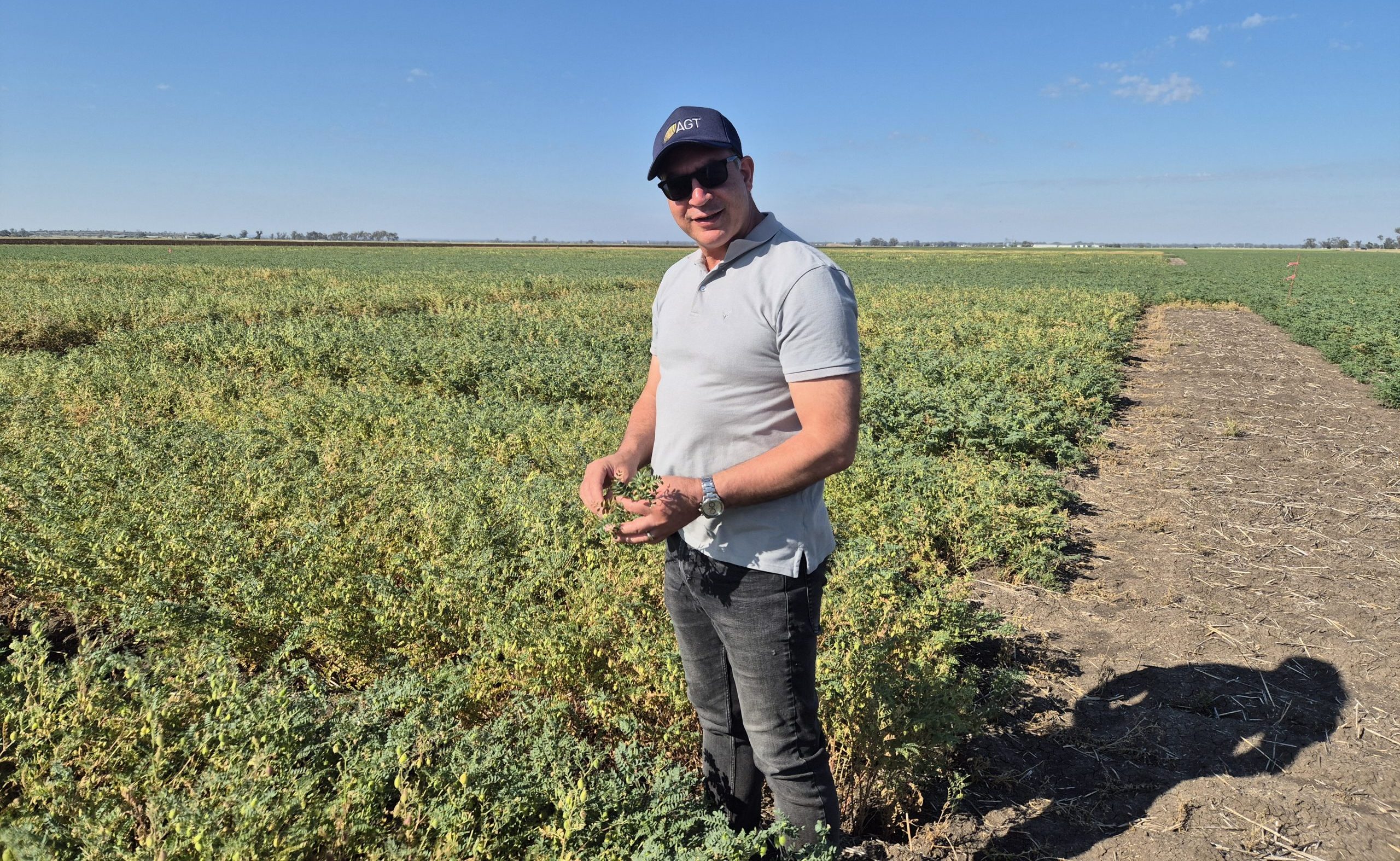
AGT chickpea breeder Dr Ali Inzaloo has moved from New Zealand to Narrabri to take up the new role. Photo: AGT
AUSTRALIAN Grain Technologies has released AGT-Opener Imi, its first desi chickpea variety which signals its lead in the pulse’s national breeding program, now centred at AGT’s Northern Crop Breeding Centre in Narrabri.
AGT-Opener Imi is Australia’s first chickpea variety with tolerance to residual imidazolinone herbicides, and has been selected from the advanced germplasm pool acquired from Chickpea Breeding Australia.
The pool came to AGT in May, when the Grains Research and Development Corporation named AGT as the replacement for the New South Wales Department of Primary Industries and Regional Development in the long-running CBA partnership.
AGT’s leadership in the chickpea-breeding space means the future use of the CBA Breeding and Research Centre, opened in December 2023 at the department’s Tamworth Agricultural Institute, is uncertain.
Building on tradition
In keeping with the CBA tradition, AGT has named its first chickpea variety after a cricketing term.
AGT pulse coordinator Adam Norman said AGT’s chickpea-breeding program aims to accelerate the delivery of improved commercial varieties.
“Taking on responsibility for the national chickpea breeding program is a privilege and a significant responsibility,” Dr Norman said.
“AGT-Opener Imi is the first variety to emerge from this new era and demonstrates our commitment to delivering practical innovations that improve productivity, profitability and flexibility for Australian growers.
“We would also like to acknowledge the dedicated contributions of the previous plant breeders, Dr Kristy Hobson, Dr Nicole Dron and Dr Ahsan Asif, who developed this variety.”
AGT has also this week announced the appointment of Ali Izanloo as its chickpea breeder, based in Narrabri.
Dr Izanloo first interacted with AGT while completing his PhD through the University of Adelaide more than 20 years ago, and has since worked in international university research programs before most recently serving as a pea breeder in New Zealand.
“Ali’s appointment brings a wealth of breeding expertise and fresh perspectives to the program,” Dr Norman said.
“We are excited to welcome him to AGT and look forward to building on the outstanding foundation established by Chickpea Breeding Australia as we develop the next generation of chickpea varieties for Australian growers.”
Further enhancing AGT-Opener Imi’s potential is AGT’s application before the Australian Pesticides and Veterinary Medicines Authority for approval of Nufarm Intercept, a Group 2 Imazamox and Imazapyr formulation, for in-crop use.
If approved, it would become the first registered imidazolinone herbicide for use in chickpeas carrying this trait.
Alongside its herbicide tolerance, AGT-Opener Imi’s disease package offers resistance levels comparable to current commercial standards for Ascochyta blight.
The variety also demonstrates excellent resistance and tolerance to the Pratylenchus thornei root-lesion nematode, although resistance to Phytophthora root rot is slightly lower than some leading varieties.
What future for Tamworth site?
The CBA Breeding and Research Centre at Tamworth was funded by GRDC and the then NSW DPI at a cost of $10 million, and a robotic seed packer was among its enhancements from a subsequent $1M spend.
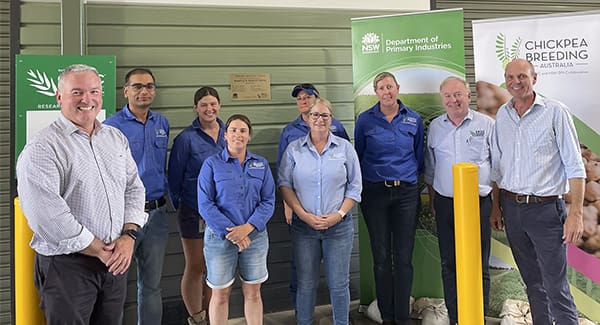
The December 2023 opening of the Chickpea Breeding Australia facility at Tamworth, with then NSW DPI director general Scott Hansen, and NSW DPI’s CBA team (from left to right) Ahsan Asif, Belinda Rowe, Sarah Kampe, Bec Miller, Kristy Hobson, Narelle Moore, with GRDC managing director Nigel Hart and GRDC chair John Woods at right. File photo: NSW DPI
With the chickpea germplasm now ensconced at AGT’s Narrabri facility, around 170km north-west of Tamworth, Grain Central understands the facility is being used for some plant breeding activities, including pathology work in the glasshouses.
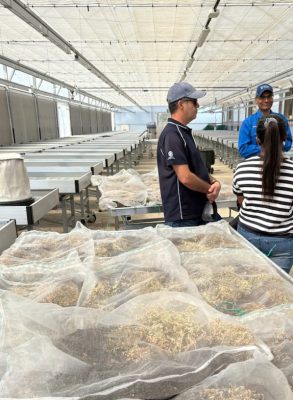
Some glasshouse work is ongoing at the former CBA headquarters at Tamworth. Photo: Supplied
However, much of the site is reportedly empty or underutilised.
A NSW DPIRD spokesperson said the site was still being used “to support the transition of the breeding program to AGT”.
“This includes disease screening and advancing populations for GRDC,” the spokesperson said.
“The department remains committed to maintaining the facility and its equipment and is actively engaging with partners to maximise its future value, including through disease screening, pre-breeding research, and other collaborative research opportunities.”
Grain Central understands some growers, agronomists and advisors in the region are concerned the facility may become an underutilised or wasted resource once the CBA germplasm move to Narrabri is complete.
Changing times
The removal of CBA germplasm from NSW DPIRD fold is the latest development in a two-decade shift towards privatisation of operations which rely on contracts and projects funded externally, particularly by GRDC.
Human capital has also been lost, with close to 170 jobs cut in mid-2025 at facilities including Orange Agricultural Institute, Wagga Wagga Agricultural Institute and Wollongbar Agricultural Environmental Labs.
Moree-based principal of Crown Analytical Services Rob Long said “it was a pity” that the CBA site was not being used to its full potential.
“Me and every other advisor in the north would be thinking that the underutilisation of the facilities and of the personnel…is troubling,” Mr Long said.
Mr Long also cited the Moree Rural Skills Centre, saying it was unused and had been left to become derelict.
“It’s a travesty that that facility has just been let slide and not being utilised for agricultural research and or research validation.”
GRDC was contacted for comment.
Grain Central: Get our free news straight to your inbox – Click here
HAVE YOUR SAY