
 Weather: NOAA’s CPC gives an 83 percent chance that October–December 2026 beats every El Niño since 1950, with weekly Niño 3.4 at +3.3°C for the week centred 7 October, the third record week in a row. The effects are already showing in Asia: India’s agriculture secretary warned the rabi season will be challenging for rainfed areas and foodgrain output could suffer, while Indonesia’s rainy season may be delayed until November or December, and Kalimantan fire hotspots are at a decade high.
Australia has largely escaped the El Niño hit. Rabobank forecasts a 62.9 million tonnes (Mt) winter crop with 31Mt wheat, including a record 12.44Mt for South Australia, and record 8.1Mt canola, though Queensland’s crop is forecast to fall 47.6pc to 2.03Mt on poor rainfall. A mild WA spring added 864,500t to GIWA’s wheat estimate.
In Brazil, northern Brazil’s wettest period has been pushed back, and 15-day rain totals have eased to mostly 1.5–2.5 inches, after many areas topped 100°F through mid-October. The risk is that repeated delays push soybean planting later and narrow the second-crop corn window, although Mato Grosso planting is still running ahead of average.
Northern hemisphere winter crops are mixed. In the US, winter wheat was 51pc seeded, with a dry week ahead for the HRW belt followed by above-normal rain in week two. In Russia, winter grain sowing is the slowest since 2013, slowed by low soil moisture and occupied fields, and a third of Ukraine’s winter wheat area is in moisture deficit. Warm, dry Prairie weather is letting Canada finish harvest after a damaging wet September.
Markets
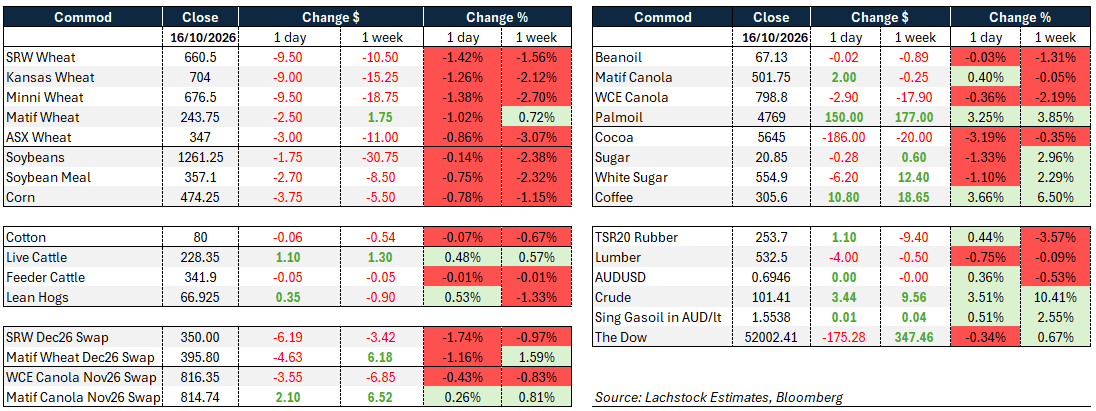
US wheat lost 10.50 to 18.75c on the week, led by Minneapolis, and ASX dropped A$11/t (-3.07pc) as harvest pressure and the GIWA upgrade weighed. Matif was the exception, gaining €1.75/t on the week, so the Matif Dec26 swap at A$395.80 now sits A$45.80 over the SRW Dec26 swap at A$350.00, which favours Matif-linked pricing for Australian wheat.
Soybeans shed 30.75c on the week despite roughly 1.9Mt announced sales, with China’s return already priced. Meal and oil followed beans lower. ICE canola broke below C$800 to a seven-week low on Prairie harvest selling, down C$17.90 on the week. The Matif canola Nov26 swap gained A$6.52 while the WCE swap lost A$6.85, leaving the two within A$1.61 of each other at about A$815.
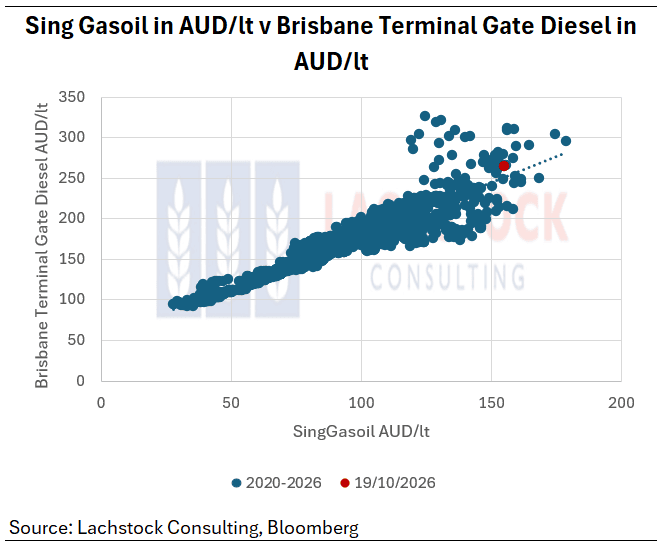
Palm was the standout, up 3.85pc on the week on strong October exports and El Niño supply risk for 2027. Crude rose 10.41pc to $101.41 and gasoil gained 2.55pc in A$ terms, supporting vegetable oils through biofuel demand while lifting freight and on-farm fuel costs into harvest.
Fund long liquidation in corn, recession talk, a firmer US dollar and live October Fed hike risk all weighed on the complex, and corn has now lost four sessions in a row below its 200-day. A 0.53pc weaker AUD on the week gave Australian prices only a small cushion against offshore losses.
Day Ahead – Australia
US wheat futures markets simply feel heavy – rallies are hard fought only to see the bleed take over with little resistance. This divergence between northern and southern hemisphere should continue given freight differentials.
Russia is pounding Ukraine supply chains – in the context of the percentage of Russian exports exiting via the Baltic and the fact this will face weather challenges, its hard to be friendly Black sea export pace. So the Asian consumer is still captive to Australia and Argy for a period of time.
Rain forecast sticking around in Qld which will be amazing for sorghum and cotton.
Quiet ahead of harvest pressure.
 Wheat: Wheat put up little resistance into the weekend. All three US classes lost 9 to 9.5c and WZ implied vol was steady at 23.73pc.
In Paris, Matif Dec was turned away at €250/t on both Wednesday and Thursday, and frustrated longs liquidated into Friday, with March off €3.25. Russian cash was unchanged at US$204/t fob.
With US futures down more than $1 in recent weeks, importers are happy to stay hand to mouth while the southern hemisphere harvest approaches.
GIWA lifted its WA wheat forecast by 864,500t to 10.9Mt on mild spring temperatures.
US weekly wheat sales of 320kt missed the 450kt expected.
The SRW Dec26 swap fell A$6.19 to A$350.00, while the Matif Dec26 swap slipped A$4.63 to A$395.80 but held a weekly gain of A$6.18.
Black Sea logistics are tightening on several fronts. Bulgaria’s grain producers say 5Mt of wheat is ready for export, but ships are refusing Bulgarian Black Sea ports after drone strikes in its economic zone sank a second cargo vessel. Romania’s president warned that Russia is increasingly targeting Ukraine’s export corridors, and Russia struck a vessel bound for Odesa overnight.
Rusagrotrans sees Russian October wheat exports at 3Mt, up from a revised 2.9Mt in September, with about 65pc moving through the Baltic. However, rail capacity to the Baltic and eastern networks is struggling as flows are diverted from Azov-Black Sea ports. Baltic November supply is largely committed and December weather is expected to limit loadings.
Latvia’s prime minister has urged Europe to block Russian grain transit through Baltic ports altogether.
Minister Lut put the Russian harvest above 130Mt bunker weight, including about 95Mt of wheat.
FranceAgriMer has French soft wheat 15pc planted, behind 24pc last year and the 21pc average.
The IGC held world wheat at 820Mt, and China kept its 2027 wheat TRQ unchanged at 9.64Mt.
A wet September in Canada has damaged spring wheat quality.
In the US view, any window for US wheat into non-traditional destinations is unlikely before late winter or spring, leaving Australia well placed to take a large share of near-term demand.
Corn and oilseeds: Corn fell for a fourth straight session, a day after settling below the 200-day moving average.
The market is still absorbing the 400m bu-plus lift in US supply at harvest.
Last week’s COT showed nearly 55,000 long corn contracts closed.
Marex flagged a weekend harvest pre-hedge, chart selling and talk of macro funds exiting commodities on US recession fears.
The IGC raised 2026/27 world corn by 6Mt to 1.307 billion tonnes, mostly on a bigger US crop.
Demand is firming underneath, with weekly corn sales of 1.122Mt beating the 850kt expected, plus a 127kt flash sale to Japan.
China’s September corn imports were 430kt, up 663.6pc y/y.
The US commentary argues that if Ukraine cannot execute exports, demand for US corn will pick up quickly.
French grain maize was 92pc harvested by 12 October, and China held its corn TRQ at 7.2Mt.
Soybeans sold off overnight before a late bid trimmed losses.
Dec crush eased 4.5c to 262.75. Announced flash sales totalled 1.9Mt this week, including 558kt to China and 236kt to unknown destinations on Friday.
Some estimates put Chinese buying at around 2.5Mt, but Futures International noted China’s return was largely priced in.
Weekly bean sales of 575kt disappointed, though next week’s tally should be several times larger.
Meal sales were 366kt against 400kt expected and soyoil exports were just 1.2kt against 5kt.
Mato Grosso planting is 51.86pc complete against the 43pc five-year average, with some dryness complaints further north.
ICE canola hit a seven-week low and the close below C$800 is technically bearish. Steady farmer selling and a warm, dry Prairie weekend should let growers finish harvest. Deliveries of 620,100t in the week to 11 October were down 19pc w/w, but crop-year deliveries of 4.45Mt are 28pc ahead of last year.
Weekly exports fell to 158,300t from 248,400t, though crop-year exports of 1.38Mt are up 44pc.
The WCE canola Nov26 swap fell A$3.55 to A$816.35, while the Matif canola Nov26 swap rose.
Macro: Crude added more than 10pc on the week as both the Russia-Ukraine and Middle East conflicts escalated.
Trump waived part of the new Russia sanctions law named after Senator Graham under a deal for Moscow to supply limited diesel volumes. The move drew bipartisan backlash, and US lawmakers have introduced a bill to stop the agreement.
Zelenskyy accused Trump of pushing Kyiv toward capitulation. He cited slowed Starlink speeds and Patriot interceptor deliveries of only 12 a month, and offered to stop striking Russian refineries in exchange for more Patriots. Both sides kept hitting energy infrastructure over the weekend, including fires at the St Petersburg oil terminal. Putin ordered continued mass strikes on Ukrainian logistics, and Moscow moved to place French, German, Swedish and Belgian company assets under temporary management.
In the Gulf, the US and Iran both claim control of the Strait of Hormuz. Iran appointed missile specialist Mehrdad Akhlaghi as defence minister, and he quickly taunted Washington over its “mother of all bombs” threat.
The Houthis have struck Riyadh airport and Saudi Aramco’s headquarters.
Washington is weighing lifting sanctions on some shadow fleet tankers to ease record freight rates.
US September industrial production rose 0.7pc m/m against 0.4pc expected, its highest level since September 2018. Manufacturing rose 0.3pc, held back by a 3pc fall in motor vehicles, and was up 0.5pc ex-autos. Capacity utilisation rose to 76.9pc, still below the 79.4pc long-run average.
Fed Chair Warsh offered no guidance before the 27–28 October blackout, and markets price only a 15pc chance of an October hike. One research note supplied argues that stalled disinflation and building pipeline pressures justify consecutive hikes. Hot inflation data deepened the AI-led equity rout late in the week, though the Dow still closed the week higher.
The PBOC pledged further opening of China’s financial markets. The US midterms are on 3 November.
Local: Canola ended the week bid at $865 in the west, with wheat $383 and barley $322 FIS Albany.
In the east, canola was $804, wheat $350 and barley $288 track Geelong.
The coming week looks set to bring 25–150mm across much of Qld and 25–50mm across SA, Vic and NSW, with rain now becoming more of a hindrance than a help in many cropping areas.
Protein spreads have widened, with H2 now attracting a $10–$15 premium locally. Heavy rain forecast for Argentina has traders reluctant to sell wheat above 11.5pc protein, while Canada’s slow, wet harvest has hampered quality and much of Australia’s crop is expected to be ASW-type wheat.
Restockers chased young cattle ahead of forecast rain, lifting 200–280kg steers 36c to 633c/kg and light heifers 29c to 530c/kg, despite online listings increasing 14pc to 11,846 head.
HAVE YOUR SAY