
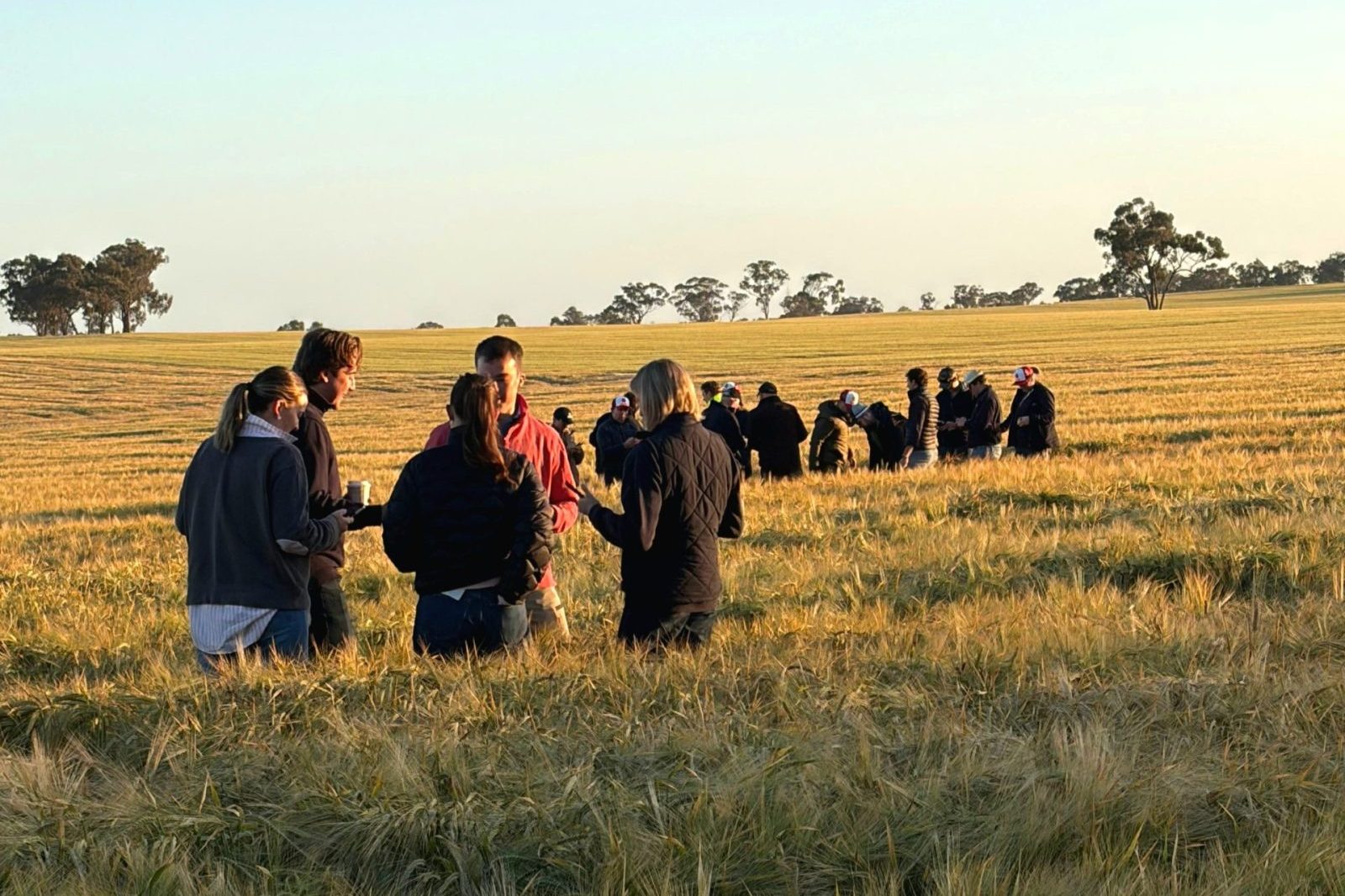
The first stop on the 2026 GIAV crop tour north of Bendigo. Photo: GIAV
THE annual Grain Industry Association of Victoria crop tour took to the road last week to shine some light on potential for Victoria’s record barley crop, and also the size of the wheat crop, when harvest gets going later this month.
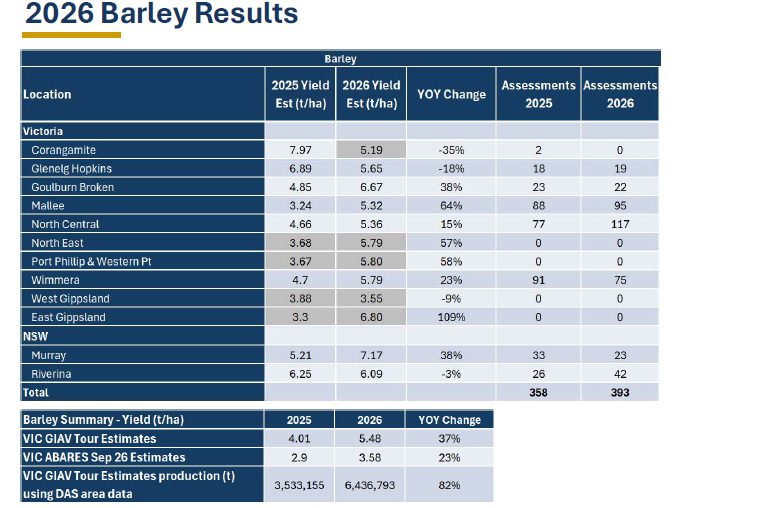
Through tested yield-estimating methodology based on DAS Grain Intelligence area data, GIAV has come up with a Vic wheat crop of 4.66 million tonnes (Mt), up 18 percent on last year, and barley at 6.44Mt, up a thumping 82pc on last year.
It means Vic’s barley crop will be bigger than its wheat crop for the first time this century, according to ABARES figures, and possibly ever.
GIAV estimates compare with ABARES as released in its September 1 Australian Crop Report of 4.9Mt for wheat and 3.4Mt for barley.
GIAV’s estimates for the 2025-26 crop were 3.96Mt for wheat and a record 3.53Mt for barley.
Sponsored by Riordan Group, the GIAV crop tour saw eight routes take a total of more than 40 participants travelling in 15 vehicles into Vic’s Mallee, Wimmera and Western District and into the Murray Valley and eastern Riverina in New South Wales.
They inspected a total of 143 barley and 150 wheat crops to calculate an average wheat yield for the state of 3.83t/ha, well ahead of ABARES standing estimate of 3.4t/ha released.
On barley, the GIAV tour has come up with an average yield of 5.48t/ha versus ABARES Sep 1 estimate of 3.58t/ha.
Based on GIAV average yield estimates and its production forecasts, barley area stands at 1.17M hectares and wheat at 1.22Mha.
Outlook Commodities manager Dom Hogan was a driver on the tour’s Ouyen route, and said crops look “sensational”, and yields will be well above average to rival those seen in the typically higher-rainfall districts of the Wimmera and Western District.
“We were measuring some crops over 6t/ha in the Mallee,” Mr Hogan said.
Wheat normally accounts for at least half the Mallee’s cereal area, but Mr Hogan indications were that it could be close to one third this season.
“We picked up that they are growing a lot more barley in the Mallee than wheat this year.
Following is a summary of conditions by route:
Wagga Wagga route
Finding barley through the Goulburn Valley proved a challenge, but from St James to Yarrawonga the crops were looking exceptionally strong, with yields increasing north of the river. The lowest wheat yield recorded was 2.5 t/ha. Waterlogging was minimal, although some frost damage was evident, with the first third of heads missing in places. There was still moisture underfoot, only two windrowed crops were observed, and harvest looks to be at least a couple of weeks away.
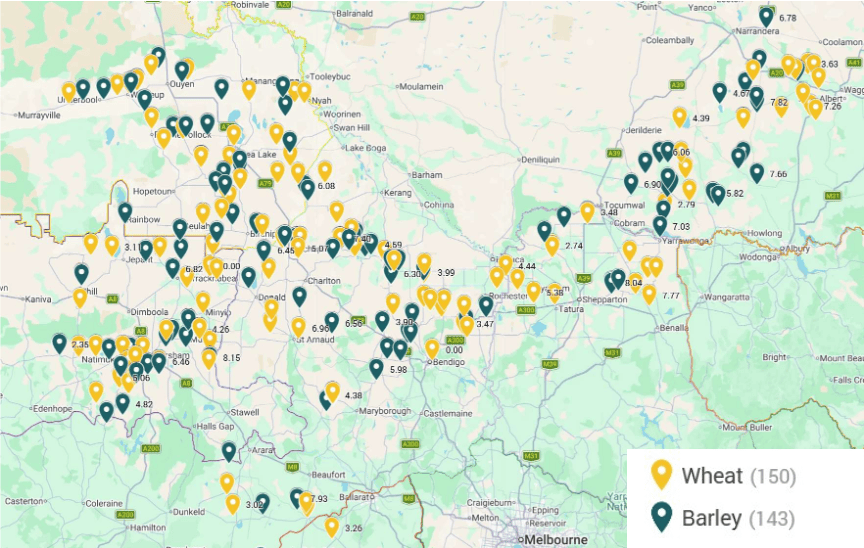
Locations of wheat and barley crops checked on the 2026 GIAV crop tour. Source: GIAV
Ouyen route
The standout word for the Ouyen route was “impressive”. Everything looked exceptional for this time of year. The lowest wheat yield observed by the Ag Vic team was 3.5t/ha, with averages estimated around 3.9t/ha for wheat and 4.9t/ha for barley. Most wheat crops were filling three to four grains wide with one and a half green leaves remaining. Some barley crops were close to maturity, but the majority were some way off curing. Crops appeared more advanced than in previous years. Minor frost damage was present in many paddocks, along with some pinched barley. Patches of fungal disease, rust and powdery mildew were noticeable with the occasional effect on grain size. Yields dropped away slightly more than expected in the western areas. Even so, overall yields exceeded expectations.
Horsham routes
One of the biggest surprises across the Horsham routes was how dry the soil profile had become, showing just how hard the crops have been working. Some wetter conditions remained south of Horsham, while barley crop numbers increased closer to the South Australian border. Wheat crops were predominantly filling four grains wide, with the occasional five-wide crop observed. Frost damage was generally light but more noticeable in later-sown crops, with one complete crop failure attributed to frost. Wheat appears to be around a month away from harvest. South of Ararat, there were more wheat crops in the rotation, while barley yields in this area were noticeably lower. Tourists also noted increased fungal pressure across parts of the Western District.
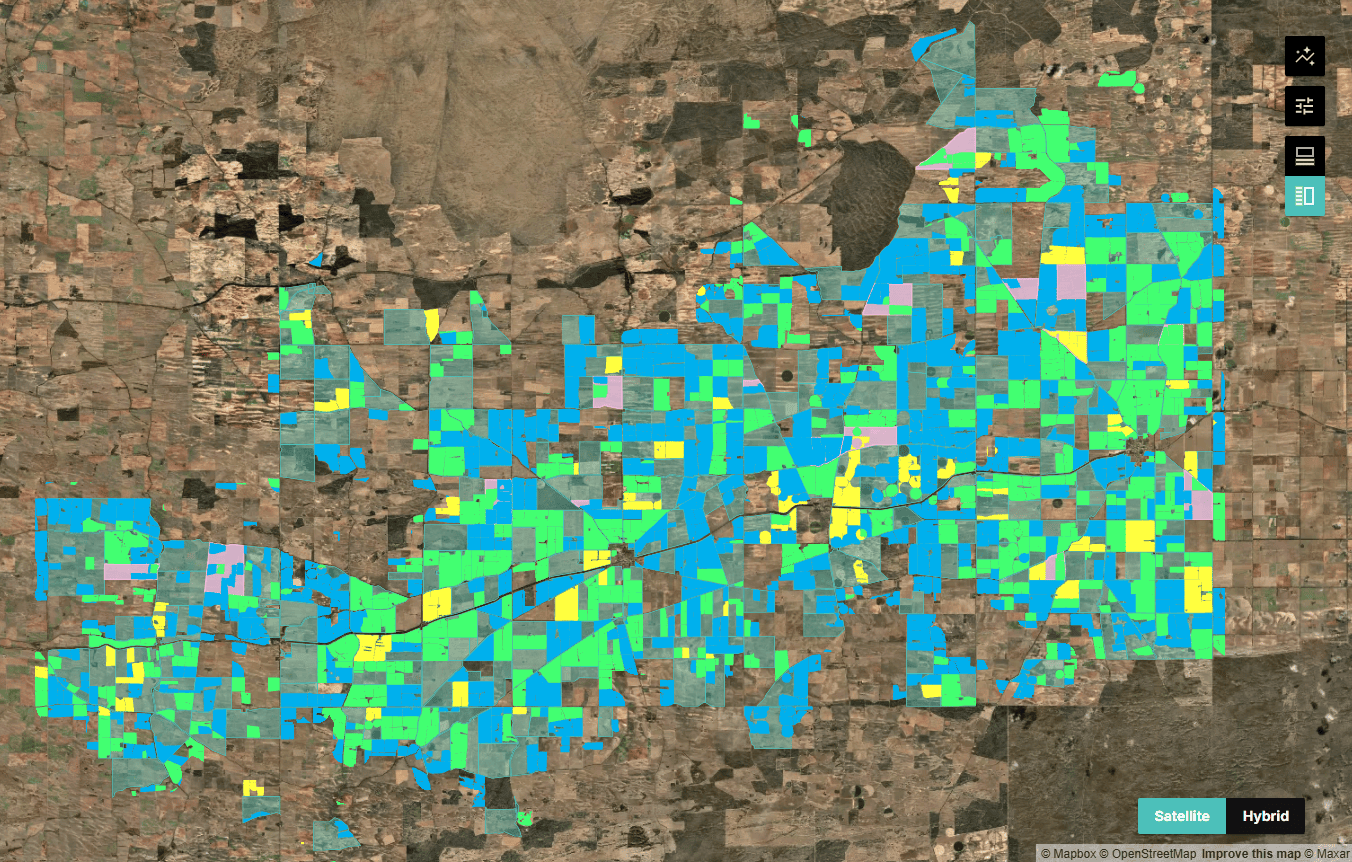
Canola in yellow, wheat in green, and barley in blue show the extent of barley plantings in the southern Mallee this year. Source: DAS
Insights via satellite
In a separate statement, DAS head of data science and GIAV crop tour participant Sam Atkinson said the Victorian shift out of wheat and into barley was part of a national trend most pronounced in Western Australia as well as Vic.
“Wheat area is now 19pc below last year, while barley has reached its largest area in our records,” Mr Atkinson said of the national crop.
“With some exceptionally strong yields emerging, we’re now expecting the biggest barley harvest since our records began.”
GIAV methodology
State yields are weighted averages using regional area estimates provided by DAS, and yield estimates from the crops visited use factors commonly employed by agronomists.
NRM regions that were not assessed were calculated using percentages from the 2021 census in proportion to Glenelg Hopkins and/or Wimmera.
Grain weights used are 0.028g for wheat and 0.035g for barley which are not the highest possible but do assume good moisture for grain fill.
Wheat yield has been adjusted with a 0.82 floret factor to account uncertain yield potential for immature crops.
Mallee and North Central numbers may be elevated due to limited randomisation of paddock choice, with one car having a set paddock route.
Yields are the median of the estimates for each paddock, then region.
Results may include elements of bias and transcription errors, but all reasonable attempts have been made to avoid them.
Bias may enter in terms of the paddocks that were selected for assessment, the portions of the paddock assessed and the heads that were assessed.
Source: GIAV, DAS, ABARES
HAVE YOUR SAY